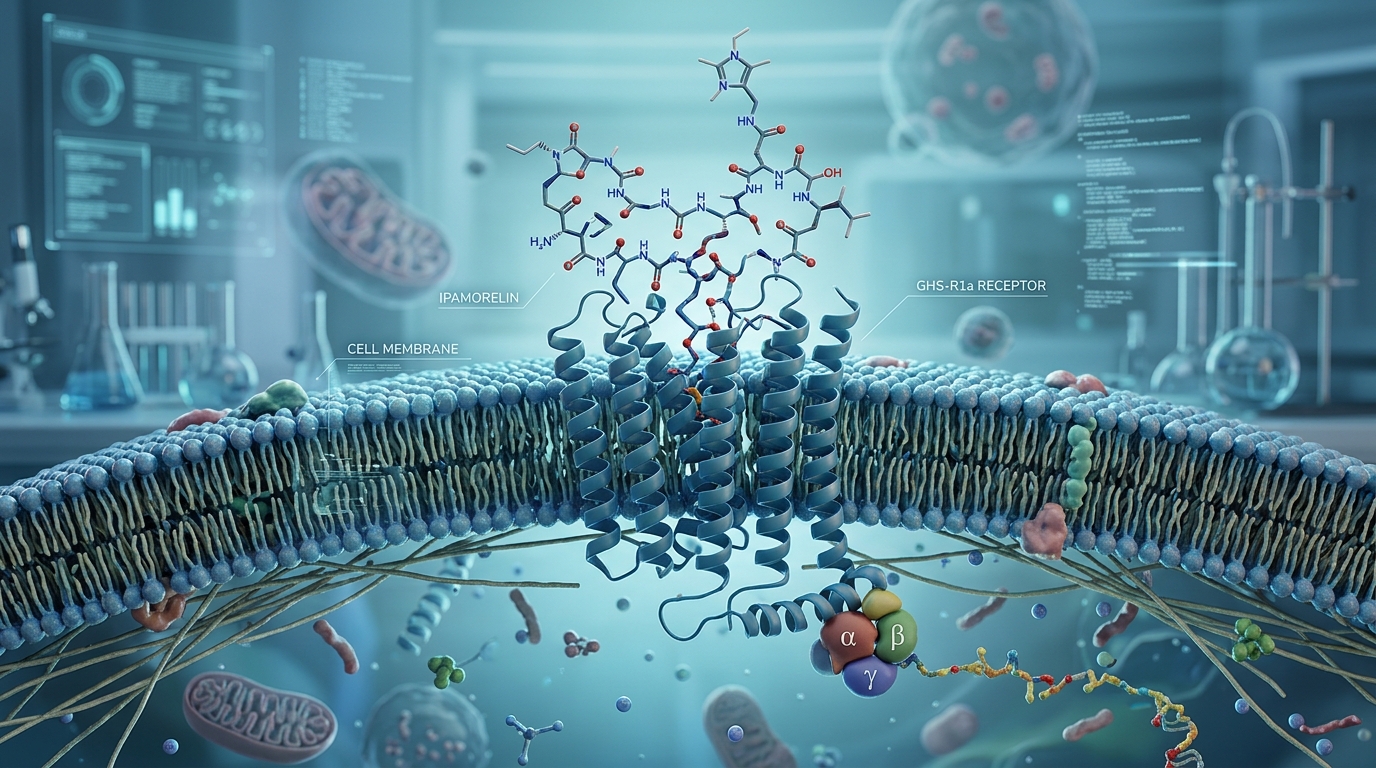
Executive Summary
Main Conclusion: Ipamorelin is a synthetic pentapeptide growth hormone secretagogue that stimulates targeted, pulsatile growth hormone release via the GHS-R1a receptor without inducing clinically meaningful elevations in cortisol, prolactin, or adrenocorticotropic hormone.
Key Supporting Arguments
- Exceptional Receptor Selectivity: Ipamorelin selectively activates the growth hormone secretagogue receptor type 1a (GHS-R1a) without activating the broader hypothalamic-pituitary-adrenal (HPA) axis or prolactin pathways.
- Robust Multimodal Efficacy Across Study Models: Preclinical and early clinical investigations demonstrate significant efficacy in accelerating longitudinal bone growth, enhancing gastrointestinal motility, and preserving nitrogen balance.
- Favorable Pharmacodynamic and Endocrine Profile: The compound produces a rapid, transient, and physiological pulse of growth hormone that mimics endogenous secretion while minimizing metabolic and glycemic disruption.
Reason 1: Exceptional Receptor Selectivity for GHS-R1a
Ipamorelin (sequence: Aib-His-D-2-Nal-D-Phe-Lys-NH2) was engineered to overcome the lack of endocrine selectivity observed in first- and second-generation secretagogues such as GHRP-6 and GHRP-2.
In-Vitro Evidence
- Pituitary Cell Assays: In cultured primary rat pituitary cells, Ipamorelin demonstrated an EC50 for growth hormone (GH) release comparable to GHRP-6 (~1.3 nmol/L), but failed to stimulate ACTH or prolactin release even at concentrations exceeding 1000-fold its effective dose.
- Receptor Binding Studies: Radioligand binding assays confirm that Ipamorelin acts as a full agonist at the ghrelin/GHS-R1a receptor with high specificity, lacking off-target affinity for opioid, adrenergic, or central appetite-regulating receptors.
Human Clinical Evidence
- Endocrine Profiling in Healthy Volunteers: Phase I human trials documented that single and repeated escalating intravenous doses produced robust, dose-dependent GH elevations without statistically significant changes in serum cortisol, ACTH, prolactin, LH, FSH, or TSH.
Hypotheses
- Researchers hypothesize that the specific spatial orientation of the D-2-Naphthylalanine and D-Phenylalanine residues allows Ipamorelin to stabilize an active conformation of GHS-R1a that selectively couples to GH-releasing pathways while bypassing collateral pituitary cascades.
Reason 2: Robust Multimodal Efficacy Across Study Models
Due to its selective stimulation of the somatotropic axis and peripheral ghrelin-like signaling, Ipamorelin exhibits wide-ranging physiological effects on skeletal, gastrointestinal, and musculoskeletal tissues.
Animal Evidence
- Longitudinal Bone Growth: In female Sprague-Dawley rats, systemic administration of Ipamorelin (0.5 to 5 mg/kg/day over 15 days) produced a pronounced, dose-dependent increase in longitudinal bone growth rate (up to 20% over baseline) and cortical bone density without altering bone marrow cellularity.
- Body Composition and Anabolism: Rodent models of glucocorticoid-induced catabolism demonstrated that Ipamorelin counteracted steroid-induced muscle wasting, significantly improving nitrogen balance and total body weight retention.
- Gastrointestinal Motility: In rodent models of postoperative ileus (POI), Ipamorelin administration restored gastric emptying and small-bowel transit time in a dose-dependent manner by activating enteric GHS-R1a receptors.
Human Clinical Evidence
- Postoperative Ileus Phase II Trials: In a multi-center, double-blind, placebo-controlled clinical trial involving patients undergoing bowel resection, intravenous Ipamorelin (0.03 mg/kg twice daily) demonstrated a trend toward faster recovery of gastrointestinal function, though the primary endpoint of time to first meal tolerance did not reach statistical superiority to warrant standalone commercialization for this specific indication.
Anecdotal Claims vs. Scientific Reality
- Anecdotal Claims: Research community forums often claim Ipamorelin promotes rapid, direct lipolysis and dramatic skeletal muscle hypertrophy comparable to supraphysiological recombinant human growth hormone (rhGH).
- Scientific Reality: Controlled studies indicate that Ipamorelin’s effects on body composition are moderate and mediated primarily through physiological GH pulses and downstream IGF-1 induction rather than direct hyper-anabolic or acute lipolytic mechanisms.
Reason 3: Favorable Pharmacodynamic and Endocrine Profile
Ipamorelin exhibits a pharmacokinetic and pharmacodynamic profile that closely resembles natural pulsatile somatotrope physiology rather than sustained, non-physiological elevation.
Human Clinical Evidence
- Pulsatile Kinetics: Pharmacokinetic evaluations in humans indicate a rapid terminal elimination half-life of approximately 1.5 to 2 hours following parenteral administration, producing a sharp GH peak (Cmax) at 30 to 45 minutes followed by a return to baseline within 4 hours.
- Insulin Sensitivity Preservation: Unlike continuous exogenous rhGH administration, which often induces peripheral insulin resistance and hyperinsulinemia, clinical evaluations of short-term pulsatile Ipamorelin exposure revealed no significant deterioration of fasting glucose or homeostatic insulin markers (HOMA-IR).
Animal Evidence
- Receptor Desensitization Dynamics: Chronic dosing studies in swine and rodents demonstrated that twice-daily administration maintained GH release amplitude over prolonged experimental windows, displaying lower tachyphylaxis and receptor down-regulation compared to older GH secretagogues.
Hypotheses
- Investigators propose that the transient peak dynamic preserves endogenous somatostatin negative-feedback loops, preventing the downregulation of anterior pituitary responsiveness observed with continuous somatotropic stimulation.