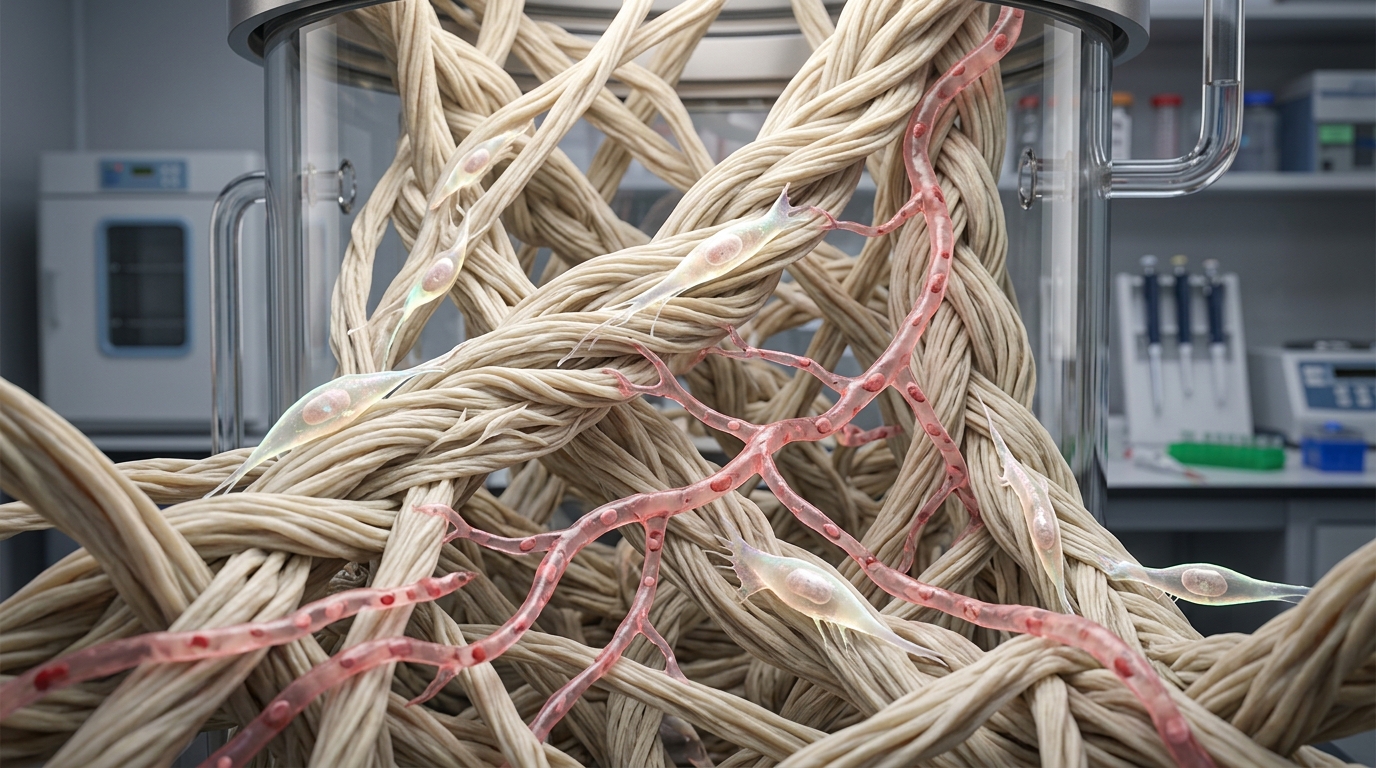
Interest in BPC-157 musculoskeletal healing has expanded across sports medicine, orthopedics, and regenerative biology. Derived from a sequence identified in human gastric juice, the synthetic pentadecapeptide Body Protection Compound-157 (BPC-157) is extensively investigated for its role in soft tissue and structural regeneration. While laboratory and animal studies report striking improvements in connective tissue repair, the transition to human clinical validation remains incomplete.
Key Takeaways
- Preclinical Breadth: Animal models demonstrate that BPC-157 promotes cellular migration, angiogenesis, and collagen organization across transected tendons, damaged ligaments, skeletal muscle tears, and bone defects.
- Molecular Pathways: In vitro experiments show activation of the focal adhesion kinase (FAK)-paxillin signaling cascade, upregulation of vascular endothelial growth factor (VEGF), and modulation of the nitric oxide system.
- Evidence Gap: The vast majority of published literature consists of in vitro and rodent experiments; well-controlled, large-scale randomized human clinical trials are currently lacking.
- Regulatory Status: BPC-157 is not approved by the U.S. Food and Drug Administration (FDA) for any therapeutic indication and is listed on the World Anti-Doping Agency (WADA) Prohibited List.
What Is BPC-157?
BPC-157 is a 15-amino-acid synthetic peptide (molecular weight ~1,419 Da) with the primary structure Gly-Glu-Pro-Pro-Pro-Gly-Lys-Pro-Ala-Asp-Asp-Ala-Gly-Leu-Val. Originally developed based on a protective protein fragment found in gastric secretions, the compound displays unusual enzymatic stability compared to many linear peptides, maintaining structural integrity across varying pH environments.
While initial research targeted gastrointestinal mucosal defense and ulcer healing, investigators observed systemic cytoprotective and reparative properties. This prompted extensive investigation into its potential applications for orthopedic injuries, where dense, hypovascular tissues heal slowly and often form mechanically inferior scar tissue.
Mechanisms of Action in Connective Tissue
Connective tissues such as tendons and ligaments are composed primarily of aligned type I collagen fibers maintained by specialized cells called tenocytes. Because these tissues possess limited intrinsic vascularity, injury repair is inherently sluggish. Research identifies several distinct mechanisms through which BPC-157 may influence this biological process:
FAK-Paxillin Signaling and Fibroblast Dynamics
Research published in the Journal of Applied Physiology demonstrated that BPC-157 accelerates the outgrowth of tendon fibroblasts from explants and significantly increases cell survival under oxidative stress induced by hydrogen peroxide. The peptide dose-dependently enhances fibroblast migration and spreading by stimulating the phosphorylation of focal adhesion kinase (FAK) and paxillin without altering total protein levels. Activation of the FAK-paxillin pathway facilitates actin cytoskeleton reorganization, enabling structural cells to migrate efficiently into wounded tissue matrices.
Angiogenesis and Vascular Endothelial Growth Factor
Re-establishing microvascular networks is critical for delivering oxygen and essential nutrients to damaged musculoskeletal tissue. Preclinical studies indicate that BPC-157 upregulates vascular endothelial growth factor receptor 2 (VEGFR2) and stimulates the Akt-eNOS (endothelial nitric oxide synthase) pathway. This pro-angiogenic activity promotes functional capillary sprouting at the repair zone, addressing one of the primary rate-limiting factors in connective tissue recovery.
Collagen Architecture and Remodeling
Unassisted musculoskeletal healing frequently results in disorganized type III collagen deposition, which reduces tensile strength. Histomorphological assessments in animal models indicate that BPC-157 administration correlates with earlier realignment of collagen fibrils and a faster transition toward mature type I collagen fibers, improving the biomechanical load-bearing capacity of repaired tissue.
Preclinical Evidence Across Tissue Types
Tendon and Ligament Repair
The most heavily researched musculoskeletal domain for BPC-157 is tendon biology. In rat Achilles tendon transection models, systemic or local administration of the peptide consistently resulted in accelerated gap closure, enhanced functional biomechanics (such as maximum load to failure, stiffness, and Young’s modulus), and improved histological scores compared to untreated controls. Similar regenerative patterns have been reported in models of medial collateral ligament (MCL) transection, demonstrating accelerated functional restoration.
Skeletal Muscle Regeneration
Muscle injuries involving significant fiber disruption often heal with debilitating fibrous scar formation. In rodent models of severe muscle crush injuries, transections, and corticosteroid-induced damage, BPC-157 treatment was associated with faster myofiber regeneration, decreased fibrosis, and improved preservation of neuromuscular junctions and acetylcholine receptor density. These findings suggest the peptide may modulate both structural muscle fibers and local innervating elements.
Bone Defect and Fracture Healing
Bone repair involves complex interactions between inflammatory signals, angiogenic cascades, and osteoblast differentiation. In animal studies evaluating segmental osteoperiosteal defects in rabbit radii and standard rat osteotomy models, BPC-157 significantly stimulated callus formation and microphotodensitometric mineral density. Researchers noted that the resulting bone continuity was comparable to local bone marrow or autologous cortical bone graft interventions.
Clinical Status and Research Limitations
Despite promising preclinical findings, significant limitations characterize the current evidence base:
- Lack of Human Clinical Trials: Published clinical trials evaluating BPC-157 for orthopedic conditions (such as tendinopathy, rotator cuff tears, or ligament ruptures) are exceedingly scarce. The few available human studies consist primarily of small pilot cohorts or early-phase safety evaluations.
- Concentration of Research: A substantial proportion of published preclinical studies originates from a limited number of academic research teams. Independent replication across varied global centers is essential to confirm the consistency and reproducibility of reported outcomes.
- Unknown Long-Term Pharmacokinetics: Comprehensive human pharmacokinetic profiles, optimal therapeutic windows, bio-distribution characteristics, and long-term toxicity endpoints have not been systematically established in peer-reviewed Phase II and III trials.
- Purity and Characterization Concerns: The FDA has highlighted potential concerns regarding peptide characterization, active pharmaceutical ingredient (API) stability, and immunogenicity risks associated with unvalidated synthetic peptide preparations.
Frequently Asked Questions
Is BPC-157 FDA-approved for musculoskeletal injuries?
No. BPC-157 is not approved by the U.S. FDA or any major international regulatory body for treating tendonitis, muscle tears, bone fractures, or any other medical condition.
How does BPC-157 differ from growth hormone or anabolic steroids?
BPC-157 is a 15-amino-acid peptide derived from gastric secretions rather than a steroid hormone. It does not act directly via androgen receptors or the classical endocrine pathways of growth hormone, functioning instead primarily through localized cellular signaling, cell migration pathways, and angiogenic modulation.
Why is most BPC-157 research conducted in animal models?
Early-stage drug discovery begins in vitro and in small animals to elucidate molecular pathways and assess basic safety before costly, complex human trials are approved. BPC-157 has largely remained in this preclinical exploratory phase.
Is BPC-157 permitted in athletic competition?
No. The World Anti-Doping Agency (WADA) lists BPC-157 under Section S0 (Non-approved Substances), prohibiting its use at all times by competitive athletes.
References
- Chang CH, Tsai WC, Lin MS, Hsu YH, Su Pang JH. The promoting effect of pentadecapeptide BPC 157 on tendon healing involves tendon outgrowth, cell survival, and cell migration. J Appl Physiol (1985). 2011;110(3):774-780. https://pubmed.ncbi.nlm.nih.gov/21030672/
- Seiwerth S, Rucman R, Turkovic B, et al. BPC 157 and Standard Angiogenic Growth Factors. Gastrointestinal Tract and Beyond. Curr Pharm Des. 2018;24(18):1972-2001. https://pubmed.ncbi.nlm.nih.gov/29998800/
- Sikiric P, Seiwerth S, Brcic L, et al. Revised Robert’s cytoprotection and adaptive cytoprotection: the role of BPC 157. Med Sci Monit. 2006;12(1):RA25-RA45. https://pubmed.ncbi.nlm.nih.gov/16382228/
- U.S. Food and Drug Administration. Certain Bulk Drug Substances for Use in Compounding Under Section 503A That May Present Significant Safety Risks. https://www.fda.gov/
Research Summary
BPC-157 exhibits consistent cytoprotective, pro-angiogenic, and tissue-reparative properties in laboratory assays and animal models of musculoskeletal trauma. In these experimental settings, it accelerates fibroblast migration, stimulates FAK-paxillin signaling, and improves mechanical recovery in damaged tendons, ligaments, muscles, and bones. However, because robust human clinical trials are virtually absent, its efficacy, optimal dosing, and human safety profile remain unproven. BPC-157 remains an experimental research compound without FDA approval for clinical use.