Key Takeaways
- Sermorelin is a 29-amino-acid analog of native human growth hormone-releasing hormone (GHRH 1-44), representing the shortest functional peptide fragment that retains full receptor-binding affinity and biological activity.
- Targeted Somatotroph Activation: It binds GHRH receptors on anterior pituitary somatotroph cells, triggering a Gs-protein-coupled signaling cascade that elevates intracellular cyclic AMP (cAMP) and mobilizes calcium to release endogenous growth hormone.
- Preserved Physiological Feedback: Unlike direct somatropin administration, sermorelin operates within endogenous regulatory constraints; somatostatin and circulating insulin-like growth factor 1 (IGF-1) maintain homeostatic negative feedback.
- Regulatory and Clinical Profile: Originally approved by the U.S. Food and Drug Administration (FDA) as Geref for diagnostic testing and pediatric growth hormone deficiency, it was commercially discontinued in 2008 and is currently studied in endocrine research.
What Is Sermorelin and the Somatotropic Axis?
The somatotropic axis is a neuroendocrine system that governs cellular growth, protein synthesis, substrate utilization, and somatic repair throughout the human lifespan. In physiological states, hypothalamic neurons in the arcuate nucleus synthesize and release native growth hormone-releasing hormone (GHRH), a 44-amino-acid neuropeptide. GHRH travels across the hypophyseal portal circulation to the anterior pituitary gland, where it stimulates specialized endocrine cells known as somatotrophs to synthesize and secrete growth hormone (GH, also termed somatotropin).
Sermorelin (often designated as GHRH 1-29 amide or GRF 1-29) is an engineered synthetic peptide comprising the first 29 amino acids of the endogenous 44-residue GHRH molecule: Tyr-Ala-Asp-Ala-Ile-Phe-Thr-Asn-Ser-Tyr-Arg-Lys-Val-Leu-Gly-Gln-Leu-Ser-Ala-Arg-Lys-Leu-Leu-Gln-Asp-Ile-Met-Ser-Arg-NH₂. Structural-activity studies in the 1980s demonstrated that the N-terminal 29-residue sequence contains the essential pharmacophore necessary for full receptor binding and signal transduction. In scientific investigations of sermorelin pituitary dynamics, the peptide serves as a selective research tool for probing somatotroph responsiveness and the integrity of the hypothalamic-pituitary-somatotropic axis.
Molecular Mechanism: GHRH Receptor and Somatotroph Activation
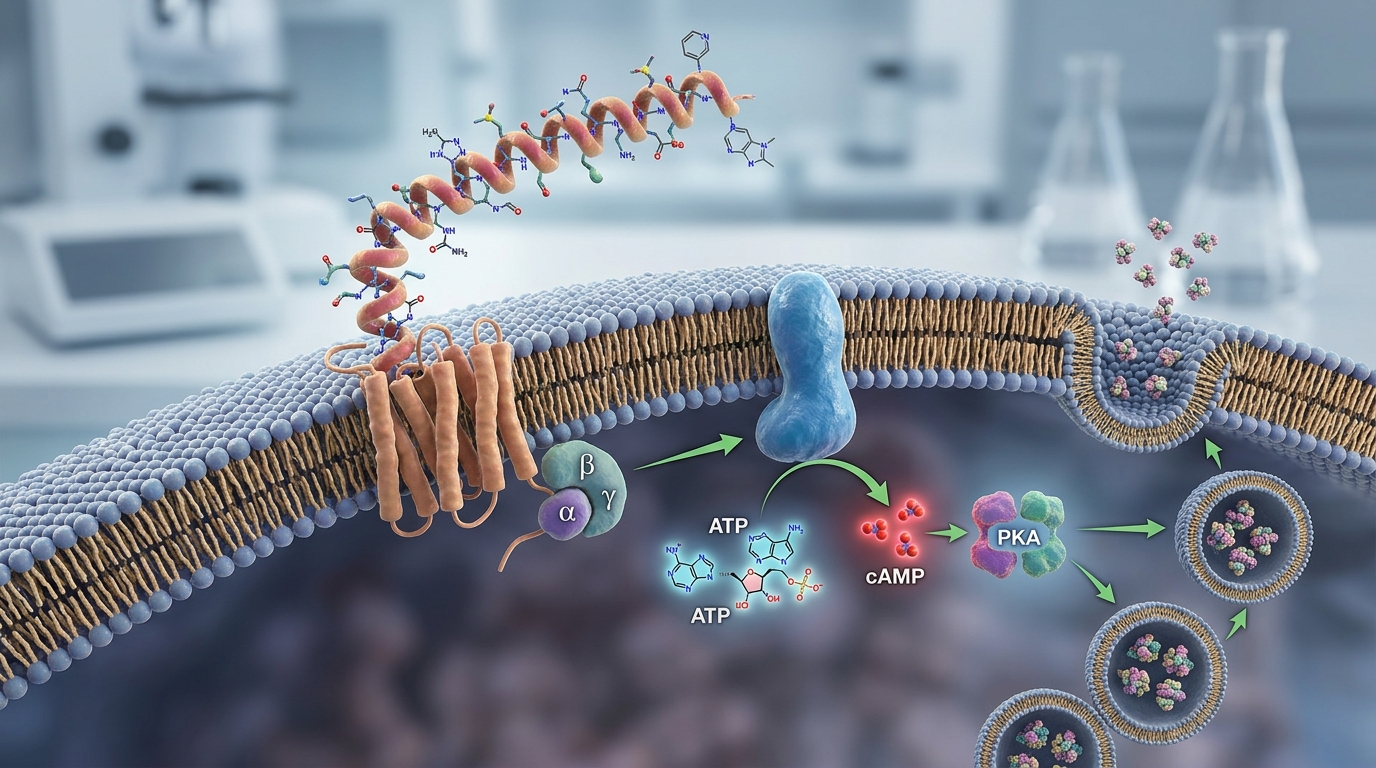
At the cellular level, sermorelin exerts its biological effects by binding selectively to the growth hormone-releasing hormone receptor (GHRHR), a class B G-protein-coupled receptor (GPCR) predominantly expressed on the surface of pituitary somatotrophs. This binding initiates a well-characterized intracellular signaling sequence:
- Gs Alpha Subunit Activation: Ligand binding induces a conformational change in the GHRHR, promoting the exchange of GDP for GTP on the Gαs subunit.
- Adenylate Cyclase Stimulation: The dissociated Gαs subunit activates membrane-bound adenylate cyclase, which catalyzes the conversion of adenosine triphosphate (ATP) into intracellular cyclic adenosine monophosphate (cAMP).
- Protein Kinase A (PKA) Activation: Elevated cAMP levels activate PKA, which subsequently phosphorylates downstream target proteins, including L-type voltage-dependent calcium channels.
- Calcium Influx and Exocytosis: The resulting influx of extracellular calcium (Ca2+) triggers the rapid exocytosis of preformed secretory granules containing growth hormone into the systemic circulation.
- Gene Transcription via CREB: Simultaneously, catalytic subunits of PKA translocate to the nucleus and phosphorylate the cAMP response element-binding protein (CREB), stimulating transcription of the growth hormone gene and promoting somatotroph cellular proliferation.
Because sermorelin has an unmodified peptide backbone, it exhibits a rapid plasma elimination profile, with an estimated functional half-life of roughly 10 to 20 minutes under research conditions due to enzymatic cleavage by dipeptidyl peptidase IV (DPP-IV) and neutral endopeptidases. This transient kinetic profile means that somatotroph stimulation occurs in discrete episodes rather than continuous receptor occupancy, preventing down-regulation and desensitization.
Endocrine Feedback Dynamics: Somatostatin and IGF-1 Homeostasis
A central focus in neuroendocrinology is how secretagogues interact with endogenous regulatory feedback loops. Exogenous recombinant human growth hormone (rhGH) delivers a continuous supraphysiological surge that bypasses the pituitary gland, suppressing endogenous secretagogue tone and somatotroph activity. In contrast, sermorelin acts upstream at the pituitary level, which preserves the dual-arm regulatory architecture of the somatotropic axis.
Hypothalamic Somatostatin Tone
The primary inhibitor of growth hormone secretion is somatostatin (growth hormone-inhibiting hormone, or GHIH), produced by periventricular hypothalamic neurons. Somatostatin binds to somatostatin receptors (primarily SSTR2 and SSTR5) on somatotrophs. These receptors couple to inhibitory G-proteins (Gαi), which inhibit adenylate cyclase, lower cAMP, and open potassium channels, hyperpolarizing the cell membrane and blocking calcium-mediated GH granule exocytosis. When circulating GH levels rise, hypothalamic somatostatin tone increases, blunting excessive pituitary response even in the presence of circulating GHRH agonists.
IGF-1 Mediated Negative Feedback
Growth hormone released into circulation binds to hepatic growth hormone receptors, stimulating the transcription and secretion of insulin-like growth factor 1 (IGF-1) and its primary binding protein, IGFBP-3. Systemic IGF-1 acts as a long-loop feedback signal. In vitro and animal models demonstrate that elevated IGF-1 exerts direct inhibitory actions on pituitary somatotrophs while simultaneously stimulating hypothalamic somatostatin release and suppressing arcuate GHRH transcription. Because sermorelin relies on the somatotroph’s functional capacity, these physiological brakes prevent the uncontrolled hormone elevations often observed with direct exogenous hormone replacement.
Clinical and Experimental Evidence on Pituitary Dynamics
Clinical investigations of sermorelin span several decades, addressing both diagnostic and therapeutic paradigms:
- Diagnostic Provocative Testing: Intravenous sermorelin (typically 1 μg/kg) was widely evaluated as a provocative agent to assess pituitary somatotroph reserve. Clinical trials demonstrated that sermorelin testing could differentiate between primary hypothalamic deficits (where somatotrophs retain responsiveness) and intrinsic pituitary failure. When combined with arginine—which suppresses somatostatin tone—sermorelin provided enhanced specificity in identifying severe adult growth hormone deficiency.
- Pediatric Somatotropic Insufficiency: Multicenter trials evaluating once-daily subcutaneous administration (30 μg/kg) in prepubertal children with idiopathic growth hormone deficiency reported increased height velocity in approximately 74% of participants after 6 to 12 months of therapy. Catch-up growth was sustained in extended cohorts, demonstrating that episodic stimulation of endogenous somatotrophs can maintain physiological linear growth.
- Adult and Age-Related Endocrine Models: Studies in healthy older adults experiencing somatopause (the age-dependent reduction in GH and IGF-1 pulsatility) demonstrated that nightly administration of GHRH(1-29) could augment mean 24-hour GH pulse amplitude and raise circulating IGF-1 concentrations. However, investigators observed that the magnitude of IGF-1 elevation is strictly contingent on baseline somatotroph reserve; subjects with baseline IGF-1 levels already in the normal range exhibited minimal further elevation, highlighting the self-limiting nature of endogenous feedback.
- Cognitive and Metabolic Research: A 6-month randomized, double-blind study in older adults investigated sermorelin administration and observed modest improvements in specific cognitive domains—including working memory and psychomotor processing speed—correlating with changes in circulating IGF-1. Nonetheless, changes in gross body composition in healthy adults have shown variable and inconsistent results across trials.
Safety Considerations and Research Limitations
In clinical trials, sermorelin displayed a favorable safety profile compared to direct recombinant growth hormone. The most frequently reported adverse effects were local and transient, including injection-site erythema, swelling, pruritus, mild headaches, and transient facial flushing occurring shortly after administration.
Key limitations in the current evidence base include:
- Pituitary Reserve Dependency: Sermorelin requires viable, functional pituitary somatotrophs; it lacks efficacy in cases of severe panhypopituitarism, pituitary necrosis, or surgical resection.
- Inconsistent Adult Endpoint Data: While short-term physiological studies confirm GH pulsatility, long-term randomized controlled trials evaluating hard clinical outcomes (such as functional mobility, bone mineral density, and metabolic disease risk in healthy older adults) remain limited and inconclusive.
- Anti-Sermorelin Antibodies: In pediatric studies with daily subcutaneous dosing, a proportion of patients developed low-titer anti-GHRH antibodies, although these rarely neutralized the clinical growth response.
Regulatory Status
Sermorelin acetate was initially designated as an orphan drug and subsequently approved by the FDA under NDA 19-863 in December 1990 as a diagnostic agent for evaluating pituitary somatotroph function. In September 1997, the FDA approved sermorelin (trade name Geref, NDA 20-443) for the treatment of idiopathic growth hormone deficiency in children with growth failure.
In 2008, the manufacturer voluntarily ceased commercial production of Geref due to corporate commercial reasons and market competition from recombinant somatropin. The FDA confirmed that the product was not discontinued or withdrawn for reasons of safety or effectiveness. Currently, finished sermorelin drug formulations do not hold active commercial marketing authorization from the FDA, though the molecule remains an active subject of basic endocrine research and is prepared by licensed compounding pharmacies under physician prescription.
Frequently Asked Questions
How does sermorelin differ mechanistically from recombinant human growth hormone?
Recombinant human growth hormone (somatropin) supplies exogenous GH directly to the bloodstream, maintaining continuous circulating levels and suppressing endogenous pituitary output. Sermorelin acts upstream at the pituitary GHRH receptor, stimulating the somatotrophs to synthesize and release the body’s own GH in natural, pulsatile bursts while remaining subject to somatostatin-mediated negative feedback.
Why does somatostatin prevent growth hormone overproduction during sermorelin administration?
Somatostatin binds to Gi-coupled receptors on somatotroph cells, reducing intracellular cAMP and inhibiting calcium influx. When circulating GH or IGF-1 levels rise, the hypothalamus increases somatostatin secretion, which directly counteracts the stimulatory action of GHRH analogs and prevents supraphysiological hormone spikes.
What is the biological half-life of sermorelin?
Sermorelin has a relatively short functional half-life of approximately 10 to 20 minutes in human plasma. It undergoes rapid enzymatic degradation by dipeptidyl peptidase IV (DPP-IV), which limits persistent receptor occupancy and prevents somatotroph receptor desensitization.
Can sermorelin stimulate growth hormone release if the pituitary gland is damaged?
No. Because sermorelin functions strictly by activating receptors on pituitary somatotrophs, it requires an intact and functional anterior pituitary. In conditions involving severe pituitary destruction, hypophysectomy, or pituitary aplasia, sermorelin cannot induce growth hormone release.
Research Summary
Current scientific literature establishes sermorelin as a potent and selective 29-amino-acid GHRH receptor agonist capable of stimulating endogenous somatotroph secretion. Human clinical data—derived from historical pediatric GHD trials, diagnostic provocation protocols, and adult neuroendocrine studies—confirm that sermorelin preserves pulsatile GH release, physiological somatostatin braking, and hepatic IGF-1 feedback. Although originally FDA-approved as Geref and later discontinued for commercial market reasons, the peptide remains a valuable model for investigating pituitary dynamics, receptor kinetics, and endocrine homeostatic regulation.
References
- Sigalos JT, Pastuszak AW. The Safety and Efficacy of Growth Hormone Secretagogues. Investigative and Clinical Urology. 2018;59(1):19-24.
- Prakash A, Goa KL. Sermorelin: A Review of its Use in the Diagnosis and Treatment of Children with Idiopathic Growth Hormone Deficiency. BioDrugs. 1999;12(2):139-157.
- Vitiello MV, Moe KE, Merriam GR, Mazzoni G, Buchner DH, Schwartz RS. Growth Hormone Releasing Hormone Improves the Cognition of Healthy Older Adults. Neurobiology of Aging. 2006;27(2):318-325.
- U.S. Food and Drug Administration. Orphan Drug Designation: Sermorelin Acetate (Geref). NDA 20-443. FDA Database.