Key Takeaways
- Targeted Enzyme Inhibition: 5-Amino-1MQ (5-amino-1-methylquinolinium) is a synthetic, membrane-permeable small molecule designed to selectively inhibit the cytosolic enzyme nicotinamide N-methyltransferase (NNMT).
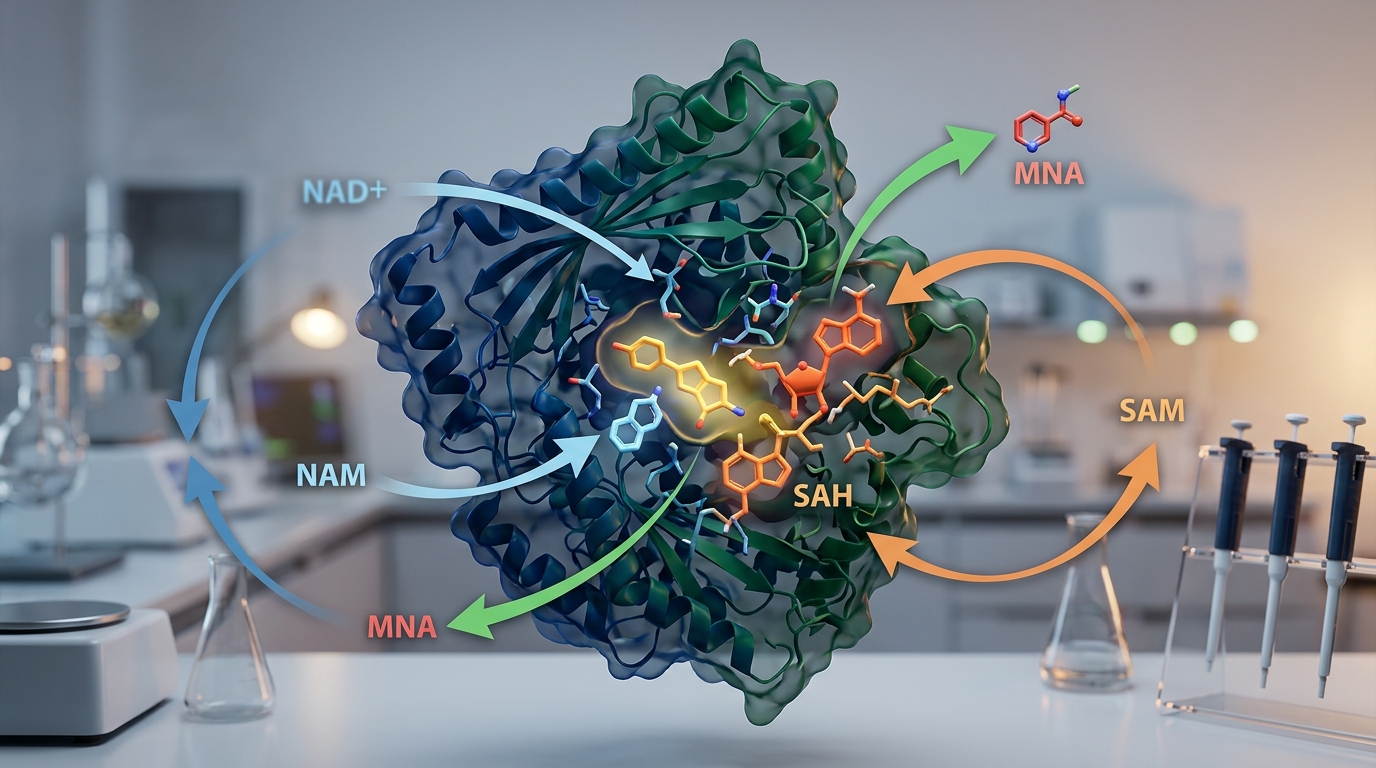
- NAD+ Salvage Flux: NNMT normally consumes nicotinamide (NAM) to produce 1-methylnicotinamide (1-MNA). Inhibiting NNMT preserves NAM as a substrate for nicotinamide phosphoribosyltransferase (NAMPT), reinforcing the primary salvage pathway for nicotinamide adenine dinucleotide (NAD+) synthesis.
- Methyl Donor Balance: Blocking NNMT conserves S-adenosylmethionine (SAM) and reduces S-adenosylhomocysteine (SAH) generation, preserving cellular methylation potential.
- Downstream Metabolic Signaling: Preclinical models demonstrate that elevated intracellular NAD+ promotes sirtuin-1 (SIRT1) activation, upregulating fatty acid oxidation and mitochondrial respiration.
- Research Status: 5-Amino-1MQ is an investigational compound tested exclusively in vitro and in animal models; it is not approved by the U.S. Food and Drug Administration (FDA) for human use.
What Is 5-Amino-1MQ?
5-Amino-1MQ is a low-molecular-weight quinolinium-derivative compound (molecular formula C10H10N2, molecular weight ~174.20 Da). Although frequently cataloged within biomedical and peptide-adjacent biochemical research libraries, 5-Amino-1MQ is structurally a synthetic organic small molecule rather than an amino acid peptide chain.
The molecule was developed at the University of Texas Medical Branch as part of a targeted medicinal chemistry program aimed at finding selective, membrane-permeable inhibitors of NNMT. Prior pharmacological tools targeting methyltransferases often lacked cell permeability or exhibited off-target inhibition across structurally homologous methyltransferases or enzymes within the NAD+ synthesis cascade. 5-Amino-1MQ was optimized to overcome these kinetic and pharmacological challenges.
The Role of NNMT in Cellular Biochemistry
Nicotinamide N-methyltransferase is a cytosolic enzyme expressed predominantly in white adipose tissue, liver, and skeletal muscle stem cells. It sits at a critical biochemical junction connecting the methionine methylation cycle and NAD+ energy metabolism.
The Enzymatic Reaction
NNMT catalyzes the transfer of a methyl group from S-adenosylmethionine (SAM)—the primary methyl donor in mammalian cells—to nicotinamide (NAM, a form of vitamin B3). This single reaction generates two primary products:
- 1-Methylnicotinamide (1-MNA): A stable methylated metabolite that is excreted or further oxidized.
- S-Adenosylhomocysteine (SAH): The demethylated byproduct of SAM, which acts as a feedback inhibitor for multiple transmethylation enzymes.
When NNMT is overexpressed—a state frequently observed in models of diet-induced obesity, metabolic dysfunction, and cellular senescence—it creates a dual metabolic sink. First, it depletes the pool of cellular NAM that would otherwise enter the NAD+ salvage pathway. Second, it rapidly consumes SAM, altering the SAM/SAH ratio and impairing histones, DNA, and phospholipid methylation capacity.
5-Amino-1MQ Mechanism: How NNMT Inhibition Works
The primary 5-Amino-1MQ mechanism relies on competitive binding within the active site of the NNMT enzyme. Structural biochemistry shows that 5-Amino-1MQ mimics the binding geometry of the transition state between SAM and the nicotinamide substrate, arresting enzymatic turnover with an inhibitory concentration (IC50) of approximately 1.2 micromolar.
Selectivity Profile
A key finding from biochemical selectivity screens is that 5-Amino-1MQ does not inhibit other SAM-dependent methyltransferases, including histone methyltransferases, DNA methyltransferases, or phenylethanolamine N-methyltransferase. Furthermore, assays demonstrate that the compound does not directly inhibit or bind other major enzymes involved in NAD+ metabolism, such as NAMPT, nicotinamide mononucleotide adenylyltransferases (NMNATs), or sirtuins (SIRT1–SIRT3). Its physiological downstream effects are therefore mediated through substrate diversion rather than direct off-target enzyme modulation.
NAD+ Dynamics and Salvage Pathway Redirection
In mammalian cells, NAD+ is continuously broken down into NAM by NAD+-consuming signaling enzymes, including sirtuins, poly(ADP-ribose) polymerases (PARPs), and cyclic ADP-ribose hydrolases (CD38). To maintain energetic balance, cells rely primarily on the two-step NAD+ salvage pathway:
- NAM to NMN: NAMPT converts NAM and phosphoribosyl pyrophosphate into nicotinamide mononucleotide (NMN).
- NMN to NAD+: NMNAT enzymes convert NMN and adenosine triphosphate (ATP) into NAD+.
Because NNMT directly competes with NAMPT for free intracellular NAM, elevated NNMT activity diverts NAM toward 1-MNA excretion, permanently removing it from the recycling loop. By blocking NNMT, 5-Amino-1MQ prevents this loss, channeling free NAM back toward NAMPT. Preclinical studies in cultured 3T3-L1 adipocytes confirmed that 5-Amino-1MQ treatment significantly decreases intracellular 1-MNA while increasing steady-state NAD+ concentrations by approximately 1.2- to 1.6-fold.
Downstream Metabolic Signaling
The preservation of NAD+ pools through NNMT inhibition triggers several cascade mechanisms governing cellular energy expenditure and substrate utilization:
1. SIRT1-Dependent Transcriptional Reprogramming
SIRT1 is an NAD+-dependent deacetylase that regulates mitochondrial biogenesis, lipid clearance, and glucose homeostasis. Elevated NAD+ levels facilitate increased SIRT1 deacetylase activity. In turn, SIRT1 deacetylates peroxisome proliferator-activated receptor-gamma coactivator 1-alpha (PGC-1alpha), a master regulator of mitochondrial oxidative phosphorylation and fatty acid oxidation genes.
2. Suppression of Adipocyte Lipogenesis
In vitro and animal models show that NNMT inhibition shifts adipocyte phenotype. Rather than accumulating triglycerides, adipocytes exposed to 5-Amino-1MQ exhibit suppressed lipogenic gene expression (such as fatty acid synthase, Fasn) and reduced total lipid content. In high-fat diet rodent models, administration of 5-Amino-1MQ resulted in reduced white adipose tissue mass, smaller adipocyte diameter, and lowered circulating total cholesterol without alterations in caloric intake.
3. Preservation of the Methylation Potential
By preventing the unregulated consumption of SAM by NNMT, 5-Amino-1MQ elevates cellular SAM levels and restores the SAM/SAH ratio. This preserves the cellular capacity for epigenetic regulation and structural lipid synthesis, mitigating some of the cellular stress pathways associated with chronic metabolic overload.
Preclinical Evidence in Skeletal Muscle Regeneration
Beyond adipose tissue biology, researchers have examined NNMT inhibition in skeletal muscle aging. In aged mice, NNMT expression is significantly elevated in muscle stem cells (satellite cells), correlating with a decline in regenerative capacity and impaired muscle repair.
In a 2019 study published in Biochemical Pharmacology, Neelakantan and colleagues demonstrated that treating senescent muscle stem cells with 5-Amino-1MQ restored their proliferative capacity and accelerated muscle fiber regeneration after injury in aged mice. These effects were associated with restored cellular NAD+ levels and improved mitochondrial function in regenerating myoblasts.
Research Limitations and Evidence Gaps
While the biochemical rationale for NNMT inhibition is well-documented in model systems, substantial gaps remain:
- Absence of Human Trials: As of 2026, no Phase 1, Phase 2, or Phase 3 clinical trials of 5-Amino-1MQ in humans have been published or completed. All available kinetic and metabolic data are derived from rodent models or in vitro cell culture.
- Long-Term Toxicological Profiles: The long-term physiological impact of chronic NNMT inhibition in humans is unknown. 1-MNA itself has known signaling roles in vascular endothelium, and broad systemic suppression of its synthesis requires dedicated safety assessment.
- Interspecies Metabolic Discrepancies: Rodents and humans differ in their basal expression of NNMT across different tissue beds, meaning that tissue-specific responses in mice cannot be assumed to translate directly to human metabolic parameters.
Regulatory Status
5-Amino-1MQ is not approved by the FDA, the European Medicines Agency (EMA), or any other national pharmaceutical regulatory body for any medical indication. It is categorized strictly as an investigational research chemical intended exclusively for laboratory and preclinical research.
Frequently Asked Questions
Is 5-Amino-1MQ an NAD+ precursor like NMN or NR?
No. Nicotinamide mononucleotide (NMN) and nicotinamide riboside (NR) are direct chemical building blocks that enter the salvage pathway to produce NAD+. 5-Amino-1MQ is an enzyme inhibitor that prevents the degradation and methylation of endogenous nicotinamide, thereby indirectly conserving NAD+ pools.
Is 5-Amino-1MQ a peptide?
No. 5-Amino-1MQ is a synthetic small-molecule quinolinium salt (molecular weight 174.20 Da), not a chain of amino acids linked by peptide bonds.
How does NNMT inhibition affect appetite or caloric intake in animal studies?
In preclinical rodent models, 5-Amino-1MQ reduced white adipose tissue mass and body weight without suppressing appetite or changing total food intake, indicating that its effects were driven by shifts in cellular metabolic rate and substrate utilization rather than central nervous system-mediated satiety.
Has 5-Amino-1MQ been studied in human clinical trials?
No. There are no completed or published randomized controlled clinical trials evaluating the safety, pharmacokinetics, or efficacy of 5-Amino-1MQ in human subjects.
References
- Neelakantan H, Vance V, Wetzel MD, et al. Selective and membrane-permeable small molecule inhibitors of nicotinamide N-methyltransferase reverse high fat diet-induced obesity in mice. Biochem Pharmacol. 2018;147:180-192.
- Neelakantan H, Brightwell CR, Graber TG, et al. Small molecule nicotinamide N-methyltransferase inhibitor activates senescent muscle stem cells and improves regenerative capacity of aged skeletal muscle. Biochem Pharmacol. 2019;163:481-492.
- Kraus D, Yang Q, Kong D, et al. Nicotinamide N-methyltransferase knockdown protects against diet-induced obesity. Nature. 2014;508(7495):258-262.
- Campagna R, Pozzi C, Carotti S, et al. Mechanisms and inhibitors of nicotinamide N-methyltransferase. RSC Med Chem. 2021;12(7):1060-1077.
- Imai S, Guarente L. NAD+ and sirtuins in aging and disease. Trends Cell Biol. 2014;24(8):464-471.
- Kannt A, Rajagopal S, Kadnur SV, et al. Roles of Nicotinamide N-Methyltransferase in Obesity and Type 2 Diabetes. Front Endocrinol. 2021;12:689708.
Research Summary
The biological rationale for 5-Amino-1MQ centers on its selective inhibition of nicotinamide N-methyltransferase (NNMT). By blocking the methylation of nicotinamide to 1-MNA, the compound spares nicotinamide for salvage into NAD+ via NAMPT and prevents excessive consumption of the cellular methyl donor SAM. In preclinical animal and cellular models, this mechanism correlates with enhanced mitochondrial function, increased SIRT1 signaling, reduced adiposity, and improved muscle stem cell proliferation. However, the evidence is exclusively preclinical; no human clinical trials have evaluated 5-Amino-1MQ, and it remains an unapproved research compound without established therapeutic indications.