Core Conclusion
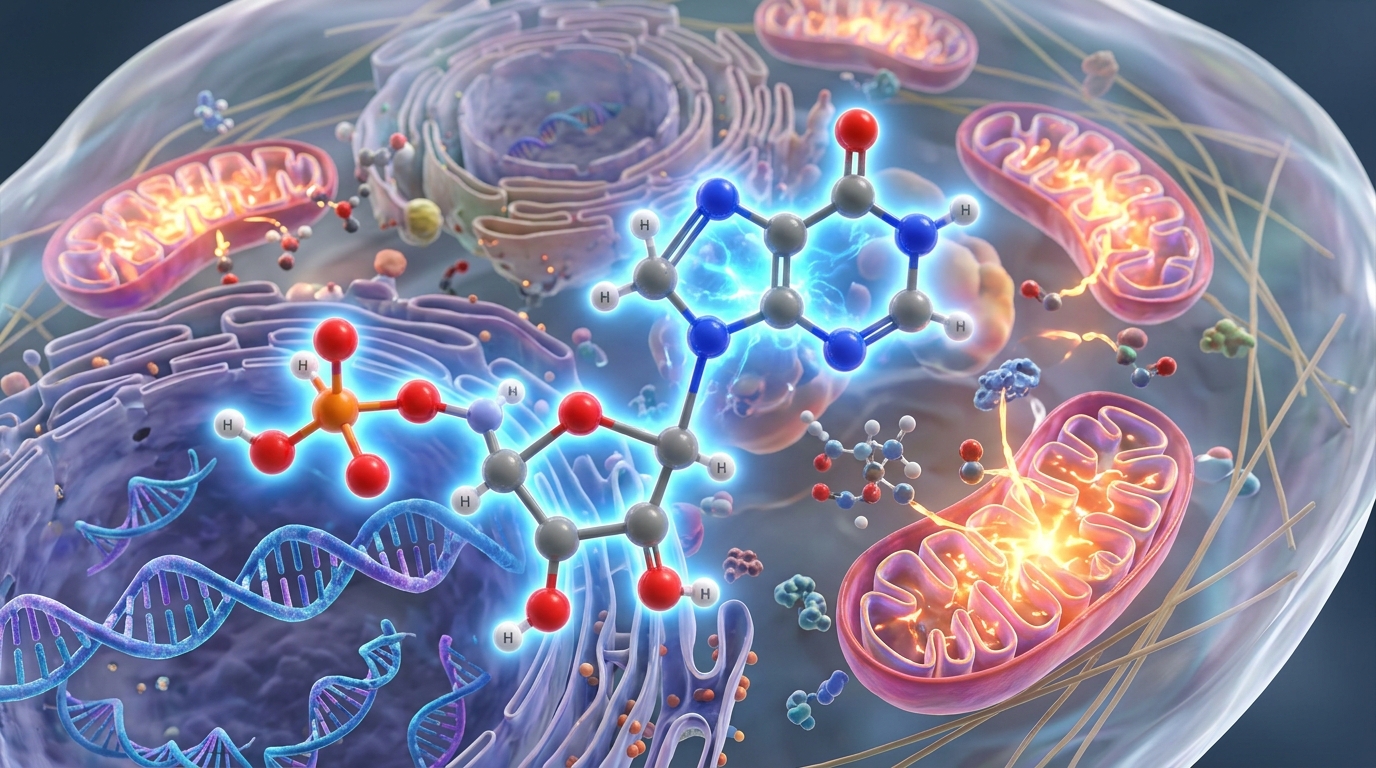
Nicotinamide adenine dinucleotide (NAD+) is an indispensable cellular coenzyme and signaling substrate whose systemic, age-dependent depletion directly drives mitochondrial dysfunction, genomic instability, and metabolic dysregulation, making its therapeutic restoration a primary focus of longevity and metabolic research.
Executive Summary: Supporting Pillars
- Bioenergetic Engine: NAD+ serves as an essential redox cofactor required for catabolic energy production, mitochondrial respiration, and cellular ATP homeostasis.
- Obligate Consumptive Substrate: NAD+ functions as a rate-limiting consumable substrate for pivotal regulatory enzymes—specifically sirtuins (SIRT1-7), poly(ADP-ribose) polymerases (PARPs), and cyclic ADP-ribose hydrolases (CD38/CD157)—that orchestrate DNA repair, gene silencing, and inflammatory signaling.
- Clinically Modifiable Biomarker: Preclinical models and emerging human clinical trials demonstrate that elevating systemic NAD+ pools via targeted precursor administration or degradation-inhibiting pathways improves metabolic, vascular, and physiological parameters.
Pillar 1: Bioenergetic Engine and Redox Homeostasis
The primary classical role of NAD+ is acting as a high-affinity electron acceptor in core metabolic pathways, cycling continuously between its oxidized (NAD+) and reduced (NADH) states.
In-Vitro & Biochemical Evidence
In cell-free assays and isolated mitochondrial models, NAD+ is an obligate electron acceptor for glyceraldehyde 3-phosphate dehydrogenase (GAPDH) in glycolysis and for the pyruvate dehydrogenase complex and isocitrate dehydrogenase in the tricarboxylic acid (TCA) cycle. The cytosolic and mitochondrial NAD+/NADH ratios dictate cellular redox balance, regulating glycolytic flux and Complex I (NADH:ubiquinone oxidoreductase) electron transfer in the electron transport chain.
Animal Evidence
Rodent models of high-fat-diet-induced metabolic stress demonstrate that a declining cytosolic NAD+/NADH ratio impairs hepatic beta-oxidation and promotes hepatic steatosis, while restoring the pool preserves Complex I assembly and oxidative phosphorylation capacity in skeletal muscle.
Human Clinical Evidence
Magnetic resonance spectroscopy (31P-MRS) studies in healthy human volunteers show an age-dependent decline in intracellular NAD+ concentration and NAD+/NADH redox balance in human brain and skeletal muscle tissue, correlating directly with diminished mitochondrial capacity.
Hypotheses & Anecdotal Claims
Hypothesis: A declining mitochondrial NAD+/NADH ratio is the primary upstream trigger of whole-body bioenergetic exhaustion during chronological aging.
Anecdotal Claim: Intravenous NAD+ infusions instantly restore perceived physical stamina by rapidly saturating mitochondrial respiration pools (unsupported by pharmacokinetic kinetic data, as whole NAD+ molecules do not cross intact plasma membranes efficiently).
Pillar 2: Obligate Consumptive Substrate for Enzymatic Defense and Repair
Beyond its cyclic redox actions, NAD+ is irreversibly cleaved into nicotinamide (NAM) and ADP-ribose products by enzymatic consumers that regulate cellular survival and genome maintenance.
In-Vitro Evidence
Cell culture studies show that PARP1 and PARP2 rapidly consume up to 80% of intracellular NAD+ upon exposure to alkylating agents or reactive oxygen species (ROS) to synthesize poly(ADP-ribose) chains, recruiting DNA base excision repair machinery. Concurrently, nuclear and mitochondrial sirtuins (e.g., SIRT1, SIRT3) consume NAD+ to perform deacetylation of histones, PGC-1alpha, and FOXO transcription factors, driving mitochondrial biogenesis and antioxidant defense.
Animal Evidence
Transgenic murine knockouts have elucidated the pathogenic role of CD38, an ecto-enzyme and major NAD+ consumer. CD38-knockout mice maintain elevated NAD+ tissue levels throughout life, exhibiting resistance to high-fat-diet-induced obesity, enhanced mitochondrial density, and extended healthspan compared to wild-type controls.
Human Clinical Evidence
Ex-vivo analyses of peripheral blood mononuclear cells (PBMCs) from human cohorts confirm that CD38 expression increases progressively with chronological age, whereas tissue PARP activity spikes in response to acute ultraviolet-induced DNA damage, accelerating tissue NAD+ exhaustion.
Hypotheses & Anecdotal Claims
Hypothesis: Hyperactivation of PARPs during chronic low-grade sterile inflammation starves sirtuins of NAD+, creating an intracellular survival-versus-repair competition that drives senescence.
Anecdotal Claim: Increasing NAD+ entirely prevents epigenetic aging; current clinical data show marker modulation, but definitive epigenetic reversal remains unproven in humans.
Pillar 3: Clinically Modifiable Biomarker via Precursors and Modulators
Intracellular NAD+ depletion is not permanent; it can be pharmacologically and nutritionally augmented using biosynthetic precursors such as Nicotinamide Mononucleotide (NMN), Nicotinamide Riboside (NR), or salvage pathway intermediates.
Animal Evidence
Extensive rodent trials have established that oral administration of NR or NMN elevates hepatic, muscular, and neural NAD+ concentrations, leading to enhanced treadmill endurance, reversal of arterial stiffness, preserved neural stem cell function in Alzheimer’s disease models, and mitigation of acute kidney injury.
Human Clinical Evidence
Multiple randomized, double-blind, placebo-controlled human trials demonstrate that oral NR (1,000–2,000 mg/day) and NMN (250–1,000 mg/day) safely and dose-dependently raise whole-blood or PBMC NAD+ levels by 40% to 100% within 2 to 4 weeks. Clinically validated outcomes include reduced systemic inflammatory markers (e.g., IL-6, TNF-alpha), improved skeletal muscle insulin sensitivity in postmenopausal prediabetic women, and improved walking distance in older adults.
In-Vitro Evidence
Human cell line models indicate that exogenous NR and NMN utilize distinct cell-surface transporters (such as SLC12A8 for NMN or equilibrative nucleoside transporters for NR) and phosphorylation cascades (NRK1/2) to reconstitute the intracellular NAD+ salvage pathway.
Hypotheses & Anecdotal Claims
Hypothesis: Long-term precursor supplementation may reduce incidence rates of age-associated neurodegenerative disorders by stimulating neuronal mitophagy.
Anecdotal Claim: Sublingual or IV NAD+ confers immediate cognitive sharpening and complete alleviation of acute withdrawal symptoms in addiction disorders (requires further rigorous, large-scale blinded validation).