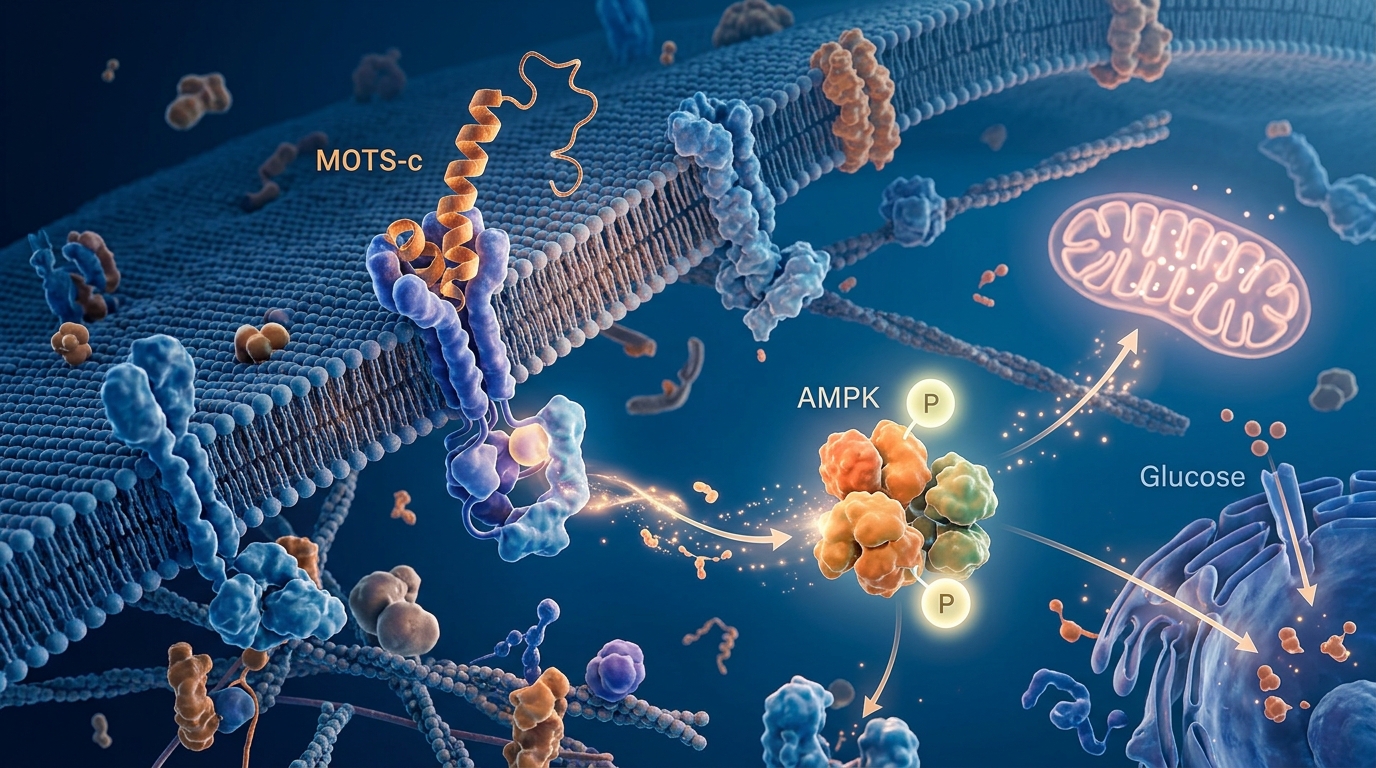
MOTS-c is an endogenous mitochondrial-derived peptide that regulates systemic metabolic homeostasis and physical performance primarily through AMPK activation, though its therapeutic efficacy is currently established in preclinical animal and in-vitro models rather than confirmatory human clinical trials.
This conclusion is supported by three primary scientific findings:
- Distinct Molecular Signaling: MOTS-c operates via a novel mitochondrial-to-nuclear signaling axis, inhibiting the folate-purine pathway to activate 5′ AMP-activated protein kinase (AMPK) and coordinate adaptive metabolic responses.
- Robust Preclinical Efficacy: Animal models consistently demonstrate that exogenous MOTS-c reverses diet-induced insulin resistance, increases physical endurance, and prevents age-associated physical decline.
- Early Translational Landscape: Human data remain largely confined to observational correlative studies and early-stage safety pharmacology, meaning clinical efficacy and safety profiles remain unproven.
1. Molecular Signaling: The Folate-AMPK Axis and Nuclear Translocation
In-Vitro Evidence
- Folate-Methionine Cycle Modulation: Cell culture studies in HEK293 and C2C12 myoblasts show that MOTS-c temporarily disrupts the folate cycle at the 5-methyl-THF stage, leading to de novo purine synthesis inhibition and intracellular accumulation of 5-aminoimidazole-4-carboxamide ribonucleotide (AICAR).
- AMPK Activation: Elevated AICAR directly stimulates AMPK phosphorylation, leading to GLUT4 translocation, enhanced cellular glucose uptake, and upregulated fatty acid beta-oxidation independently of insulin receptor signaling.
- Nuclear Translocation Under Stress: Under metabolic or oxidative stress, MOTS-c translocates from the cytoplasm directly into the nucleus, binding to antioxidant response elements (ARE) and transcription factors (such as Nrf2) to regulate nuclear gene expression.
Mechanistic Hypotheses
- Mitokine Function: Researchers hypothesize that MOTS-c functions systemically as an endocrine-like mitokine, allowing stressed mitochondria to signal distant organ systems to alter lipid and carbohydrate utilization.
2. Preclinical Efficacy: Metabolic Regulation and Exercise Capacity
Animal Evidence
- Diet-Induced Obesity and Insulin Resistance: In high-fat diet (HFD) fed mice, systemic MOTS-c administration significantly improved systemic insulin sensitivity, reduced hepatic steatosis, and enhanced skeletal muscle glucose disposal without increasing caloric intake.
- Physical Capacity and Sarcopenia: Long-term administration in aged mice improved treadmill running performance, grip strength, and neuromuscular preservation, effectively mimicking the physiological adaptations associated with aerobic training.
- Bone and Vascular Homeostasis: Murine models of osteoporosis and vascular calcification demonstrate that MOTS-c suppresses osteoclastogenesis and attenuates arterial calcification through suppression of the TGF-beta/Smad pathway.
Anecdotal Claims
- Athletic Enhancement and Fat Loss: Bodybuilding and biohacking communities frequently claim rapid fat loss, improved mitochondrial density, and enhanced athletic endurance from subcutaneous administration; however, these self-reports lack standardized dosing, purity verification, and placebo controls.
3. Translational Status: Human Clinical Evidence and Therapeutic Outlook
Human Clinical Evidence
- Observational and Biomarker Studies: Epidemiological studies reveal that circulating endogenous MOTS-c levels decline with chronological age and correlate inversely with body mass index (BMI) and HOMA-IR in metabolic syndrome cohorts.
- Exercise-Induced Elevation: Human trial data show that acute bouts of high-intensity endurance exercise significantly elevate endogenous plasma MOTS-c levels in healthy males, pointing to its physiological role in exercise adaptation.
- Phase 1 Trials: Synthetic MOTS-c analogs (e.g., CB4211) have completed early Phase 1a/1b safety and pharmacokinetic evaluations in healthy volunteers and individuals with non-alcoholic fatty liver disease (NAFLD), demonstrating short-term tolerability.
Current Clinical Limitations
- Lack of Phase II/III Efficacy: No large-scale, randomized, double-blind, placebo-controlled Phase II/III clinical trials have proven MOTS-c to be safe or effective for treating type 2 diabetes, obesity, or age-related sarcopenia.
- Pharmacokinetics: Natural MOTS-c exhibits a short systemic half-life in biological fluids, presenting delivery and bio-distribution challenges for therapeutic translation without peptide stabilization or analog engineering.