Key Takeaways
- Central site of action: PT-141 (bremelanotide) operates primarily within the central nervous system (CNS), specifically targeting melanocortin receptors in key hypothalamic nuclei.
- Receptor pharmacology: As a synthetic cyclic heptapeptide analog of alpha-melanocyte-stimulating hormone (α-MSH), PT-141 acts as an agonist at melanocortin receptors, displaying significant affinity for MC1R, MC3R, and MC4R.
- Downstream neurotransmission: Activation of MC4R in regions such as the medial preoptic area (mPOA) and paraventricular nucleus (PVN) triggers downstream dopaminergic and oxytocinergic signaling cascades that regulate sexual motivation and appetitive behavior.
- Mechanistic distinction: Unlike phosphodiesterase-5 (PDE5) inhibitors that cause localized peripheral vasodilation, PT-141 modulates the neurobiological drivers of sexual arousal at the brain level.
- Regulatory standing: Subcutaneous bremelanotide is FDA-approved under the brand name Vyleesi for premenopausal hypoactive sexual desire disorder (HSDD), while intranasal formulations and other applications remain investigational or discontinued.
What Is PT-141?
PT-141, known generically as bremelanotide, is a synthetic cyclic heptapeptide with the sequence Ac-Nle-cyclo[Asp-His-D-Phe-Arg-Trp-Lys]-OH. Structurally derived from the tanning peptide Melanotan II (MT-II), PT-141 was developed by removing the C-terminal amide to optimize its central receptor selectivity and reduce systemic side effects.
Research into the PT-141 mechanism of action originated during early investigations of synthetic α-MSH analogs. Scientists observed that α-MSH mimetic compounds produced spontaneous central arousal and pro-erectile effects in animal models, independent of direct penile or genital stimulation. This finding shifted pharmacological interest toward mapping the central melanocortinergic pathways responsible for sexual drive, motivation, and autonomic response.
The Melanocortin System and Receptor Selectivity
The endogenous melanocortin system consists of peptide hormones derived from the post-translational processing of pro-opiomelanocortin (POMC), including α-, β-, and γ-MSH, as well as adrenocorticotropic hormone (ACTH). These peptides exert their biological effects by binding to a family of five G-protein coupled receptors (GPCRs), designated MC1R through MC5R:
- MC1R: Expressed primarily on melanocytes in the epidermis and hair follicles; regulates melanogenesis (pigmentation) and certain anti-inflammatory pathways.
- MC2R: Expressed in the adrenal cortex; selectively responsive to ACTH and regulates glucocorticoid steroidogenesis (PT-141 does not bind MC2R).
- MC3R: Located predominantly in the hypothalamus and limbic structures; involved in energy homeostasis, autonomic regulation, and motivational behavior.
- MC4R: Broadly expressed throughout the central nervous system, particularly in the hypothalamus, brainstem, and spinal cord; acts as a master regulator of metabolic rate, satiety, and sexual function.
- MC5R: Widely distributed in exocrine glands and peripheral tissues; implicated in sebaceous lipid production.
PT-141 is a non-selective melanocortin agonist with significant binding affinity for MC1R, MC3R, MC4R, and MC5R. Pharmacological studies indicate that its primary behavioral and autonomic effects are mediated by its agonist activity at MC3R and, predominantly, MC4R within specific subcortical brain structures.
Central Nervous System Pathways and Hypothalamic Circuitry
To understand the PT-141 mechanism of action, researchers have traced how melanocortin signaling interfaces with central neurocircuitry. The peptide crosses the blood-brain barrier following systemic administration and engages melanocortin receptors on neuronal cell bodies and presynaptic terminals in key brain regions:
1. The Medial Preoptic Area (mPOA)
The mPOA of the anterior hypothalamus is an essential integrative node for sexual motivation and appetitive behaviors. Presynaptic MC4R activation in the mPOA stimulates the release of dopamine into synaptic clefts. Dopamine acting within the mPOA and mesolimbic reward pathways lowers the threshold for sexual arousal and enhances responsiveness to sexual stimuli. Animal studies utilizing c-Fos immunoreactivity mapping have confirmed marked neuronal activation within the mPOA following PT-141 administration.
2. The Paraventricular Nucleus (PVN)
The PVN coordinates neuroendocrine and autonomic outputs. Activation of MC4R on PVN neurons stimulates oxytocinergic pathways that project to autonomic centers in the brainstem and the lumbosacral spinal cord. This signaling cascade initiates descending pro-erectile and pro-sexual autonomic signals, facilitating genital vasocongestion via the pelvic nerve while suppressing sympathetic vasoconstriction.
3. Intracellular Signaling and G-Protein Coupling
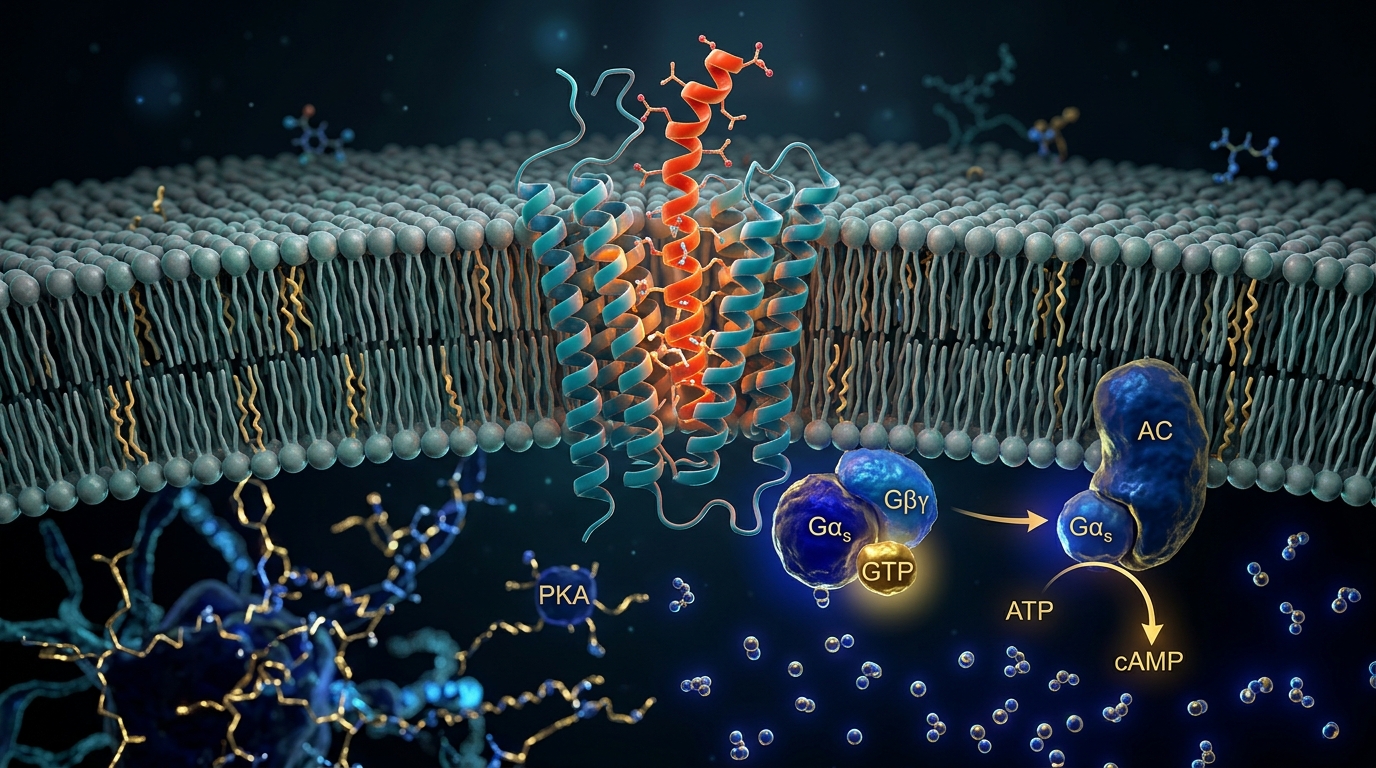
At the cellular level, binding of PT-141 to MC4R couples to the stimulatory G-protein subunit (Gαs). This stimulates adenylate cyclase, increasing intracellular cyclic adenosine monophosphate (cAMP) and activating protein kinase A (PKA). In addition to classical G-protein signaling, studies suggest MC4R activation may also modulate inwardly rectifying potassium channels (such as Kir7.1), leading to membrane depolarization and sustained neuronal firing in target hypothalamic circuits.
Distinction from Peripheral Vascular Agents
A critical distinction in sexual medicine research is the difference between centrally acting melanocortin agonists and peripherally acting phosphodiesterase-5 (PDE5) inhibitors such as sildenafil or tadalafil.
PDE5 inhibitors do not initiate sexual desire or stimulate the brain’s motivational pathways; they work peripherally by inhibiting the breakdown of cyclic guanosine monophosphate (cGMP) in smooth muscle cells of vascular tissue, facilitating nitric oxide-mediated vasodilation upon sexual stimulation. In contrast, PT-141 acts upstream in the central nervous system to stimulate the neurochemical initiators of desire and arousal. Preclinical and human studies have demonstrated that combining central melanocortin receptor activation with peripheral PDE5 inhibition can act additively or synergistically on erectile responses, confirming independent mechanisms.
Clinical Evidence and Regulatory Status
The clinical development of PT-141 has explored both male and female sexual dysfunction:
- Hypoactive Sexual Desire Disorder (HSDD): In June 2019, the U.S. Food and Drug Administration (FDA) approved subcutaneous bremelanotide (Vyleesi, 1.75 mg autoinjector) for the treatment of acquired, generalized HSDD in premenopausal women. Phase 3 clinical trials (RECONNECT studies) demonstrated statistically significant increases in sexual desire scores and meaningful reductions in distress related to low desire compared to placebo.
- Male Erectile Dysfunction: Early trials investigated intranasal formulations of PT-141 in men with psychogenic and organic erectile dysfunction, showing significant pro-erectile efficacy. However, intranasal development was halted in 2008 due to concerns regarding transient, asymptomatic blood pressure elevations.
Safety Findings and Mechanistic Side Effects
Because melanocortin receptors are distributed across multiple organ systems, PT-141 exhibits characteristic on-target and off-target physiological effects:
- Hemodynamic alterations: Central MC4R activation stimulates the sympathetic nervous system and autonomic centers regulating vasomotor tone. Clinical administration is associated with transient increases in systolic and diastolic blood pressure (typically peaking 2 to 4 hours post-dose) and slight reductions in heart rate. Consequently, it is contraindicated in patients with uncontrolled hypertension or cardiovascular disease.
- Nausea and vomiting: Nausea is the most commonly reported adverse event in clinical trials (occurring in approximately 40% of patients), mediated in part by central melanocortin actions in the brainstem and chemoreceptor trigger zone.
- Hyperpigmentation: Non-selective activation of MC1R on cutaneous melanocytes can cause focal hyperpigmentation of the skin and gums, particularly with frequent, repeated dosing.
Frequently Asked Questions
How does PT-141 cross into the brain?
PT-141 is a cyclized peptide engineered with chemical modifications that provide sufficient stability against enzymatic degradation, allowing clinically relevant concentrations to penetrate the blood-brain barrier and reach hypothalamic receptor targets.
Why did intranasal PT-141 development stop?
Intranasal PT-141 trials were suspended after clinical monitoring identified unpredictable pharmacokinetic spikes that caused transient elevations in systolic blood pressure. Subsequent development pivoted to subcutaneous administration, which provides a more predictable pharmacokinetic profile.
Does PT-141 affect appetite or weight?
Endogenous MC4R signaling plays a critical role in energy balance and satiety regulation. While chronic MC4R agonists are studied for obesity, PT-141’s intermittent, on-demand dosing profile is optimized for central sexual arousal rather than long-term metabolic management.
Research Summary
PT-141 (bremelanotide) represents a clinically validated, centrally acting peptide that targets melanocortin signaling networks in the central nervous system. By acting as an agonist at hypothalamic MC3R and MC4R sites, it modulates dopaminergic and autonomic circuits that govern sexual motivation and physiological arousal. The compound has robust human clinical trial evidence supporting its efficacy for premenopausal HSDD, leading to FDA approval for subcutaneous use. Its pharmacological profile is distinct from peripheral vasodilators, though MC4R-mediated pressor effects and MC1R-related pigmentation remain important physiological considerations.
References
- Rosen, R. C., et al. (2003). PT-141: a melanocortin agonist for the treatment of sexual dysfunction. Annals of the New York Academy of Sciences, 994, 296–302.
- Kingsberg, S. A., et al. (2021). The neurobiology of bremelanotide for the treatment of hypoactive sexual desire disorder in premenopausal women. CNS Spectrums, 26(4), 353–360.
- Martin, W. J., & MacIntyre, D. E. (2004). Melanocortin Receptors, Melanotropic Peptides and Penile Erection. European Urology Supplements, 3(4), 21–25.
- U.S. Food and Drug Administration. (2019). Vyleesi (bremelanotide injection) Prescribing Information. FDA Center for Drug Evaluation and Research.
- Clayton, A. H., et al. (2022). Bremelanotide for Treatment of Female Hypoactive Sexual Desire Disorder. Journal of Clinical Medicine, 11(1), 167.