Key Takeaways
- Peptide Structure: Semax is a synthetic heptapeptide (Met-Glu-His-Phe-Pro-Gly-Pro) derived from adrenocorticotropic hormone (ACTH 4-7) stabilized by a C-terminal tripeptide (Pro-Gly-Pro).
- Multi-Target Mechanism: Laboratory studies indicate Semax promotes neuroprotection by upregulating brain-derived neurotrophic factor (BDNF) and its TrkB receptor, modulating inflammatory cytokines, and altering ischemic brain gene expression.
- Clinical Investigations: Russian clinical trials have examined intranasal Semax in acute ischemic stroke and stroke rehabilitation, reporting accelerated motor recovery and improved neurological scores.
- Evidence Limitations: Most published human data originate from a single national research ecosystem, with limited independent replication under modern Western regulatory trial frameworks.
- Regulatory Status: Semax is approved for cerebrovascular conditions in Russia but is not approved by the U.S. Food and Drug Administration (FDA) or European Medicines Agency (EMA).
Understanding Semax in Ischemic Stroke Research
Ischemic stroke represents one of the leading global causes of mortality and long-term functional disability. The pathology is initiated by a thromboembolic occlusion that abruptly reduces cerebral blood flow, causing rapid energy depletion in the ischemic core alongside a surrounding, metabolically compromised region known as the penumbra. Rescuing this salvageable penumbral tissue before secondary injury cascades inflict permanent damage is the central objective of acute neuroprotective strategies.
Semax in ischemic stroke research emerged from the Institute of Molecular Genetics of the Russian Academy of Sciences in the late 20th century. Designed as an ACTH(4-10) analog without endocrine or corticotropic activity, Semax couples the neuroactive sequence of ACTH with a C-terminal Pro-Gly-Pro motif. This chemical modification confers metabolic stability against endopeptidases, permitting rapid absorption across the nasal mucosa directly into central nervous system structures. Over several decades, researchers have investigated the compound as a biological response modifier capable of dampening excitotoxicity, reducing microvascular damage, and enhancing neuroplasticity.
Biological Targets and Mechanisms of Action
Preclinical stroke models—predominantly rodent middle cerebral artery occlusion (MCAO) paradigms—have elucidated several distinct but overlapping neuroprotective mechanisms driven by Semax.
1. Neurotrophin Induction and TrkB Signaling
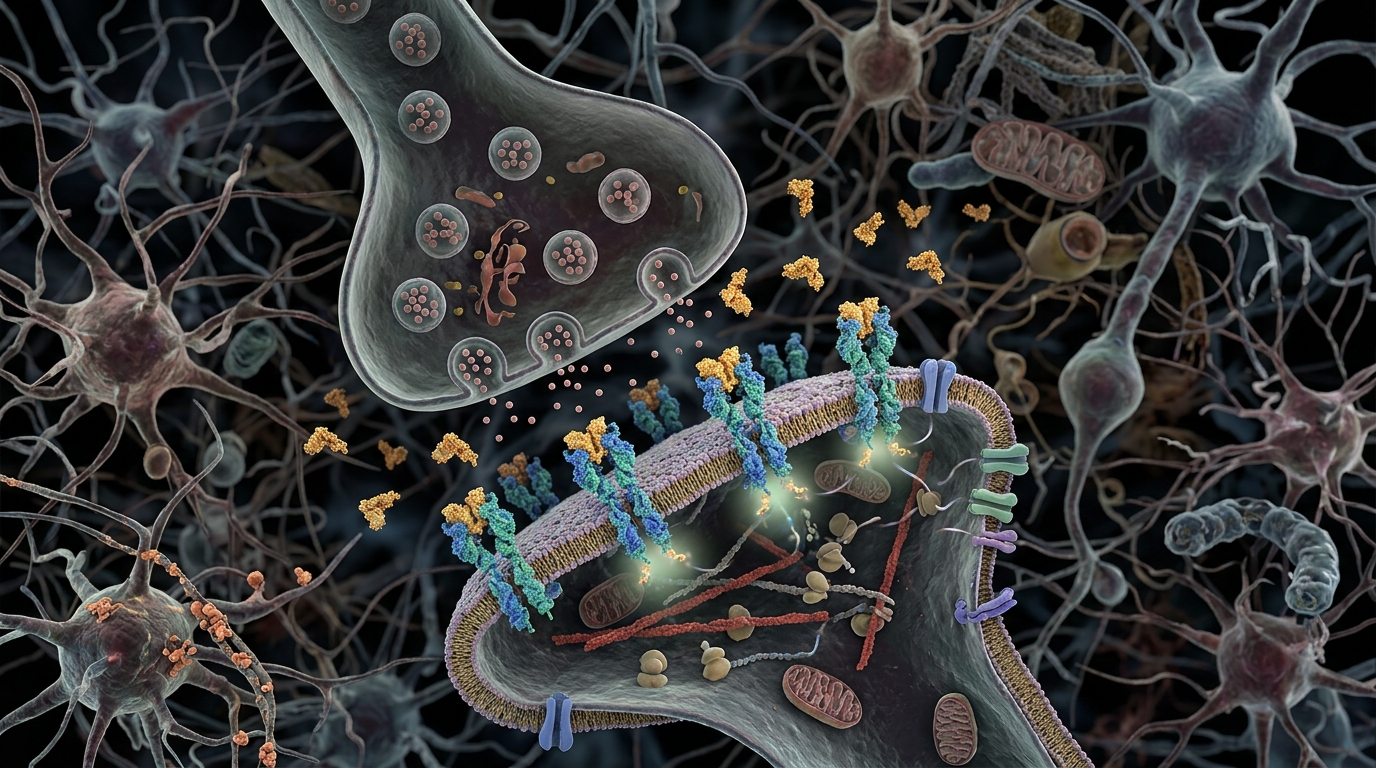
One of the primary pathways through which Semax influences neuronal survival is the stimulation of neurotrophic factor synthesis. Research by Dolotov et al. (2006) demonstrated that Semax rapidly induces mRNA expression of BDNF and its high-affinity receptor, Tropomyosin receptor kinase B (TrkB), in rat hippocampal tissue. A study by Kamayev et al. (2010) reported significant elevations in BDNF, nerve growth factor (NGF), and glial cell line-derived neurotrophic factor (GDNF) transcripts following peptide administration in brain injury models. By enhancing BDNF-TrkB signaling, the peptide is thought to activate downstream prosurvival pathways, including the extracellular signal-regulated kinase (ERK) and Akt pathways, which inhibit apoptotic signaling within the penumbra.
2. Modulation of the Post-Ischemic Immune Cascade
Cerebral ischemia triggers an intense neuroinflammatory response marked by microglial activation, blood-brain barrier disruption, and leukocyte infiltration. Transcriptome and proteome analyses indicate that Semax shifts this immune response away from cytotoxic damage. Genome-wide RNA sequencing during cerebral ischemia-reperfusion demonstrates that Semax downregulates pro-inflammatory gene networks and attenuates matrix metalloproteinase-9 (MMP-9) and c-Jun N-terminal kinase (JNK) activation. Simultaneously, the peptide increases the expression of anti-inflammatory mediators such as interleukin-10 (IL-10) while suppressing pro-inflammatory mediators including interleukin-8 (IL-8) and C-reactive protein (CRP).
3. Antihypoxic and Excitotoxicity Buffering
During acute vascular occlusion, severe ATP depletion leads to excessive synaptic accumulation of glutamate and calcium overload. In vitro neuronal culture studies indicate that Semax reduces glutamate-induced excitotoxicity, limits reactive oxygen species (ROS) accumulation, and blunts caspase-3 activation, thereby preserving mitochondrial integrity during metabolic stress.
Clinical Trial Evidence in Ischemic Stroke
Unlike many theoretical neuroprotectants that exist solely in preclinical literature, Semax has undergone clinical evaluation in Russian acute care and neurorehabilitation settings.
Acute Ischemic Stroke Studies
Early clinical trials investigated the physiological and electrophysiological impact of Semax in acute hemispheric stroke. In a controlled study led by E.I. Gusev and colleagues, patients presenting with acute hemispheric ischemic stroke received intranasal Semax at dosages of 12 mg per day (moderate stroke) or 18 mg per day (severe stroke) over 5 to 10 days alongside standard care. Investigators monitored clinical deficit regression alongside continuous quantitative electroencephalography (EEG) and somatosensory evoked potentials. Patients receiving Semax exhibited accelerated recovery of motor and general cerebral functions and a faster normalization of bioelectric activity relative to conventional therapy controls.
Subsequent biochemical investigations in acute stroke patients confirmed a significant shift in inflammatory biomarkers, with treated patients showing sustained elevation of neuroprotective IL-10 and lower concentrations of systemic inflammatory markers in cerebrospinal fluid and plasma.
Rehabilitation and Motor Recovery Trials
In a clinical study published by Gusev et al. (2018), researchers assessed the functional outcomes and plasma BDNF dynamics of 110 patients undergoing early (around 90 days post-stroke) or late (around 210 days post-stroke) rehabilitation. Participants received two 10-day courses of intranasal Semax at 6,000 mcg per day separated by a 20-day interval.
- Biomarker Response: Semax administration produced sustained elevations in circulating plasma BDNF across both early and late cohorts.
- Functional Endpoints: Higher BDNF levels correlated with accelerated functional improvements on the British Medical Research Council (MRC) motor score scale and Barthel Index of daily living activities.
Research Limitations and Methodological Considerations
While published findings report favorable outcomes, critical methodological limitations must be considered when evaluating the broader applicability of this data:
- Single Ecosystem Origin: Virtually all human clinical trials have been conducted within Russian clinical centers and published in regional journals. There is an absence of multi-center, independent Phase III trials conducted under Western regulatory frameworks.
- Trial Designs and Blinding: Several historical studies utilized open-label or active-control comparative designs rather than rigorous double-blind, placebo-controlled protocols.
- Heterogeneous Outcome Measures: Clinical metrics across older studies relied partly on customized neurological rating systems that complicate meta-analytic comparisons with modern international stroke scales (e.g., NIH Stroke Scale and modified Rankin Scale).
- Unclear Penetration Dynamics: Although intranasal delivery bypasses the blood-brain barrier via olfactory and trigeminal neural pathways, the exact pharmacokinetic profile and tissue distribution in human brain parenchyma remain incompletely characterized.
Regulatory Status
Semax was registered by the Ministry of Health of the Russian Federation in the 1990s as a pharmaceutical agent (formulated as 0.1% and 1% intranasal drops) for acute ischemic stroke, vascular encephalopathy, and optic nerve pathology.
In contrast, Semax is not approved by the U.S. FDA, the EMA, or other major Western regulatory authorities for any medical indication. In these jurisdictions, it remains classified as an unapproved investigational research peptide.
Frequently Asked Questions
How does Semax differ from standard ACTH?
Semax contains only the N-terminal 4–7 sequence of adrenocorticotropic hormone coupled to a C-terminal Pro-Gly-Pro stabilizing tripeptide. It completely lacks the steroidogenic sequence of ACTH, meaning it does not stimulate the adrenal cortex, alter systemic corticosteroid levels, or induce hormonal side effects.
What is the theoretical therapeutic window for Semax in stroke?
Preclinical and early clinical protocols suggest that the ideal window begins in the hyperacute phase (within the first 6 to 12 hours) to protect the penumbral zone, although rehabilitation studies have evaluated its neuroplasticity effects months after the initial ischemic event.
Can Semax replace standard acute stroke interventions like thrombolysis or thrombectomy?
No. Mechanical thrombectomy and intravenous thrombolysis (e.g., alteplase) are standard-of-care reperfusion therapies that physically recanalize occluded blood vessels. Semax has only been investigated as an adjunctive neuroprotective compound, not a primary recanalization agent.
What adverse effects have been reported in stroke trials?
Russian clinical studies report a generally mild adverse-event profile. The most frequently noted complaints are transient local nasal irritation, mild headache, and occasional mild agitation, with no documented organ toxicity at studied doses.
Research Summary
Semax is a synthetic melanocortin-derived heptapeptide investigated extensively in Eastern Europe for its neuroprotective, neurotrophic, and immunomodulatory properties during cerebral ischemia. Preclinical research robustly demonstrates its ability to stimulate BDNF/TrkB expression, attenuate inflammatory cascades, and mitigate ischemic neuronal damage. Human clinical trials in acute stroke and stroke rehabilitation demonstrate accelerated motor and functional recovery associated with elevated plasma neurotrophin levels. However, because the clinical dataset is geographically isolated and lacks large-scale, international randomized controlled validation, Semax remains an unapproved investigational compound in the United States and Western jurisdictions.
References
- Dolotov, O. V., et al. (2006). Semax, an analog of ACTH(4-10) with cognitive effects, regulates BDNF and trkB expression in the rat hippocampus. Brain Research, 1117(1), 54–60. PubMed: 16996037
- Gusev, E. I., et al. (2018). The efficacy of semax in the treatment of patients at different stages of ischemic stroke. Zhurnal Nevrologii i Psikhiatrii imeni S.S. Korsakova, 118(3), 61–68. PubMed: 29798983
- Gusev, E. I., et al. (1997). Effectiveness of semax in acute period of hemispheric ischemic stroke (a clinical and electrophysiological study). Zhurnal Nevrologii i Psikhiatrii imeni S.S. Korsakova, 97(6), 26–34. PubMed: 9285918
- Miasoedova, N. F., et al. (1999). Investigation of mechanisms of neuro-protective effect of semax in acute period of ischemic stroke. Zhurnal Nevrologii i Psikhiatrii imeni S.S. Korsakova, 99(5), 15–19. PubMed: 10358912
- Medvedeva, E. V., et al. (2014). The peptide semax affects the expression of genes related to the immune and vascular systems in rat brain focal ischemia: genome-wide transcriptional analysis. BMC Genomics, 15, 228. PubMed: 24666579
- Kamayev, Y. A., et al. (2010). Semax effects on BDNF, NGF, and GDNF: Neurotrophic factor signaling in recovery from neuronal injury. Journal of Molecular Neuroscience, 41(1), 30–35. PubMed: 20217303