Key Takeaways
- Targeted Visceral Fat Reduction: Phase 3 clinical trials demonstrate that tesamorelin selectively reduces visceral adipose tissue (VAT) by approximately 15% to 18% over 26 weeks without depleting subcutaneous fat.
- Hepatic Fat and Fibrosis: Randomized trials show significant reductions in hepatic fat fraction (HFF) and an attenuation of liver fibrosis progression in patients with steatotic liver disease.
- Lipid Profile Improvements: Trial participants consistently exhibit meaningful decreases in serum triglycerides and total-to-HDL cholesterol ratios.
- Regulatory Scope: Tesamorelin is FDA-approved exclusively for reducing excess abdominal fat in individuals with HIV-associated lipodystrophy; non-HIV metabolic applications remain investigational.
What Is Tesamorelin? Biological Mechanism and Target
Tesamorelin is a synthetic peptide analogue consisting of the 44-amino acid sequence of human growth hormone-releasing hormone (GHRH), modified by the addition of a trans-3-hexenoic acid moiety at its N-terminus. This structural modification enhances its enzymatic stability against dipeptidyl peptidase-4 (DPP-4) degradation, resulting in a prolonged pharmacokinetic profile compared to native GHRH.
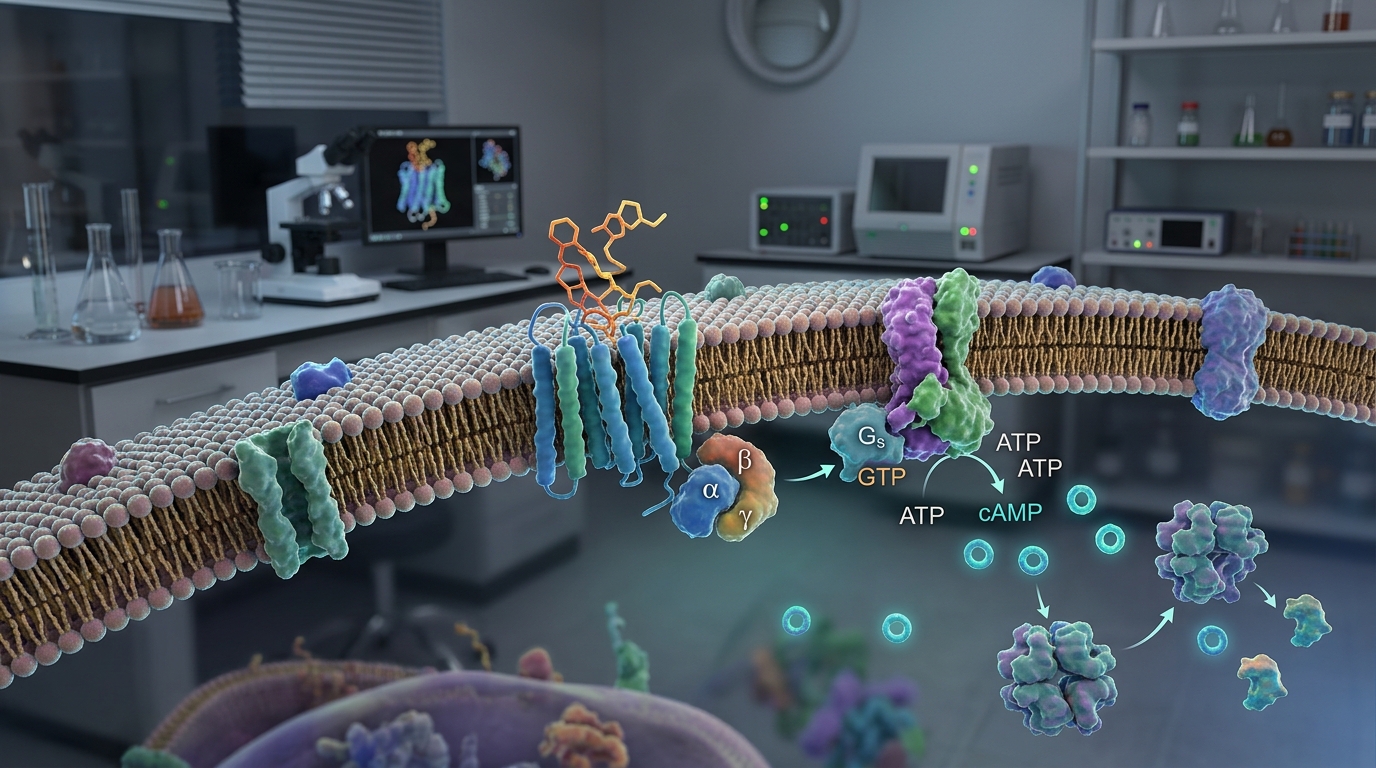
Tesamorelin acts selectively on GHRH receptors on anterior pituitary somatotrophs. Binding stimulates the synthesis and pulsatile secretion of endogenous growth hormone (GH), which subsequently triggers hepatic synthesis of insulin-like growth factor 1 (IGF-1). Unlike exogenous recombinant human growth hormone administration, which produces supraphysiological, continuous GH peaks and suppresses endogenous feedback, tesamorelin preserves natural physiological feedback loops via somatostatin release. This pulsatile elevation in GH promotes lipolysis—specifically in metabolically active visceral and ectopic fat depots—by stimulating hormone-sensitive lipase and inhibiting triglyceride uptake into adipocytes.
Visceral Adipose Tissue (VAT): Pivotal Phase 3 Evidence
The primary clinical validation for tesamorelin comes from large-scale, randomized, double-blind, placebo-controlled trials evaluated in individuals with HIV-associated lipodystrophy, a condition characterized by pathological visceral adiposity and ectopic fat accumulation.
In a landmark 26-week study published in the New England Journal of Medicine by Falutz et al. (2007), 412 patients were randomized to receive 2 mg of tesamorelin or placebo daily. Visceral adipose tissue, quantified by computed tomography (CT) scans at the L4–L5 level, decreased by a mean of 15.2% in the tesamorelin group compared to a 5.0% increase in the placebo arm (P < 0.001). Crucially, subcutaneous adipose tissue (SAT) remained largely unchanged, demonstrating that tesamorelin does not exacerbate peripheral fat wasting.
A subsequent pooled analysis of two multicenter Phase 3 trials involving 806 participants, published in the Journal of Clinical Endocrinology & Metabolism by Falutz et al. (2010), confirmed a treatment effect of -15.4% on VAT. However, the study also revealed that treatment cessation resulted in a rebound of visceral fat toward baseline levels within 26 weeks, demonstrating that ongoing therapy is required to sustain morphological improvements.
Liver Health: Effects on Hepatic Steatosis and Fibrosis
Given the close pathophysiological link between visceral adiposity and ectopic fat storage in non-adipose organs, clinical researchers investigated tesamorelin’s effects on non-alcoholic fatty liver disease (NAFLD), now categorized as metabolic dysfunction-associated steatotic liver disease (MASLD).
A randomized clinical trial by Stanley et al. (2014) in JAMA evaluated 50 patients with abdominal fat accumulation. Tesamorelin treatment significantly decreased liver fat (median change in lipid-to-water percentage of -2.0% vs. +0.9% for placebo; P = 0.003) alongside a significant decrease in visceral fat.
These findings were expanded in a dedicated multicenter trial published in The Lancet HIV by Stanley et al. (2019). In this 12-month study of 61 patients with hepatic steatosis (defined as hepatic fat fraction ≥5% by magnetic resonance spectroscopy):
- Hepatic Fat Fraction (HFF): Tesamorelin reduced absolute HFF by 4.1% (a relative reduction of approximately 37%), compared to a 0.3% increase in the placebo arm (P = 0.018).
- Fibrosis Progression: Only 10.5% of patients in the tesamorelin group showed progression of liver fibrosis on repeat biopsy, compared to 37.5% of participants in the placebo group.
- Transcriptomic Signatures: Hepatic biopsy profiling revealed that tesamorelin downregulated genes involved in lipogenesis, inflammation, and extracellular matrix deposition.
Metabolic Parameters: Lipids and Glycemic Homeostasis
Clinical trials have extensively evaluated the broader endocrine and metabolic impacts of tesamorelin therapy:
- Serum Lipids: Across Phase 3 trials, tesamorelin induced a significant reduction in serum triglycerides (treatment effect of approximately -12% to -15%) and improved the total-to-HDL cholesterol ratio. A responder analysis published by Stanley et al. (2012) found that individuals achieving ≥8% VAT reduction had the most pronounced improvements in lipid parameters.
- Glucose Homeostasis: Because growth hormone possesses counter-regulatory effects on insulin sensitivity, glycemic safety was closely monitored. While short-term elevations in fasting blood glucose and minor increases in glycated hemoglobin (HbA1c) have been observed in a subset of patients, mean HbA1c levels generally remained within clinically acceptable ranges throughout 52-week extension protocols. However, careful glycemic monitoring remains standard protocol.
- Lean Body Mass: Unlike calorie-restriction models that can lead to muscle wasting, tesamorelin preserved or modestly increased lean body mass, driven by IGF-1 elevation.
Regulatory Status and Safety Considerations
In 2010, the U.S. Food and Drug Administration (FDA) approved tesamorelin (under the brand name Egrifta) specifically for the reduction of excess abdominal fat in HIV-infected patients with lipodystrophy. It is not approved for general weight management, bodybuilding, anti-aging, or non-HIV-associated metabolic dysfunction.
Adverse reactions identified in clinical trials are largely consistent with growth hormone activity and localized administration:
- Injection site reactions (erythema, pruritus, pain)
- Peripheral edema and fluid retention
- Arthralgias, myalgias, and carpal tunnel symptoms related to fluid shifts
- Transient elevations in fasting blood glucose
Because IGF-1 is a mitogenic factor, tesamorelin is contraindicated in patients with active malignancies or known hypersensitivity to GHRH analogues.
Frequently Asked Questions
How quickly does tesamorelin reduce visceral fat in clinical trials?
In Phase 3 trials, statistically significant reductions in visceral adipose tissue were documented by computed tomography at the primary endpoint of 26 weeks, with substantial changes observable by week 12 in imaging sub-studies.
Does tesamorelin cause overall body weight loss?
No. Clinical trials show that tesamorelin alters body composition rather than scale weight. Reductions in visceral adipose mass are typically balanced by slight increases in lean tissue mass and extracellular water, resulting in minimal changes to total body weight or body mass index (BMI).
What happens when tesamorelin treatment is stopped?
Evidence from 52-week extension trials indicates that the metabolic and anatomical benefits are not permanent. Discontinuation leads to a re-accumulation of visceral fat and a gradual return of lipid markers toward pre-treatment baseline levels over 3 to 6 months.
Is tesamorelin effective for fatty liver disease without HIV?
While mechanistic and transcriptomic data suggest tesamorelin targets universal pathways of hepatic steatosis, rigorous Phase 3 randomized controlled trials for MASLD/MASH in non-HIV populations are ongoing or under evaluation, and it remains investigational for that indication.
References
- Falutz, J., et al. (2007). Metabolic effects of a growth hormone-releasing factor in patients with HIV. New England Journal of Medicine, 357(23), 2359–2370. PubMed PMID: 18057338.
- Falutz, J., et al. (2010). Effects of tesamorelin (TH9507), a growth hormone-releasing factor analog, in human immunodeficiency virus-infected patients with excess abdominal fat: a pooled analysis of two multicenter, double-blind placebo-controlled phase 3 trials with safety extension data. Journal of Clinical Endocrinology & Metabolism, 95(9), 4291–4304. PubMed PMID: 20554713.
- Stanley, T. L., et al. (2012). Reduction in visceral adiposity is associated with an improved metabolic profile in HIV-infected patients receiving tesamorelin. Clinical Infectious Diseases, 54(11), 1642–1651. PubMed PMID: 22495074.
- Stanley, T. L., et al. (2014). Effect of tesamorelin on visceral fat and liver fat in HIV-infected patients with abdominal fat accumulation: a randomized clinical trial. JAMA, 312(4), 380–389. PubMed PMID: 25038357.
- Stanley, T. L., et al. (2019). Effects of tesamorelin on non-alcoholic fatty liver disease in HIV: a randomised, double-blind, multicentre trial. The Lancet HIV, 6(12), e821–e830. PubMed PMID: 31607626.
Research Summary
Human clinical evidence robustly supports tesamorelin’s efficacy in selectively decreasing visceral adipose tissue, lowering hepatic fat fraction, preventing liver fibrosis progression, and improving triglyceride profiles in clinical populations with central lipodystrophy. The evidence base relies predominantly on rigorous Phase 3 randomized controlled trials and validated imaging modalities. While its clinical profile is well-established for HIV-associated lipodystrophy—the sole FDA-approved indication—its role in non-HIV metabolic dysfunction-associated steatotic liver disease and general metabolic optimization remains an active area of clinical investigation.