Key Takeaways
- Molecular Identity: Pinealon is a synthetic tripeptide consisting of glutamic acid, aspartic acid, and arginine (Glu-Asp-Arg or EDR).
- Proposed Mechanism: Preclinical hypotheses suggest Pinealon penetrates cellular nuclei to interact with histone proteins and DNA regulatory sequences, influencing the transcription of genes related to cellular defense, apoptosis, and neurotransmission.
- Preclinical Evidence: In vitro and rodent models report reduced reactive oxygen species (ROS), activation of antioxidant enzymes (such as SOD2 and GPX1), and preservation of dendritic spine density under stress conditions.
- Evidence Gaps: Current evidence relies heavily on laboratory and animal models published by a single primary research network, with no Phase 1–3 randomized controlled trials in mainstream peer-reviewed registries.
- Regulatory Status: Pinealon is an unapproved research peptide not cleared by the U.S. Food and Drug Administration (FDA) or the European Medicines Agency (EMA) for clinical use.
What Is Pinealon?
Pinealon is a synthetic short-chain peptide composed of three amino acids in the sequence L-glutamyl-L-aspartyl-L-arginine (Glu-Asp-Arg, commonly abbreviated as EDR). It has a molecular formula of C15H26N6O8 and a molecular weight of approximately 418.4 Da. The compound belongs to a class of synthetic short peptides often referred to in Eastern European literature as “cytogens” or peptide bioregulators.
Originally identified during fractionation studies of Cortexin—a bovine cortex-derived polypeptide extract—Pinealon was synthesized to examine whether a minimal three-amino-acid sequence could reproduce specific biological actions associated with neural tissue extracts. In preclinical biochemistry, ultrashort peptides consisting of two to four amino acids are investigated due to their potential ability to cross cellular membranes, avoid rapid degradation by certain exopeptidases, and enter the cell nucleus.
Proposed Mechanisms: Direct Gene Expression and Epigenetic Regulation
The primary scientific interest in Pinealon focuses on its proposed interaction with cellular chromatin and the regulation of gene expression. Unlike conventional small-molecule drugs that act primarily as competitive receptor agonists or antagonists, ultrashort peptides like EDR are hypothesized to function via epigenetic and transcriptional mechanisms.
Peptide-DNA and Histone Interactions
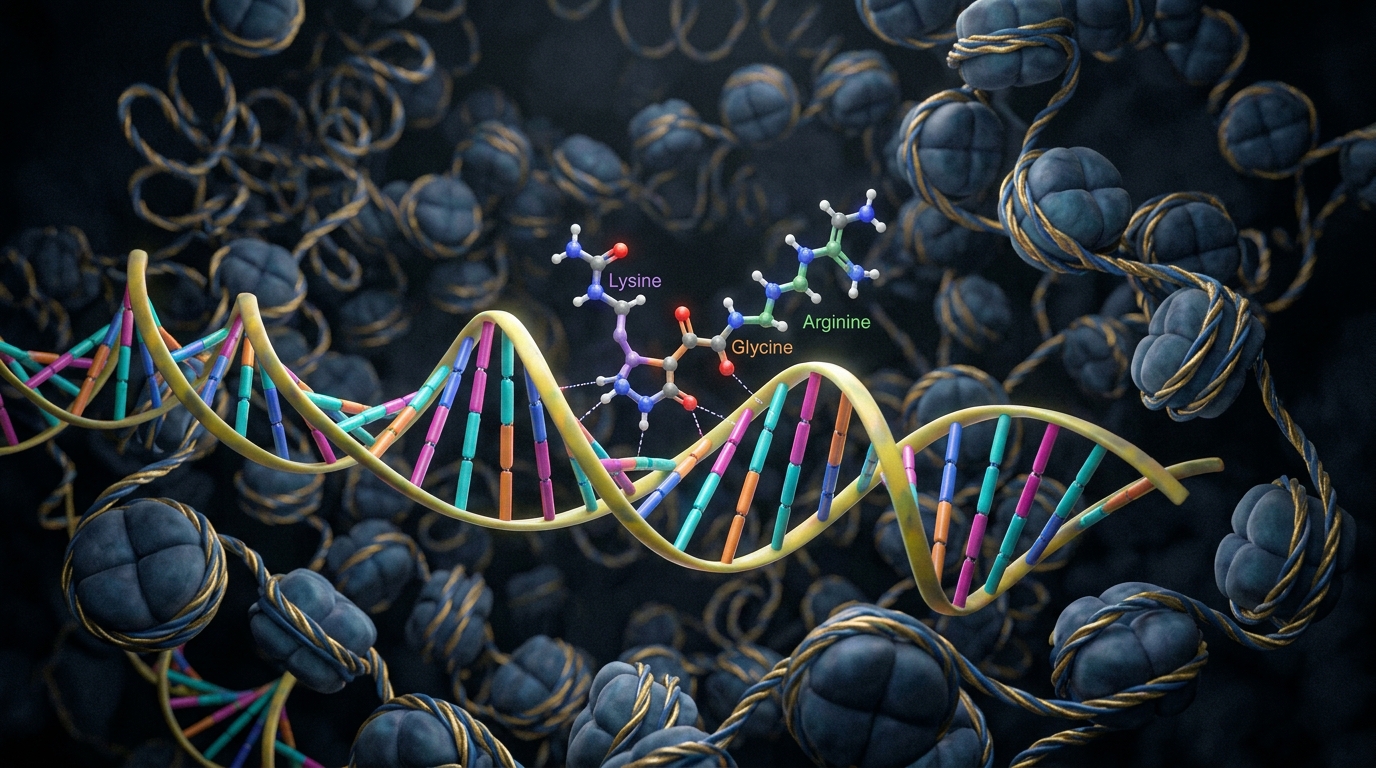
Biophysical and molecular modeling studies suggest that the charged residues within the Glu-Asp-Arg sequence create a specific electrostatic profile. In silico simulations and in vitro binding assays indicate that Pinealon may interact directly with specific nucleotide sequences in the major and minor grooves of DNA, as well as with core histone proteins (such as H1, H2B, H3, and H4). Researchers hypothesize that these interactions alter chromatin accessibility, either facilitating or repressing the binding of transcription factors to targeted promoter and enhancer elements.
Transcriptional Targets and Cellular Signaling
Preclinical reviews by Khavinson et al. (2020) describe several signaling cascades and genes reportedly modulated by EDR exposure in neuronal cultures:
- Antioxidant Defenses: Upregulation of mRNA and protein expression for endogenous antioxidant enzymes, including manganese superoxide dismutase (SOD2) and glutathione peroxidase 1 (GPX1).
- Apoptosis Pathways: Modulation of apoptotic signaling, characterized by decreased expression of pro-apoptotic factors such as p53 and cleaved caspase-3 under cellular stress conditions.
- Mitogen-Activated Protein Kinase (MAPK) Signaling: Modulation of the ERK1/2 pathway, which participates in neuronal survival, plasticity, and differentiation.
- Neurotransmitter Synthesis: Reports by Khavinson et al. (2014) indicate that EDR may stimulate the expression of tryptophan hydroxylase, the rate-limiting enzyme in serotonin biosynthesis, in cultured cortical neurons.
Preclinical Evidence Review
The published literature on Pinealon consists almost exclusively of laboratory cell assays and rodent disease models. While these studies provide mechanistic hypotheses, they represent early exploratory science rather than clinical validation.
In Vitro Cell Viability and Oxidative Stress
In primary rat cerebellar granule cells and PC12 cell lines, Khavinson and colleagues (2011) investigated the cytoprotective effects of Pinealon against chemical-induced oxidative stress. When cells were exposed to hydrogen peroxide or ouabain, pre-treatment with Pinealon was associated with suppressed steady-state levels of reactive oxygen species and increased overall cell viability. The authors noted that this effect involved both direct biochemical modulation of free-radical generation and downstream activation of cell-survival signaling.
Hypoxia and Ischemic Injury Models
Animal models evaluating antihypoxic properties report that short peptides, including EDR, can influence physiological tolerance to oxygen deprivation. In studies of hypobaric hypoxia, rodent administration of Pinealon was associated with preserved adenosine triphosphate (ATP) levels and stabilized enzymatic antioxidant defenses in brain tissue (Kozina, 2008). Similarly, in models of acute cerebral ischemia induced by bilateral carotid artery occlusion in aged rats, researchers observed reductions in cerebral caspase-3 activation and partial normalization of exploratory behavior.
Neurodevelopmental and Neurodegenerative Disease Models
In an animal model of prenatal hyperhomocysteinemia—a condition that induces oxidative stress and impaired central nervous system development in offspring—maternal administration of Pinealon was reported to attenuate brain lipid peroxidation and preserve motor coordination in the resulting pups (Arutjunyan et al., 2012). Additionally, in murine in vitro models of Alzheimer's disease pathology, EDR application was associated with the preservation of dendritic spine density on hippocampal neurons, counteracting the structural elimination typically induced by amyloid beta exposure.
Critical Research Limitations and Evidence Gaps
Despite intriguing laboratory findings, evaluation of the Pinealon literature reveals substantial methodological and translational limitations that prevent broad scientific consensus.
- Geographic and Institutional Concentration: The overwhelming majority of peer-reviewed articles evaluating Pinealon originate from a single research network based in Saint Petersburg, Russia. Independent replication across diverse international laboratories is exceptionally sparse.
- Absence of Methodological Rigor in Translation: Standardized pharmacokinetics, bio-distribution profiles, systemic half-life measurements, and comprehensive toxicology dossiers meeting International Council for Harmonisation (ICH) guidelines have not been published in mainstream biomedical literature.
- Lack of Controlled Clinical Trials: There are no published Phase 1, Phase 2, or Phase 3 randomized, double-blind, placebo-controlled trials investigating Pinealon in human clinical cohorts registered on clinical trial registries like ClinicalTrials.gov. Claims regarding cognitive enhancement or clinical neuroprotection in humans remain unverified.
- Translational Disconnect: Direct peptide-DNA interaction observed in cell-free or cell-culture assays cannot be assumed to function identically in intact living organisms, where enzymatic cleavage, physiological barriers, and renal clearance significantly affect peptide stability.
Regulatory Status and Safety Considerations
Pinealon is not approved by the U.S. FDA, the EMA, or other global health regulatory agencies for the prevention, diagnosis, or treatment of any medical condition. It is categorized strictly as an investigational research compound intended for in vitro and laboratory experimental use.
Because clinical safety and pharmacokinetic data in human subjects are lacking, long-term toxicological risks, optimal biological exposures, potential off-target genomic disruptions, and drug interactions remain unknown. Unregulated personal administration presents unpredictable risks due to the absence of clinical-grade manufacturing standards, verification of sterility, and standardized purity testing across non-pharmaceutical distribution channels.
Frequently Asked Questions
Is Pinealon approved for medical use?
No. Pinealon is not approved by the FDA, EMA, or any major regulatory authority for any medical indication. It remains an experimental research peptide.
How does Pinealon differ from Epitalon?
While both are synthetic short peptides developed within the same bioregulator research framework, their primary structures and target hypotheses differ. Pinealon is a tripeptide (Glu-Asp-Arg) focused on cortical and neuronal gene expression models, whereas Epitalon is a tetrapeptide (Ala-Glu-Asp-Gly) primarily studied for pineal activity and telomerase-related pathways.
Can laboratory gene-expression findings be applied to human health?
No. In vitro findings demonstrating changes in mRNA levels or histone binding cannot be extrapolated to human efficacy or safety. Robust, multi-phase clinical trials are necessary to determine whether these cellular effects translate in vivo.
What are the primary safety concerns regarding Pinealon?
The primary concern is the complete absence of rigorous, Western-standard Phase 1 safety trials and published toxicology profiles in humans. Long-term impacts on genomic regulation, tissue distribution, and organ-specific clearance are largely uncharacterized.
Research Summary
Pinealon (Glu-Asp-Arg) is an ultrashort synthetic tripeptide investigated for its potential role in epigenetic regulation, antioxidant enzyme induction, and neuroprotection under hypoxic and oxidative stress. To date, published evidence is confined almost entirely to preclinical laboratory assays and rodent disease models conducted within a specific research network. There is no rigorous human clinical trial evidence supporting its therapeutic efficacy or establishing its clinical safety profile. Pinealon remains an unapproved research compound without regulatory clearance for human use.
References
- Arutjunyan A, Kozina L, Stvolinskiy S, Bulygina Y, Mashkina A, Khavinson V. Pinealon protects the rat offspring from prenatal hyperhomocysteinemia. Int J Clin Exp Med. 2012;5(2):179-185. PMID: 22567179.
- Khavinson V, Linkova N, Kozhevnikova E, Trofimova S. EDR Peptide: Possible Mechanism of Gene Expression and Protein Synthesis Regulation Involved in the Pathogenesis of Alzheimer's Disease. Molecules. 2020;26(1):159. PMID: 33396470.
- Khavinson V, Ribakova Y, Kulebiakin K, Vladychenskaya E, Kozina L, Arutjunyan A, Boldyrev A. Pinealon increases cell viability by suppression of free radical levels and activating proliferative processes. Rejuvenation Res. 2011;14(5):535-541. PMID: 21978084.
- Khavinson VKh, Lin'kova NS, Tarnovskaya SI, Umnov RS, Elashkina EV, Durnova AO. Short peptides stimulate serotonin expression in cells of brain cortex. Bull Exp Biol Med. 2014;157(1):77-80. PMID: 24909721.
- Kozina LS. Investigation of antihypoxic properties of short peptides. Adv Gerontol. 2008;21(1):61-67. PMID: 18546825.