Key Takeaways
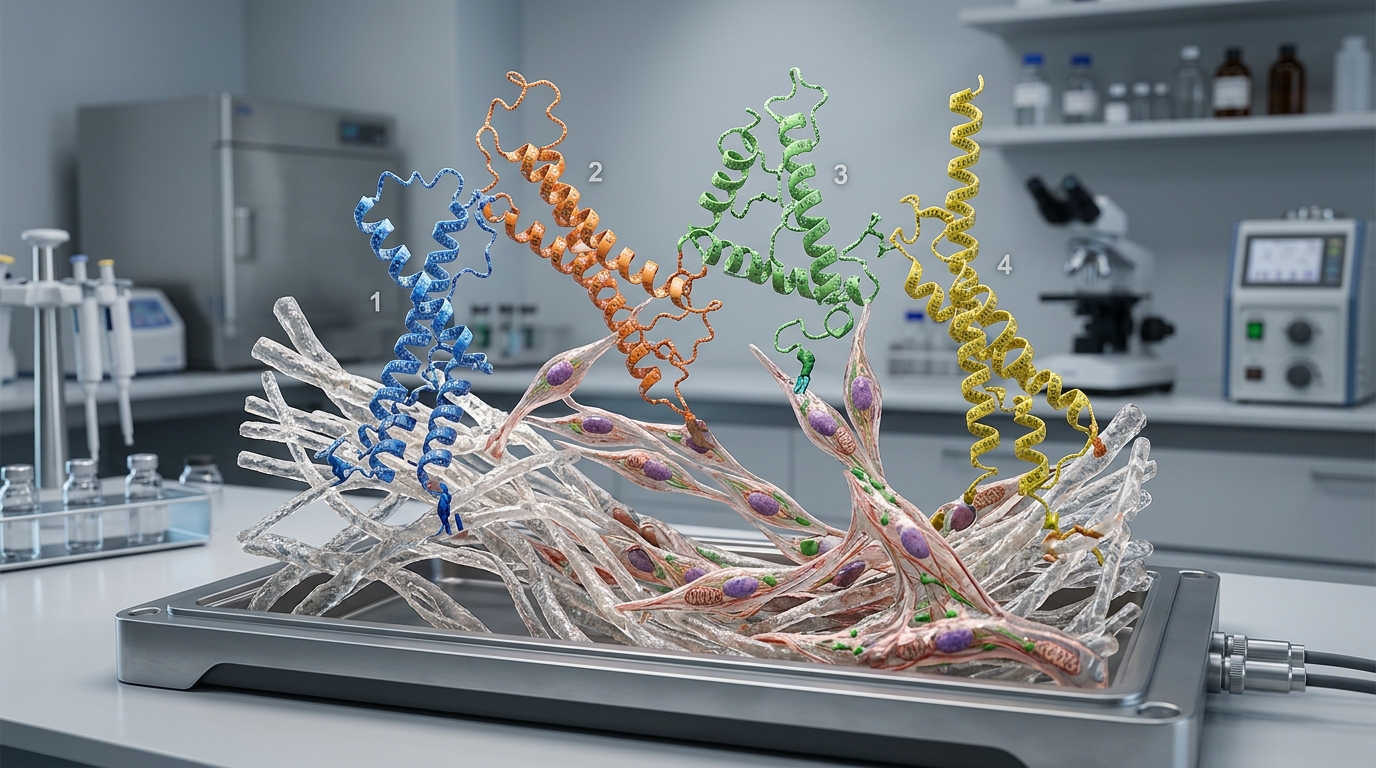
- The KLOW peptide stack is an investigational combination of four distinct synthetic and endogenous peptide derivatives: GHK-Cu, BPC-157, TB-500 (Thymosin beta-4 active domain), and KPV.
- The theoretical rationale behind the stack involves multi-pathway synergy across distinct phases of tissue repair: inflammatory resolution (KPV), angiogenic and structural signaling (BPC-157), cell migration and actin remodeling (TB-500), and extracellular matrix remodeling (GHK-Cu).
- While individual peptides in the formulation possess published preclinical literature in wound healing, tendon repair, and inflammatory models, virtually no peer-reviewed data exist examining the four compounds co-administered as a fixed blend.
- None of the peptides in the KLOW stack have received approval from the U.S. Food and Drug Administration (FDA) for systemic musculoskeletal regeneration or general tissue healing.
What Is the KLOW Peptide Stack?
In regenerative biology and experimental pharmacology, researchers frequently study multi-target interventions to address complex biological processes. The KLOW peptide stack is a co-formulated research blend consisting of four bioactive peptide sequences:
- KPV (Lys-Pro-Val): A tripeptide corresponding to the C-terminal sequence (amino acids 11–13) of alpha-melanocyte-stimulating hormone (α-MSH).
- GHK-Cu (Glycyl-L-Histidyl-L-Lysine copper complex): A naturally occurring tripeptide found in human plasma that coordinates a divalent copper ion (Cu2+).
- BPC-157 (Body Protection Compound-157): A 15-amino-acid synthetic pentadecapeptide derived from a native protein sequence isolated from human gastric juice.
- TB-500: A synthetic fragment containing the active actin-sequestering domain of the endogenous polypeptide Thymosin beta-4 (Tβ4).
The combination is typically configured in laboratory research vials where GHK-Cu represents the largest single proportion by mass, with KPV, BPC-157, and TB-500 comprising the remainder. The presence of the copper ion in GHK-Cu gives the reconstituted solution a characteristic light blue appearance.
The Multi-Pathway Synergy Hypothesis
Wound repair and musculoskeletal recovery proceed through four closely coordinated, overlapping biological phases: hemostasis, inflammation, proliferation (angiogenesis, fibroplasia, and granulation tissue formation), and remodeling. In single-agent research, targeting one step often leaves upstream inflammation unaddressed or downstream matrix organization incomplete. The KLOW formulation is structured around a multi-pathway synergy hypothesis, aiming to engage each biological phase through dedicated molecular signals.
Individual Peptide Mechanisms in Tissue Repair
1. KPV: Targeted Inflammatory Modulation
Uncontrolled inflammation delays matrix deposition and prolongs tissue degradation. Preclinical research indicates that KPV acts intracellularly via the oligopeptide transporter PepT1. Once transported into epithelial and immune cells, KPV inhibits the activation of nuclear factor kappa B (NF-κB) and mitogen-activated protein kinase (MAPK) pathways. By blocking NF-κB nuclear translocation, KPV reduces the gene expression and secretion of pro-inflammatory cytokines such as TNF-α, IL-1β, and IL-6 without triggering the broad immunosuppression typical of corticosteroids.
2. BPC-157: Angiogenesis and Tenocyte Survival
Vascular perfusion is essential for delivering oxygen and nutrients to repairing tissue. Body Protection Compound-157 is widely studied for its cytoprotective and angiogenic actions. In vitro and animal studies show that BPC-157 upregulates vascular endothelial growth factor receptor 2 (VEGFR2) expression, promoting endothelial cell migration and capillary tube formation. Furthermore, in musculoskeletal models involving transected Achilles tendons and collateral ligaments, BPC-157 enhances focal adhesion kinase (FAK) and paxillin phosphorylation, promoting fibroblast outgrowth and biomechanical recovery.
3. TB-500: Actin Dynamics and Cellular Migration
TB-500 incorporates the central G-actin-binding sequence of Thymosin beta-4. By sequestering monomeric actin, TB-500 regulates cytoskeletal dynamics necessary for cell motility. During early tissue repair, endothelial cells, dermal fibroblasts, and keratinocytes must migrate rapidly across the provisional fibrin matrix. Preclinical models demonstrate that Thymosin beta-4 derivatives facilitate this recruitment, downregulate collagen deposition during early repair to limit scar stiffness, and support microvascular sprouting.
4. GHK-Cu: Extracellular Matrix Remodeling
The final phase of healing requires mature collagen synthesis and remodeling of the extracellular matrix (ECM). Published gene profiling and biochemical investigations show that GHK-Cu modulates the expression of thousands of genes involved in tissue regeneration. GHK-Cu delivers essential copper cofactors to lysyl oxidase, an enzyme indispensable for the covalent cross-linking of collagen and elastin fibers. It concurrently regulates matrix metalloproteinases (MMPs) and tissue inhibitors of metalloproteinases (TIMPs), helping restore architectural balance to connective tissues.
Evidence Analysis: Isolated Peptides vs. The Combined Stack
When evaluating the scientific foundation of the KLOW peptide stack, a sharp distinction must be drawn between the data on its isolated constituent peptides and data on the multi-compound blend:
- Strong Preclinical Evidence for Single Agents: In vitro and rodent models provide solid documentation for BPC-157’s gastrointestinal and tendon healing, GHK-Cu’s fibroblast stimulation, KPV’s anti-colitic effects, and Thymosin beta-4’s cell migration dynamics.
- Absence of Combination Pharmacokinetics: There are no published peer-reviewed studies detailing pharmacokinetic, pharmacodynamic, or toxicological interactions when these four peptides are administered simultaneously. It is currently unknown whether competitive degradation, receptor cross-talk, or altered clearance occurs.
- Minimal Human Clinical Validation: The majority of published literature on BPC-157 and KPV consists of laboratory and animal studies. Human clinical trials for BPC-157 and KPV are scarce or exploratory, while systemic GHK-Cu and TB-500 data in healthy volunteers or athletes remain minimal.
Critical Research Limitations and Safety Uncertainties
The translation of multi-peptide protocols from cell culture dishes to in vivo biological systems involves significant biological and pharmacological challenges:
- Pro-Angiogenic Considerations: Both BPC-157 and TB-500 activate pro-angiogenic cascades (such as VEGFR2 upregulation). While beneficial in ischemic wounds, persistent neo-angiogenesis is theoretically concerning in contexts of occult neoplastic lesions or proliferative retinopathies.
- Copper Homeostasis: Systemic administration of GHK-Cu introduces exogenous copper. In sustained or unmonitored regimens, imbalances in free copper levels or alterations in trace mineral metabolism (e.g., zinc-to-copper ratios) require further safety profiling.
- Lack of Standardized Dosing: Because no Phase II or Phase III multi-center clinical trials exist for the KLOW combination, reported dosages in non-academic literature are purely empirical and lack formal therapeutic window validation.
Regulatory Status
The individual compounds and the combined KLOW blend are not approved by the FDA or the European Medicines Agency (EMA) for medical treatment or systemic tissue healing. Under federal and international regulatory frameworks, these molecules are classified as investigational research chemicals restricted to in vitro and experimental animal research. Furthermore, Thymosin beta-4 and BPC-157 appear on the World Anti-Doping Agency (WADA) Prohibited List under class S2 (Peptide Hormones, Growth Factors, Related Substances, and Mimetics), banning their use by competitive athletes at all times.
Frequently Asked Questions
How does the KLOW stack differ from the GLOW peptide stack?
The GLOW stack combines three peptides: GHK-Cu, BPC-157, and TB-500. The KLOW stack incorporates KPV (Lys-Pro-Val) as a fourth constituent, adding an intentional anti-inflammatory and NF-κB-modulating axis to the regenerative and angiogenic profile of the original formulation.
Has the KLOW combination undergone controlled human clinical trials?
No. There are no published, peer-reviewed, randomized controlled clinical trials investigating the efficacy, pharmacokinetics, or safety of the four-peptide KLOW combination in humans.
What is the cellular transporter responsible for KPV cellular uptake?
KPV is absorbed and transported across cell membranes primarily via the solute carrier transporter PepT1 (SLC15A1), which is expressed in intestinal epithelial cells, colonocytes, and certain immune cell lineages.
Why is GHK-Cu included in tissue repair formulations?
GHK-Cu serves as a copper carrier peptide that stimulates collagen and elastin synthesis, acts as a cofactor for lysyl oxidase cross-linking, and modulates matrix metalloproteinase activity during the late remodeling phase of wound healing.
Research Summary
The KLOW peptide stack represents a mechanistically coherent theoretical model for multi-phase tissue regeneration, coupling the anti-inflammatory properties of KPV, the angiogenic and cytoprotective signals of BPC-157, the cell-motility actions of TB-500, and the extracellular matrix remodeling capacity of GHK-Cu. However, current scientific evidence is almost entirely preclinical and limited to studies of individual agents. Comprehensive pharmacokinetic investigations, toxicity assays, and controlled clinical trials on the co-formulated stack are required before its safety and therapeutic efficacy can be established in human medicine.
References
- Dalmasso, G., et al. (2008). PepT1-mediated tripeptide KPV uptake reduces intestinal inflammation. Gastroenterology, 134(1), 166–178. https://www.ncbi.nlm.nih.gov/pmc/articles/PMC2431115/
- Hsieh, M. J., et al. (2017). Therapeutic potential of pro-angiogenic BPC157 is associated with VEGFR2 activation and up-regulation. Journal of Molecular Medicine, 95(3), 323–333. https://pubmed.ncbi.nlm.nih.gov/27988358/
- Pickart, L., & Margolina, A. (2018). Regenerative and Protective Actions of the GHK-Cu Peptide in the Light of the New Gene Data. International Journal of Molecular Sciences, 19(7), 1987. https://www.ncbi.nlm.nih.gov/pmc/articles/PMC6073405/
- Chang, C. H., et al. (2011). The promoting effect of pentadecapeptide BPC 157 on tendon healing involves tendon outgrowth, cell survival, and cell migration. Journal of Applied Physiology, 110(3), 774–780. https://pubmed.ncbi.nlm.nih.gov/21030672/
- Philp, D., & Kleinman, H. K. (2010). Animal studies with thymosin beta4, a multifunctional tissue repair and regeneration peptide. Annals of the New York Academy of Sciences, 1194, 81–86. https://pubmed.ncbi.nlm.nih.gov/20536453/