Key Takeaways
- Pharmacological Class: Cagrilintide is a long-acting dual amylin and calcitonin receptor agonist (DACRA) engineered with a fatty diacid side chain to enable once-weekly subcutaneous dosing.
- Receptor Architecture: It activates both the calcitonin receptor (CTR) alone and heterodimeric amylin receptor complexes formed by CTR coupled with receptor activity-modifying proteins (RAMP1, RAMP2, and RAMP3).
- Primary Central Pathways: The peptide targets circumventricular structures lacking a complete blood-brain barrier—specifically the area postrema and the nucleus of the solitary tract (NTS)—to trigger satiety circuits.
- Physiological Effects: Agonism of these receptors promotes satiety, delays gastric transit, and reduces meal-stimulated glucagon release without directly stimulating insulin secretion.
- Investigational Status: Cagrilintide is an investigational compound undergoing Phase 2 and Phase 3 clinical evaluation and is not approved by the U.S. Food and Drug Administration (FDA) as a standalone monotherapy.
What Is Cagrilintide?
Cagrilintide is a synthetic peptide analog derived from human amylin (also known as islet amyloid polypeptide, or IAPP). In human physiology, native amylin is a 37-amino-acid neuroendocrine peptide co-secreted with insulin from pancreatic beta cells in response to nutrient ingestion. While native amylin plays a physiological role in satiety signaling, postprandial glucagon suppression, and the regulation of gastric motility, its therapeutic utility has historically been limited by a very short circulating half-life (a few minutes) and an intrinsic propensity to aggregate into insoluble amyloid fibrils.
To overcome these biochemical constraints, cagrilintide was engineered with specific amino acid substitutions and a C20 fatty diacid moiety attached via a hydrophilic spacer. This lipophilic modification enables non-covalent, reversible binding to circulating serum albumin, which shields the molecule from rapid renal filtration and enzymatic proteolysis. As a result, cagrilintide demonstrates an elimination half-life of approximately 7 to 8 days in human pharmacokinetic studies, permitting once-weekly administration. Functionally, cagrilintide is classified as a dual amylin and calcitonin receptor agonist (DACRA) because it exerts potent biological activity at both calcitonin receptors and composite amylin receptors.
Receptor Architecture and Molecular Pharmacology
To understand the pharmacodynamics of cagrilintide, one must examine the atypical structural biochemistry of the calcitonin peptide receptor family. Unlike classic peptide receptors that function as single, invariant polypeptide units, amylin receptors are heterodimeric complexes.
The CTR and RAMP Receptor Complexes
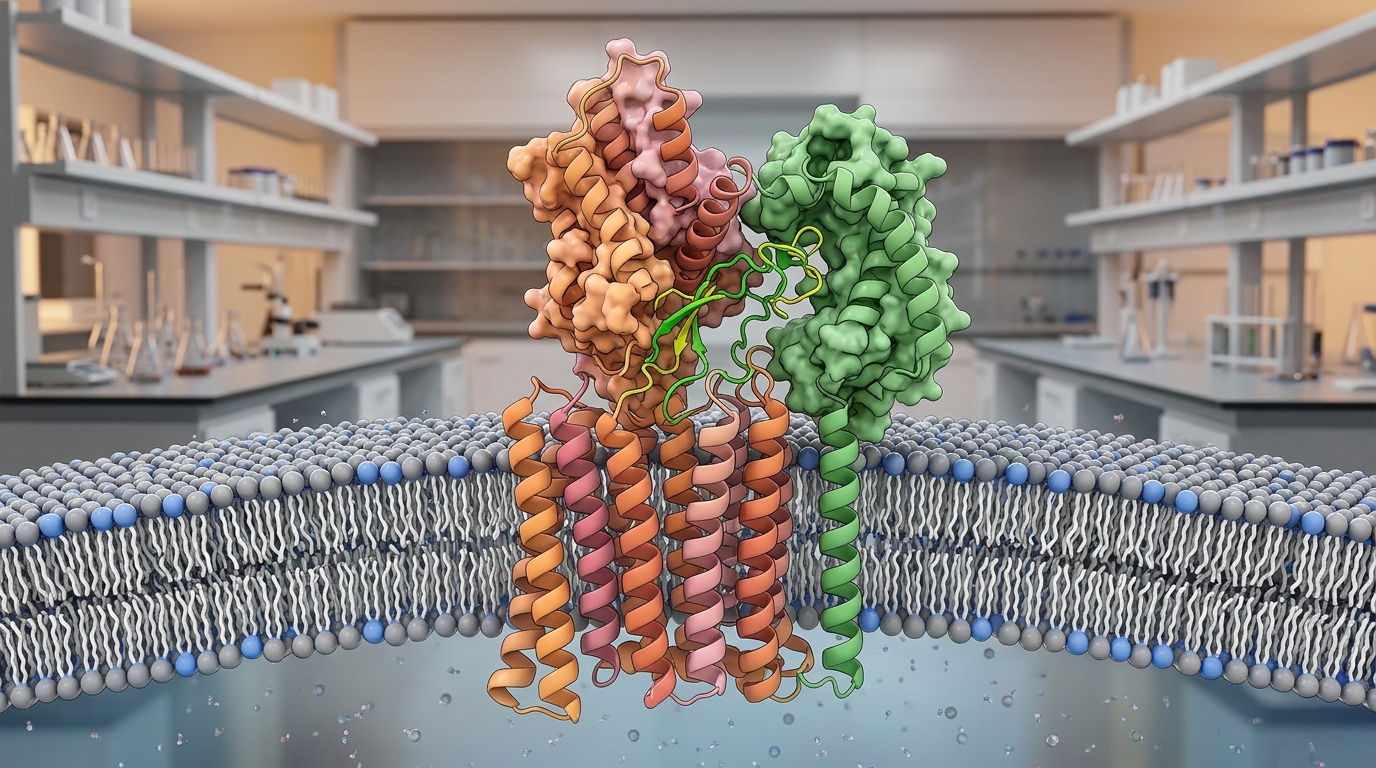
The core signaling unit of this system is the calcitonin receptor (CTR), a Class B G-protein-coupled receptor (GPCR). When expressed alone on the cell surface, CTR binds calcitonin with high affinity. However, when CTR associates with single-transmembrane accessory proteins termed receptor activity-modifying proteins (RAMP1, RAMP2, or RAMP3), its ligand-binding pocket undergoes conformational remodeling to generate distinct functional amylin receptor subtypes:
- AMY1: Formed by the heterodimerization of CTR and RAMP1.
- AMY2: Formed by the heterodimerization of CTR and RAMP2.
- AMY3: Formed by the heterodimerization of CTR and RAMP3.
Cagrilintide behaves as a non-selective, high-affinity agonist across CTR, AMY1, AMY2, and AMY3. Cryogenic electron microscopy (cryo-EM) and pharmacological characterizations show that cagrilintide engages the extracellular domain and transmembrane core of these complexes, stabilizing an active conformation coupled to the Gs heterotrimeric protein. This activation stimulates adenylyl cyclase, driving downstream intracellular accumulation of cyclic adenosine monophosphate (cAMP) and activating protein kinase A (PKA) signaling cascades.
Central Satiety Pathways and Neurobiology
The primary therapeutic interest in dual amylin and calcitonin receptor agonism stems from its actions within the central nervous system (CNS). Cagrilintide accesses metabolic control centers via specialized brain regions that lack an impermeable blood-brain barrier.
Circumventricular Targeting in the Hindbrain
The principal site of cagrilintide binding is the area postrema, a circumventricular organ situated in the dorsal medulla. Because fenestrated capillaries in the area postrema allow large peptides to exit the systemic circulation, cagrilintide directly engages AMY1, AMY3, and CTR complexes densely expressed on local neuronal populations.
Activation of these area postrema neurons initiates excitatory signaling that projects into the adjacent nucleus of the solitary tract (NTS) and the lateral parabrachial nucleus (lPBN). From the hindbrain, these signals project forward to key hypothalamic feeding networks, including the arcuate nucleus (ARC) and the ventromedial hypothalamus. This trans-synaptic cascade enhances anorexigenic pro-opiomelanocortin (POMC) tone, inhibits orexigenic neuropeptide Y/agouti-related peptide (NPY/AgRP) signaling, and reinforces homeostatic meal termination.
Peripheral and Gastrointestinal Effects
In addition to central satiety signaling, DACRA pharmacology modulates peripheral metabolic physiology through multiple coordinated mechanisms:
- Gastric Motility: Cagrilintide vagally and locally attenuates the rate of gastric emptying, thereby reducing the rate of postprandial glucose entry into the duodenum.
- Glucagon Dynamics: It suppresses inappropriate postprandial hyperglucagonemia from pancreatic alpha cells without causing direct beta-cell exhaustion or hypoglycemia.
- Energy Expenditure: Preclinical models suggest that sustained amylin and calcitonin receptor stimulation may preserve resting metabolic rate during caloric restriction relative to dietary restriction alone.
Clinical Evidence and Research Findings
The biological activity of cagrilintide has been evaluated in randomized controlled trials exploring both monotherapy and co-administration strategies.
Phase 2 Monotherapy Evidence
A landmark 26-week, multicenter, randomized, double-blind, placebo-controlled Phase 2 trial published by Lau et al. (2021) in The Lancet evaluated cagrilintide monotherapy in 706 adults with overweight or obesity without diabetes. Participants received once-weekly subcutaneous cagrilintide at doses ranging from 0.3 mg to 4.5 mg, once-daily liraglutide (3.0 mg), or volume-matched placebo.
At week 26, participants receiving cagrilintide experienced significant, dose-dependent reductions in mean body weight ranging from 6.0% (at 0.3 mg) to 10.8% (at 4.5 mg), compared with 3.0% in the placebo cohort. Weight reductions at the highest evaluated doses (4.5 mg) numerically exceeded the reduction observed with active-comparator liraglutide (9.0%).
Combination Strategies (CagriSema)
Because amylin receptor signaling functions through non-incretin neurobiological pathways distinct from glucagon-like peptide-1 (GLP-1) receptors, researchers have investigated the additive effects of combining cagrilintide with GLP-1 receptor agonists such as semaglutide. In Phase 2 and ongoing Phase 3 clinical investigations (the REDEFINE trial program), co-formulated cagrilintide and semaglutide (CagriSema) demonstrated substantial metabolic improvements and greater total weight reduction than either agent administered alone, confirming mechanistic complementarity between incretin and amylin pathways.
Safety Findings and Research Limitations
The safety profile of cagrilintide is consistent with the pharmacological class of gut-brain axis peptides. The most commonly reported adverse events in clinical trials involve the gastrointestinal system, including nausea, vomiting, diarrhea, and constipation. These effects are predominantly mild to moderate, occur primarily during dose-escalation phases, and diminish over time.
Current Evidence Gaps
- Long-Term Standalone Outcomes: Most late-stage clinical development is currently directed toward the CagriSema combination rather than cagrilintide monotherapy, leaving fewer multi-year monotherapy outcome datasets.
- Receptor Selectivity Nuances: While dual AMY/CTR activation delivers robust appetite suppression, research continues into whether pure AMY1-selective or balanced DACRA molecules offer better gastrointestinal tolerability profiles.
- Investigational Status: Cagrilintide is not approved by the FDA or international regulatory bodies as an independent prescription medication. It remains an investigational chemical subject to clinical trial protocols.
Frequently Asked Questions
How does cagrilintide differ from pramlintide?
Pramlintide is a first-generation human amylin analog approved for use at mealtimes in diabetes. It has a short half-life requiring multiple daily injections before meals and lacks fatty acid acylation. Cagrilintide is engineered with a C20 diacid chain that binds albumin, providing a half-life of roughly 7 days for once-weekly administration.
Why does cagrilintide target both amylin and calcitonin receptors?
Native amylin receptors are formed by the calcitonin receptor (CTR) core bound to RAMP proteins. Because of the high structural homology among CTR-based complexes, cagrilintide acts as a dual agonist (DACRA), engaging both uncomplexed CTR and RAMP-CTR heterodimers to trigger central satiety signaling.
Is cagrilintide an incretin hormone?
No. Incretins (such as GLP-1 and GIP) are gut-derived peptide hormones that stimulate nutrient-dependent insulin secretion from pancreatic beta cells. Amylin is a neuroendocrine hormone co-secreted with insulin from the pancreas, and cagrilintide acts on central appetite circuits and gastric motility rather than enhancing insulin release.
Research Summary
Cagrilintide represents a significant advance in metabolic peptide research, demonstrating how molecular engineering can overcome native amylin instability and rapid clearance. By functioning as a long-acting dual amylin and calcitonin receptor agonist (DACRA), it stimulates hindbrain satiety networks, slows gastric emptying, and suppresses glucagon secretion. Controlled clinical trials, including Phase 2 monotherapy and Phase 3 combination studies, demonstrate substantial, dose-dependent metabolic efficacy with a safety profile characterized primarily by transient gastrointestinal symptoms. Cagrilintide remains an investigational agent under active clinical evaluation.
References
- Lau DCW, Erichsen L, Francisco AM, et al. Once-weekly cagrilintide for weight management in people with overweight and obesity: a multicentre, randomised, double-blind, placebo-controlled and active-controlled, dose-finding phase 2 trial. The Lancet. 2021;398(10317):2160-2172.
- Le Foll C, Coester B, Ludwig MQ, et al. Cagrilintide lowers bodyweight through brain amylin receptors 1 and 3. EBioMedicine. 2025;105836.
- Kruse T, Hansen JL, Dahl K, et al. Development of Cagrilintide, a Long-Acting Amylin Analogue. Journal of Medicinal Chemistry. 2021;64(15):11183-11194.
- Gydesen S, Andreassen KV, Hjuler ST, et al. Mono and dual agonists of the amylin, calcitonin, and CGRP receptors and their potential in metabolic diseases. Molecular Metabolism. 2021;46:101152.