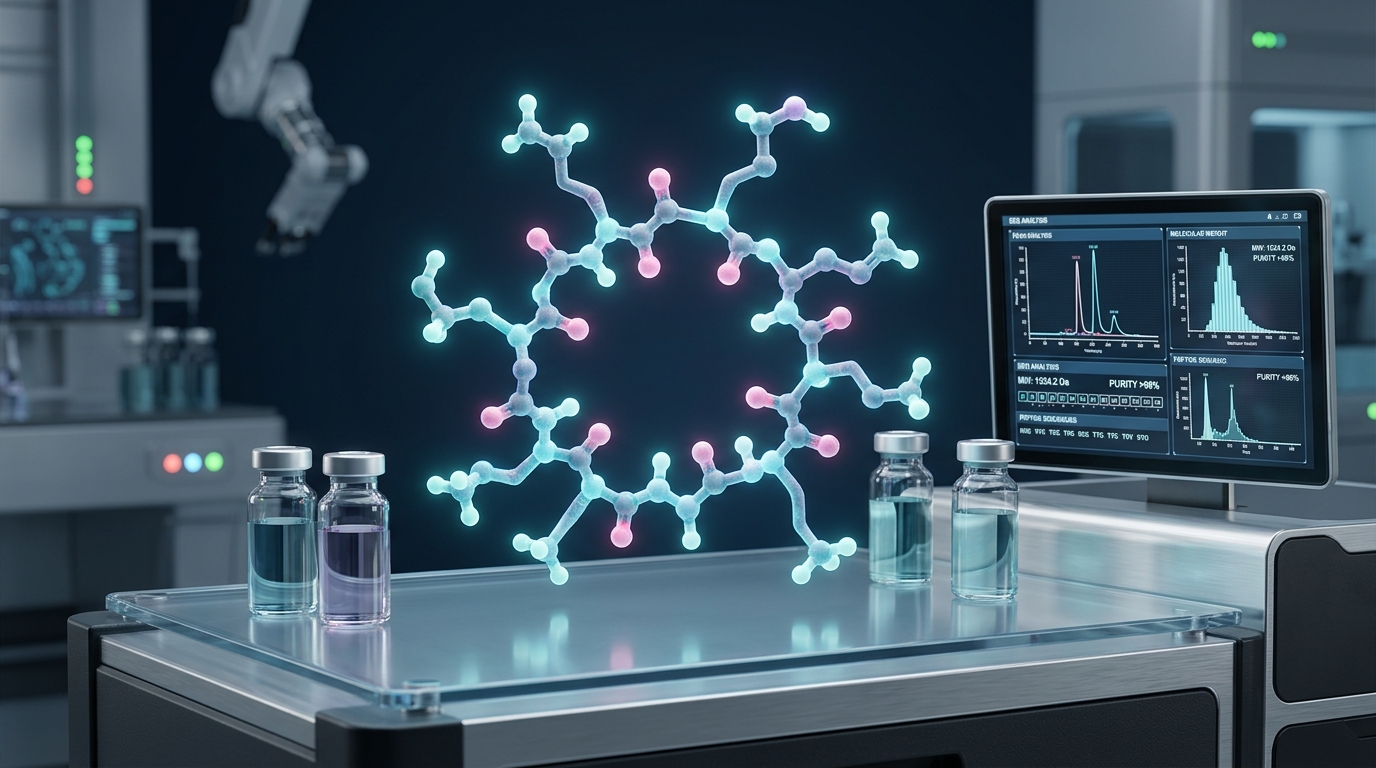
Main Conclusion: PT-141 (Bremelanotide) is a synthetic cyclic heptapeptide that treats sexual dysfunction by directly modulating central melanocortin receptors in the brain rather than altering peripheral hemodynamics.
This conclusion is supported by three primary pillars of pharmacological and medical research:
- A distinct central nervous system mechanism: PT-141 acts primarily as an agonist at central melanocortin receptors (MC3R and MC4R) to influence neuromodulatory sexual response pathways.
- Robust human clinical validation: Rigorous Phase 3 trials have demonstrated its efficacy in treating hypoactive sexual desire disorder (HSDD) and refractory erectile dysfunction.
- A well-characterized pharmacokinetic and safety profile: Subcutaneous administration exhibits predictable absorption and clearance, accompanied by manageable, mechanism-specific adverse effects.
1. Distinct Central Mechanism via Melanocortin Receptor Agonism
Unlike phosphodiesterase type 5 (PDE5) inhibitors such as sildenafil, which operate locally via smooth muscle relaxation and nitric oxide upregulation in pelvic vasculature, PT-141 functions upstream within the central nervous system.
In-Vitro and Preclinical Binding Affinity
In-vitro evidence demonstrates that Bremelanotide (cyclo-[Nle4, Asp5, D-Phe7, Lys10]α-MSH-(4–10)) is an active synthetic metabolite of Melanotan II that selectively binds to melanocortin receptors with high affinity for MC1R, MC3R, and MC4R, while exhibiting negligible activity at MC2R (adrenocortical receptors).
Central Neuromodulation in Animal Models
Animal evidence shows that microinjection of PT-141 into the medial preoptic area (mPOA) and hypothalamus of rodent models triggers dopamine release. This dopaminergic surge directly stimulates sexual arousal, solicitous behavior, and non-contact erections, confirming that PT-141 initiates sexual desire and response through neural signaling rather than direct vascular dilation.
Theoretical Considerations
Scientific hypotheses propose that by activating MC4R-expressing hypothalamic neurons, PT-141 bypasses vascular or autonomic neuropathy barriers, potentially serving populations whose dysfunction originates from neuroaffective or psychogenic causes.
2. Human Clinical Trial Evidence and Validated Efficacy
The therapeutic utility of PT-141 has progressed through rigorous regulatory evaluation, establishing clear efficacy metrics across diverse patient cohorts.
Phase 3 Clinical Trials in Premenopausal Women
Human clinical evidence from the pivotal RECONNECT trials (two identical Phase 3, double-blind, placebo-controlled studies comprising over 1,200 premenopausal women) showed that a 1.75 mg subcutaneous dose of Bremelanotide produced statistically significant increases in sexual desire scores (measured via the Female Sexual Function Index) and meaningful reductions in distress related to sexual dysfunction (measured via the Female Sexual Distress Scale-DAO). These data led to FDA approval for generalized, acquired Hypoactive Sexual Desire Disorder (HSDD).
Clinical Evidence in Male Erectile Dysfunction (ED)
Human clinical evidence from randomized, placebo-controlled Phase 2 trials demonstrated that Bremelanotide induces statistically significant, dose-dependent increases in erectile rigidity and duration in men with both psychogenic and organic ED, including individuals who failed to achieve satisfactory responses with PDE5 inhibitors.
Anecdotal Claims vs. Clinical Reality
Anecdotal claims within research and wellness subcultures often frame PT-141 as an instantaneous or universally potent aphrodisiac for healthy individuals. Clinical observations indicate that while the peptide modulates natural sexual response pathways, it requires intact physiological context and contextual stimulation, operating as a modulator rather than an involuntary physical trigger.
3. Pharmacokinetic Profile and Tolerability Landscape
The clinical application of PT-141 is defined by rapid bioavailability and clear physiological parameters.
Human Pharmacokinetics
Human clinical evidence indicates that subcutaneous administration of PT-141 yields a peak plasma concentration ($T_{max}$) within approximately 60 minutes, with a mean elimination half-life ($t_{1/2}$) of 2.7 hours. Bioavailability is near 100% via the subcutaneous route, whereas intranasal administration—investigated in earlier trials—was discontinued due to unpredictable absorption rates and blood pressure variability.
Reported Adverse Effects
- Nausea: The most prevalent adverse effect identified in human clinical trials (~40% of participants in trials, often transient and mild-to-moderate).
- Hemodynamic Shifts: Transient increases in systolic and diastolic blood pressure (typically 2–4 mmHg lasting up to 12 hours post-dose), attributed to MC4R activation in autonomic control centers.
- Hyperpigmentation: Due to partial MC1R agonist activity, repeated daily administration has been associated in clinical studies with focal skin and mucosal hyperpigmentation, establishing the rationale for limiting dosing frequency to no more than once per 24 hours and at capped monthly intervals.