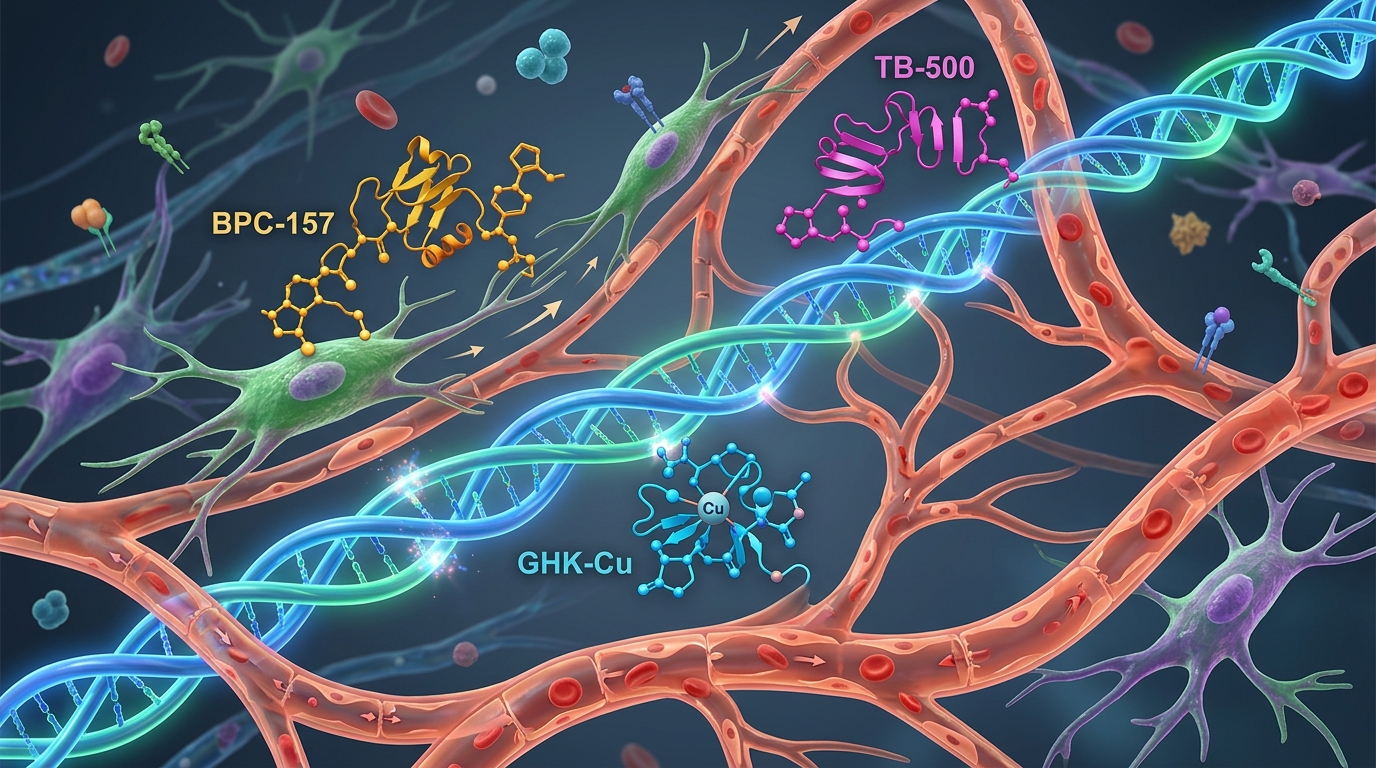
The GLOW peptide stack—a research combination of BPC-157, TB-500, and GHK-Cu—is designed to accelerate soft tissue repair, collagen synthesis, and systemic cellular regeneration through distinct yet complementary angiogenic, cytoskeletal, and gene-regulatory mechanisms, though current scientific validation is predominantly based on in-vitro and animal models rather than robust human clinical trials.
Three Primary Scientific Rationales for the GLOW Stack
Investigation into the GLOW formulation rests on three core structural pillars:
- Multi-Vector Angiogenesis and Microvascular Restoration: The triad stimulates endothelial cell proliferation, vessel outgrowth, and microcirculation via complementary growth factor cascades.
- Synchronized Cytoskeletal Motility and Extracellular Matrix (ECM) Remodeling: The compounds synergistically promote actin-mediated cell migration, fibroblast recruitment, and balanced collagen I/III deposition.
- Layered Cytoprotection and Inflammatory Modulation: The stack attenuates excessive pro-inflammatory cytokine expression while upregulating endogenous antioxidant enzymes and tissue survival factors.
Supporting Reason 1: Multi-Vector Angiogenesis and Microvascular Restoration
Tissue repair fundamentally requires rapid restoration of blood supply, a biological milestone targeted by all three components through distinct signaling axes.
Human Clinical Evidence
Direct human data for the combined GLOW stack is absent. For individual components, human evidence for BPC-157 and systemic TB-500 is currently nonexistent in peer-reviewed clinical registries. GHK-Cu has limited human skin biopsy evidence demonstrating improved capillary microcirculation and dermal blood perfusion following topical application.
Animal Evidence
In rodent models, BPC-157 (Body Protection Compound-157) consistently accelerates collateral vessel formation (early vascular occlusion rescue) and upregulates early growth response 1 (Egr-1) and vascular endothelial growth factor (VEGF). Similarly, Thymosin Beta-4 / TB-500 in murine ischemic injury models stimulates endothelial progenitor cell mobilization and vessel sprouting via the Akt pathway.
In-Vitro Evidence
GHK-Cu stimulates basic fibroblast growth factor (bFGF) and VEGF expression in human umbilical vein endothelial cells (HUVECs). In-vitro assays of BPC-157 show accelerated capillary tube formation in endothelial cultures.
Hypotheses and Anecdotal Claims
Researchers hypothesize that co-administration produces an exponential rather than additive angiogenic response. Anecdotal laboratory reports claim rapid recovery of vascular supply in localized soft tissue injuries.
Supporting Reason 2: Synchronized Cytoskeletal Motility and ECM Remodeling
Effective structural healing requires rapid cell migration to the wound site followed by organized synthesis and remodeling of structural proteins.
Human Clinical Evidence
Topical GHK-Cu is supported by multiple double-blind human clinical trials demonstrating increased procollagen synthesis, improved skin thickness, and enhanced extracellular matrix integrity. No comparative human trials exist for BPC-157 or TB-500 regarding ECM turnover.
Animal Evidence
In rat transection models (Achilles tendon, medial collateral ligament, and muscle crush), BPC-157 significantly accelerates functional load-bearing capacity and increases organized collagen type I deposition. TB-500 promotes cellular migration into wound beds in rat dermal punch and burn injury models by upregulating beta-actin polymerization.
In-Vitro Evidence
GHK-Cu directly modulates gene transcription of matrix metalloproteinases (MMPs) and their tissue inhibitors (TIMPs), preventing fibrosis while promoting structured matrix remodeling. TB-500 sequesters actin monomers, facilitating cellular locomotion in cultured human fibroblasts.
Hypotheses and Anecdotal Claims
It is hypothesized that combining TB-500 (cell transit acceleration) with GHK-Cu (gene expression of collagen and glycosaminoglycans) and BPC-157 (granulation tissue stability) eliminates rate-limiting steps in tendon-to-bone and dermal repair.
Supporting Reason 3: Layered Cytoprotection and Inflammatory Modulation
Uncontrolled inflammation delays tissue restoration and causes excessive scar formation; the GLOW stack introduces layered cytoprotective pathways that downregulate chronic inflammatory signaling.
Human Clinical Evidence
Human trials on GHK-Cu show reductions in inflammatory markers within aged and irradiated dermal tissue. Human data evaluating systemic anti-inflammatory markers for BPC-157 and TB-500 remain unpublished.
Animal Evidence
BPC-157 reduces tumor necrosis factor-alpha (TNF-α), interleukin-6 (IL-6), and inducible nitric oxide synthase (iNOS) levels across diverse animal models of colitis, peritonitis, and skeletal muscle trauma. TB-500 reduces systemic inflammatory infiltration and myocardial fibrosis in post-infarction rodent studies.
In-Vitro Evidence
GHK-Cu suppresses inflammatory cytokines and upregulates superoxide dismutase (SOD) activity in cultured fibroblasts exposed to oxidative stress. BPC-157 prevents hydrogen peroxide-induced cell death in tendon fibroblasts by preserving the FAK-paxillin pathway.
Hypotheses and Anecdotal Claims
Scientific hypotheses propose that the triad prevents hyper-catabolic tissue breakdown. Preclinical researcher anecdotes suggest reduced tissue soreness and accelerated local wound resolution, though controlled multi-arm validation is required.