Executive Summary: Core Conclusion
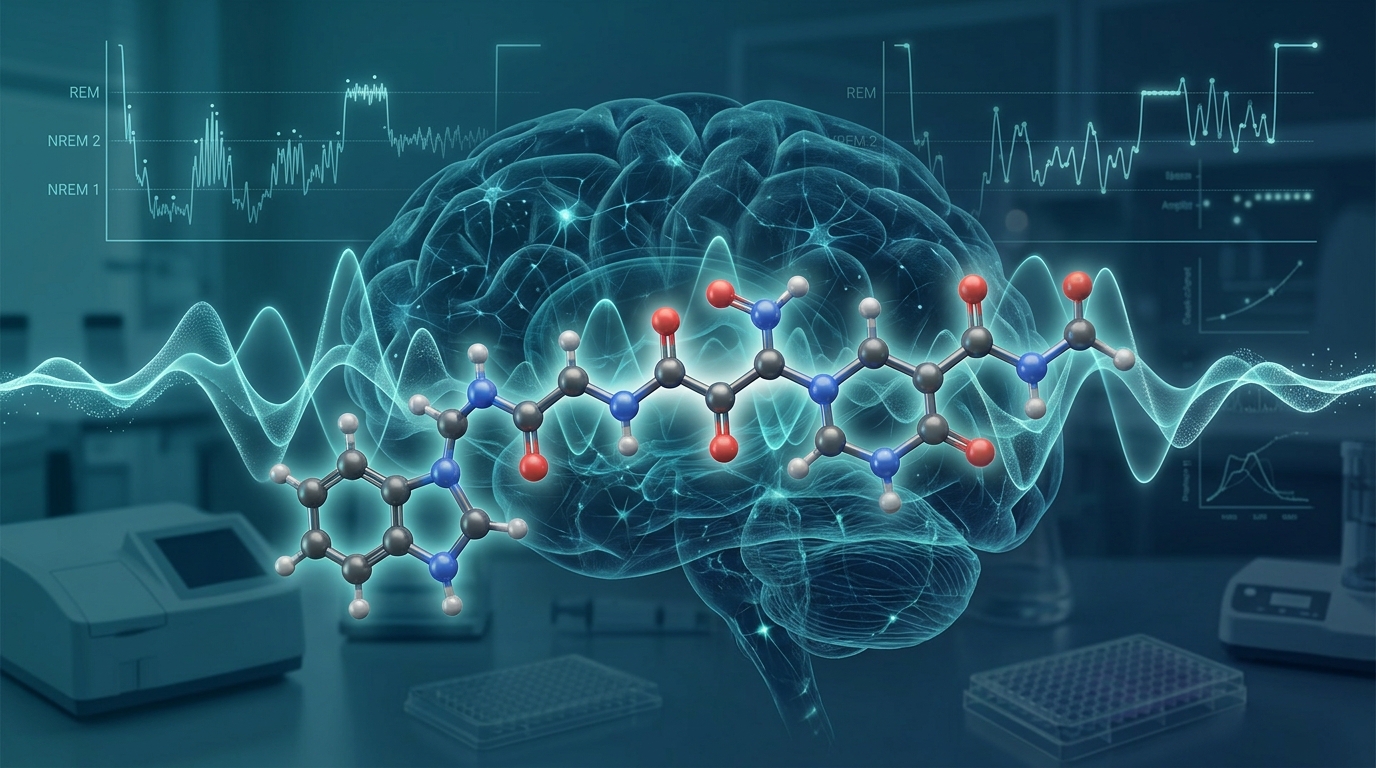
Delta Sleep-Inducing Peptide (DSIP) is an endogenous regulatory nonapeptide that functions primarily as an adaptive neuromodulator rather than a conventional sedative, capable of restoring slow-wave sleep architecture, attenuating pathological HPA-axis stress hyperactivity, and mitigating oxidative damage in preclinical and preliminary clinical models.
This conclusion is supported by three distinct physiological mechanisms demonstrated in experimental literature:
- Slow-Wave Sleep (SWS) Regulation: DSIP normalizes delta-band electroencephalogram (EEG) activity and sleep continuity without altering REM architecture or generating the dependency profiles characteristic of classical GABAergic hypnotics.
- Neuroendocrine and HPA-Axis Modulation: DSIP suppresses hyperactive corticotropin (ACTH) and corticosterone/cortisol release during acute and chronic physiological stress.
- Neuroprotective and Antioxidant Actions: DSIP enhances endogenous enzymatic defenses, decreases lipid peroxidation, and stabilizes neuronal membranes exposed to metabolic stress and hypoxia.
Reason 1: Normalization of Slow-Wave Sleep and Circadian Architecture
Unlike standard hypnotic compounds that directly agonize GABA-A receptors to force global central nervous system depression, DSIP acts as an endogenous sleep-promoting signal that modulates natural sleep architecture, particularly slow-wave sleep (delta frequency range: 0.5–4.0 Hz).
Human Clinical Evidence
- In early double-blind, placebo-controlled human trials conducted in the 1980s (e.g., Schneider-Helmert et al.), intravenous and subcutaneous DSIP administration in patients with chronic insomnia demonstrated a statistically significant increase in slow-wave sleep (stages 3 and 4) and sleep efficiency, alongside reduced sleep latency and nocturnal awakenings.
- Subsequent human trials by Bes et al. demonstrated that DSIP administered during daytime hours improved subjective sleepiness and delta-wave power during subsequent sleep periods without acute daytime sedation.
- Limitation: Most human clinical investigations were conducted with small sample sizes (n = 6 to 30) between 1977 and 1995; modern, large-scale Phase III randomized clinical trials are absent.
Animal Evidence
- DSIP was originally isolated in 1977 by Monnier and colleagues from the cerebral venous blood of rabbits subjected to low-frequency electrical stimulation of the thalamus. Infusion of the isolated peptide into recipient rabbits reliably induced delta-wave spindle patterns on EEG.
- Subsequent rodent studies confirmed that intracerebroventricular (ICV) or systemic injection of DSIP increased total slow-wave sleep duration and restored disrupted circadian sleep rhythms caused by environmental stressors.
Hypotheses and Mechanisms
- Researchers hypothesize that DSIP acts indirectly through modulatory interactions with the central cholinergic, serotonergic, and NMDA receptor systems rather than binding a singular high-affinity "DSIP receptor," which has not been cloned to date.
Anecdotal Claims vs. Evidence
- Anecdotal Claim: Gray-market research communities frequently describe DSIP as a rapid, knock-out hypnotic suitable for acute sleep induction within minutes of administration.
- Scientific Assessment: Untrue. Peer-reviewed data indicates that DSIP exerts a delayed, program-setting neuromodulatory action over several hours rather than immediate pharmacological sedation.
Reason 2: Attenuation of HPA-Axis Hyperactivity and Stress Reactivity
DSIP functions as a physiological buffer against stress-induced allostatic load by modulating the hypothalamic-pituitary-adrenal (HPA) axis and sympathetic nervous system output.
Human Clinical Evidence
- Clinical investigations in patients undergoing substance withdrawal (alcohol and opiate dependency) demonstrated that DSIP administration significantly reduced subjective withdrawal distress, tremors, and hyperadrenergic autonomic output compared to controls.
- In healthy human subjects subjected to experimental stress, DSIP attenuated the peak rise in circulating corticotropin (ACTH) and cortisol levels.
Animal Evidence
- In murine immobilization and cold-stress models, DSIP pre-treatment prevented stress-induced gastric mucosal ulcerations and normalized elevated plasma corticosterone levels.
- Rat models of amphetamine-induced hyperlocomotion and autonomic arousal demonstrated significant attenuation of hyper-arousal following DSIP administration, indicating central down-regulation of sympathetic overdrive.
In-Vitro Evidence
- Isolated rat pituitary cell cultures exposed to DSIP demonstrated a dose-dependent reduction in corticotropin-releasing hormone (CRH)-induced ACTH secretion, confirming direct endocrine modulation at the anterior pituitary level.
Reason 3: Cellular Antioxidant Defense and Neuroprotection
Beyond its electrophysiological and neuroendocrine actions, DSIP exhibits cytoprotective and metabolic-stabilizing properties under oxidative and hypoxic conditions.
Animal Evidence
- In rodent models of cerebral ischemia-reperfusion injury, DSIP administration reduced infarct volume, improved neurological deficit scores, and prevented post-ischemic blood-brain barrier hyperpermeability.
- Chronic administration of DSIP analogs in aged rats significantly reduced the accumulation of lipofuscin and structural degradation within hippocampal CA1 neurons.
In-Vitro Evidence
- Brain tissue homogenates and neuronal culture assays treated with DSIP demonstrated increased activities of endogenous antioxidant enzymes, including superoxide dismutase (SOD) and catalase, paired with a marked decline in malondialdehyde (MDA) levels (a primary marker of lipid peroxidation).
- Mitochondrial assays indicate that DSIP preserves complex I and complex IV respiratory chain activities during metabolic starvation and oxidative stress.
Hypotheses
- The antioxidant properties are hypothesized to stem from secondary signal transduction pathways that upregulate Nrf2/ARE transcription factors rather than direct radical scavenging, given that the amino acid sequence of DSIP (Trp-Ala-Gly-Gly-Asp-Ala-Ser-Gly-Glu) lacks high-efficiency direct radical-quenching motifs outside its single N-terminal tryptophan residue.
Summary of Evidence Quality and Clinical Context
Evidence DomainStatusKey TakeawayHuman Clinical TrialsPreliminary / LegacyShows positive modulation of delta sleep and withdrawal symptoms; lacks modern large-scale confirmatory trials.Animal ModelsModerate / ReplicatedConsistently demonstrates SWS induction, stress buffering, and neuroprotection across rodents and rabbits.In-Vitro AssaysMechanistic / ConsistentDemonstrates direct pituitary ACTH attenuation, SOD/catalase upregulation, and lipid peroxidation inhibition.Anecdotal / Underground UseUnverified / VariableOften mischaracterized as an acute sedative or direct growth-hormone secretagogue without robust empirical validation.