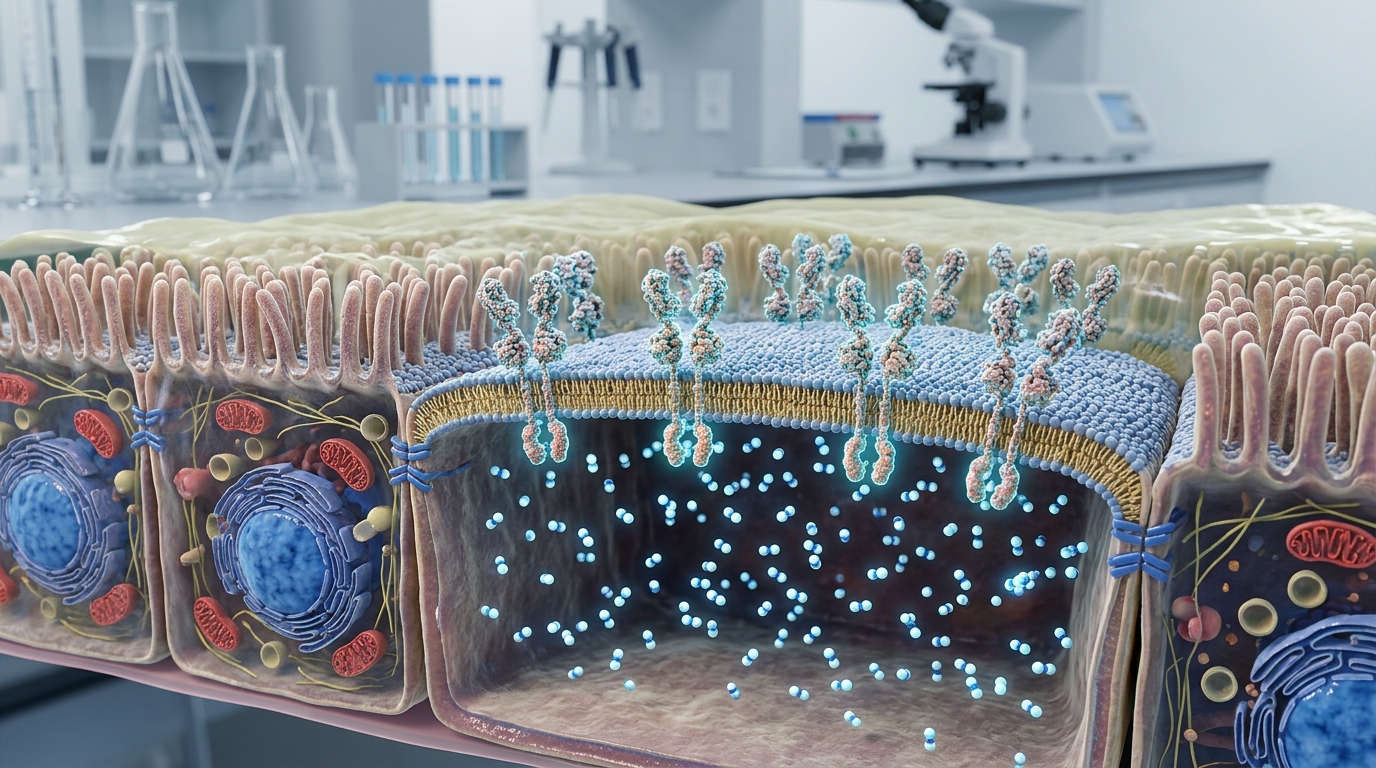
Body Protection Compound-157 (BPC-157) is a synthetic 15-amino-acid peptide derived from a naturally occurring protective protein found in human gastric juice. In laboratory settings, BPC-157 in gastrointestinal research has drawn substantial interest because of its remarkable chemical stability in gastric acid and its pronounced cytoprotective properties across diverse animal models of digestive pathology. While public interest in peptide therapies has surged, scientific evaluation requires separating laboratory findings from clinical reality.
Extensive preclinical work reveals that BPC-157 influences multiple biochemical cascades central to gut repair, mucosal preservation, and vascular maintenance. Nevertheless, the vast majority of published literature derives from animal and in vitro models, and the compound remains an unapproved investigational agent rather than an established medical therapy.
Biological Mechanisms: How BPC-157 Modulates Gut Homeostasis
The primary rationale for investigating BPC-157 in gastroenterology centers on its proposed biological mechanisms of action. Rather than acting as a simple barrier agent or acid suppressant, BPC-157 appears to stimulate endogenous repair pathways through several distinct molecular interactions.
Nitric Oxide Pathway Modulation
One of the best-characterized actions of BPC-157 in preclinical models is its bidirectional modulation of the nitric oxide (NO) system. Nitric oxide plays a dual role in gastrointestinal pathophysiology: physiological levels generated by endothelial nitric oxide synthase (eNOS) maintain mucosal blood flow and mucosal integrity, whereas uncontrolled nitric oxide output by inducible nitric oxide synthase (iNOS) accelerates oxidative stress and tissue damage. Investigations by Sikiric et al. indicate that BPC-157 counteracts both nitric oxide synthase inhibitors (such as L-NAME) and nitric oxide donors (such as L-arginine), suggesting a stabilizing, homeostatic regulatory effect on endothelial function and vascular tone.
Angiogenesis and Endothelial Cytoprotection
Tissue restoration following severe gastrointestinal injury requires the formation of new microvasculature. Preclinical assays demonstrate that BPC-157 promotes angiogenesis by upregulating vascular endothelial growth factor receptor 2 (VEGFR2) and activating the VEGFR2-Akt-eNOS signaling cascade. Furthermore, the peptide accelerates cellular migration via the focal adhesion kinase (FAK)-paxillin pathway. In rodent models of severe vascular obstruction, BPC-157 has been observed to recruit collateral vessels to circumvent ischemic tissue, restoring blood supply to hypoperfused intestinal segments.
Early Growth Response Gene and Cytokine Regulation
At the genomic and signaling level, BPC-157 stimulates the expression of early growth response-1 (Egr-1), a transcription factor critical for cellular proliferation, extracellular matrix production, and early collagen organization. Concurrently, experimental models of gastrointestinal damage show that BPC-157 attenuates the activation of nuclear factor kappa B (NF-κB), leading to measurable decreases in pro-inflammatory cytokines, including tumor necrosis factor-alpha (TNF-α) and interleukin-6 (IL-6).
Preclinical Evidence Across Gastrointestinal Models
Experimental studies spanning three decades have explored BPC-157 across numerous controlled rodent models of mucosal and intestinal injury.
Gastric and Duodenal Ulceration
Early laboratory investigations evaluated BPC-157 against acute mucosal lesions provoked by ethanol, restraint stress, and nonsteroidal anti-inflammatory drugs (NSAIDs) such as indomethacin and diclofenac. Unlike conventional mucosal protectants that primarily buffer gastric acid, BPC-157 preserved gastric mucosal microcirculation and stimulated epithelial re-epithelialization even in acidic environments. The peptide demonstrated equal protective potency whether administered via intraperitoneal injection or orally through drinking water, reflecting its unique enzymatic stability in gastric secretions.
Colitis and Inflammatory Bowel Disease Models
In animal models of inflammatory bowel disease, researchers induce colitis using chemical insults like trinitrobenzene sulfonic acid (TNBS) or dextran sodium sulfate (DSS). Multiple controlled rodent studies have shown that BPC-157 administration reduces gross mucosal inflammation, decreases macroscopic mucosal necrosis, and restores normal colon length. Microscopic evaluations revealed preserved crypt architecture, reduced inflammatory cell infiltration, and diminished myeloperoxidase activity, which serves as a biological marker of neutrophil recruitment.
Gastrointestinal Fistulas and Anastomotic Healing
One of the most complex challenges in gastrointestinal surgery is the management of fistulas and anastomotic leaks. In preclinical surgical models, BPC-157 has demonstrated efficacy in accelerating the closure of colocutaneous, gastrocutaneous, and entero-enteric fistulas in rats. In studies assessing bowel resections, animals treated with BPC-157 exhibited superior anastomotic bursting pressure and increased mature collagen deposition compared to saline-treated controls, suggesting enhanced mechanical integrity during healing.
Enteric Nervous System and Gut Motility
Recent investigations have focused on how BPC-157 interacts with the enteric nervous system (ENS). In ex vivo organ bath experiments using rodent and human intestinal tissue strips, BPC-157 modulated smooth muscle contraction and suppressed excessive motor spasms. In cell cultures, it supported the survival of enteric neurons and stimulated the proliferation of enteric glial cells, while regulating mucosal serotonin (5-HT) dynamics involved in gut transit and visceral hypersensitivity.
The Clinical Evidence Gap and Regulatory Status
Despite substantial preclinical literature, the translation of BPC-157 to human medicine remains unproven. In the early 2000s, BPC-157 was evaluated as an investigational compound designated PL-14736, advancing to exploratory Phase I and early Phase II clinical trials for ulcerative colitis. However, comprehensive peer-reviewed results from these early trials were never published in mainstream clinical journals, and clinical development under that designation was discontinued.
As of 2026, BPC-157 is not approved by the U.S. Food and Drug Administration (FDA), the European Medicines Agency (EMA), or any other major drug authority for the treatment or prevention of any gastrointestinal condition. In the United States, regulatory bodies have expressed safety concerns regarding the compounding of BPC-157 due to insufficient data on systemic toxicity, immunogenicity, and manufacturing contaminants. It is legally categorized as a research chemical, restricted strictly to laboratory in vitro and animal investigations.
Scientific Limitations of Current Research
A rigorous review of the literature reveals several notable scientific caveats that warrant caution:
- Single-Center Concentration: A large majority of published preclinical trials on BPC-157 originated from a single research collaborative based at the University of Zagreb. While independent confirmations from international laboratories have gradually emerged, broader multi-center replication remains necessary to independently validate these findings.
- Absence of Controlled Human Data: Preclinical rodent physiology differs markedly from human digestive pathophysiology. Complex human disorders, such as Crohn’s disease or refractory peptic ulcers, involve genetic, immunological, and microbiome factors that cannot be fully replicated in acute animal injury models.
- Pharmacokinetic Uncertainties: While BPC-157 exhibits unusual gastric stability compared to standard linear peptides, comprehensive human pharmacokinetic and metabolic profiling—including bioavailability, systemic half-life, and clearance pathways—remains incomplete.
- Theoretical Angiogenic Concerns: Because BPC-157 upregulates VEGF and promotes blood vessel proliferation, long-term safety concerns regarding the potential stimulation of occult gastrointestinal neoplasms require thorough exploration.
Frequently Asked Questions
Is BPC-157 approved for treating stomach ulcers or colitis?
No. BPC-157 is an investigational peptide without regulatory approval from the FDA, EMA, or any major health authority. Its biological effects have been established almost exclusively in preclinical animal models, and it cannot be legally prescribed or marketed as an approved therapy.
Why is BPC-157 considered stable in gastric acid?
Unlike most peptides, which rapidly degrade when exposed to digestive proteases such as pepsin and low pH conditions, BPC-157 possesses a specific pentadecapeptide sequence (GEPPPGKPADDAGLV) that resists enzymatic degradation in gastric juice, allowing it to retain biological activity in oral animal models.
What mechanisms account for BPC-157’s gut-healing effects in animals?
Preclinical studies indicate that BPC-157 functions through homeostatic regulation of the nitric oxide system, promotion of VEGFR2-mediated angiogenesis, stimulation of the Egr-1 gene for collagen synthesis, and downregulation of pro-inflammatory cytokines like TNF-α and IL-6.
Has BPC-157 been tested in human clinical trials?
BPC-157 was evaluated in early-phase clinical exploration under the developmental code PL-14736 for inflammatory bowel disease during the 2000s. However, those trials did not progress through large-scale, randomized Phase III evaluation, and detailed, peer-reviewed clinical efficacy data in humans remain absent.
Research Summary
Preclinical research demonstrates that BPC-157 exhibits potent cytoprotective, anti-inflammatory, and pro-angiogenic activities across numerous rodent models of gastrointestinal pathology, including chemical colitis, drug-induced ulcerations, and surgical fistulas. Its biological effects appear largely driven by nitric oxide pathway modulation, FAK-paxillin activation, and VEGFR2 signaling. However, current evidence is restricted almost entirely to preclinical animal and in vitro laboratories. In the absence of rigorous, large-scale, double-blind human clinical trials, BPC-157 remains an unapproved investigational research peptide, and its safety, pharmacokinetics, and clinical utility in human gastrointestinal disease remain unestablished.
References
- Sikiric P, Seiwerth S, Rucman R, et al. Stable Gastric Pentadecapeptide BPC 157, Robert’s Stomach Cytoprotection/Adaptive Cytoprotection/Organoprotection, and Selye’s Stress Coping Response: Progress, Achievements, and the Future. Gut and Liver. 2020;14(2):153-167.
- Wang XY, Qu M, Duan R, et al. Cytoprotective Mechanism of the Novel Gastric Peptide BPC157 in Gastrointestinal Tract and Cultured Enteric Neurons and Glial Cells. Neuroscience Bulletin. 2019;35(1):167-170.
- Sikiric P, Seiwerth S, Rucman R, et al. Focus on Ulcerative Colitis: Stable Gastric Pentadecapeptide BPC 157. Current Medicinal Chemistry. 2012;19(1):126-132.
- Klicek R, Sever M, Radic B, et al. Pentadecapeptide BPC 157, in Clinical Trials as a Therapy for Inflammatory Bowel Disease (PL 14736), is Effective in the Healing of Colocutaneous Fistulas in Rats: Role of the Nitric Oxide-System. Journal of Pharmacological Sciences. 2008;108(1):7-17.
- Veljaca M, Lesch CA, Pllana R, Sanchez B, Chan K, Guglietta A. BPC-15 Reduces Trinitrobenzene Sulfonic Acid-Induced Colonic Damage in Rats. Journal of Pharmacology and Experimental Therapeutics. 1995;272(1):417-422.
- Sikiric P, Seiwerth S, Skrtic A, et al. BPC 157 Therapy: Targeting Angiogenesis and Nitric Oxide’s Cytotoxic and Damaging Actions, but Maintaining, Promoting, or Recovering Their Essential Protective Functions. Pharmaceuticals. 2025;18(10):1450.