Key Takeaways
- Receptor Target: Ipamorelin, GHRP-6, and GHRP-2 all act as synthetic agonists at the growth hormone secretagogue receptor type 1a (GHS-R1a), mimicking endogenous ghrelin to prompt pulsatile growth hormone (GH) secretion from anterior pituitary somatotrophs.
- Endocrine Selectivity: Preclinical and clinical models demonstrate that ipamorelin is significantly more selective than GHRP-6 and GHRP-2, inducing GH release without statistically meaningful increases in adrenocorticotropic hormone (ACTH), cortisol, or prolactin.
- Appetite and Orexigenic Signaling: While GHRP-6 strongly stimulates appetite via central hypothalamic pathways, ipamorelin exhibits minimal orexigenic activity at GH-stimulating doses.
- Regulatory Status: Ipamorelin is an unapproved investigational compound. It has no approved therapeutic indication from the U.S. Food and Drug Administration (FDA) and is prohibited in competitive sports by the World Anti-Doping Agency (WADA).
What Is Ipamorelin? Structural Lineage and GHRP Evolution
When investigating growth hormone secretagogues, comparing Ipamorelin vs. GHRP-6 and GHRP-2 highlights the pharmacological evolution of the growth hormone-releasing peptide (GHRP) class. GHRPs are synthetic oligopeptides engineered to stimulate endogenous GH production independently of growth hormone-releasing hormone (GHRH).
The first generation emerged in the late 1970s and 1980s through the work of Cyril Bowers and colleagues, who identified that enkephalin-derived peptide analogs could stimulate GH release without binding opioid receptors. This research yielded GHRP-6 (His-D-Trp-Ala-Trp-D-Phe-Lys-NH2), a hexapeptide that reliably produced GH pulses. Subsequent structural refinements produced second-generation secretagogues such as GHRP-2 (D-Ala-D-2-Nal-Ala-Trp-D-Phe-Lys-NH2), which exhibited greater potency in releasing GH but retained the non-specific endocrine footprint of its predecessor.
In 1998, researchers at Novo Nordisk characterized ipamorelin (Aib-His-D-2-Nal-D-Phe-Lys-NH2), designated during development as NNC 26-0161. Built on a pentapeptide backbone with a molecular weight of approximately 711.9 Da, ipamorelin was designed to solve the selectivity trade-off that troubled earlier GHRPs. By incorporating non-proteinogenic amino acids—specifically alpha-aminoisobutyric acid (Aib) at position 1 and D-2-naphthylalanine at position 3—investigators produced a compound that demonstrated resilience against rapid proteolytic degradation while altering interaction kinetics at target neuroendocrine receptors.
Mechanism of Action: The Ghrelin Receptor Pathway
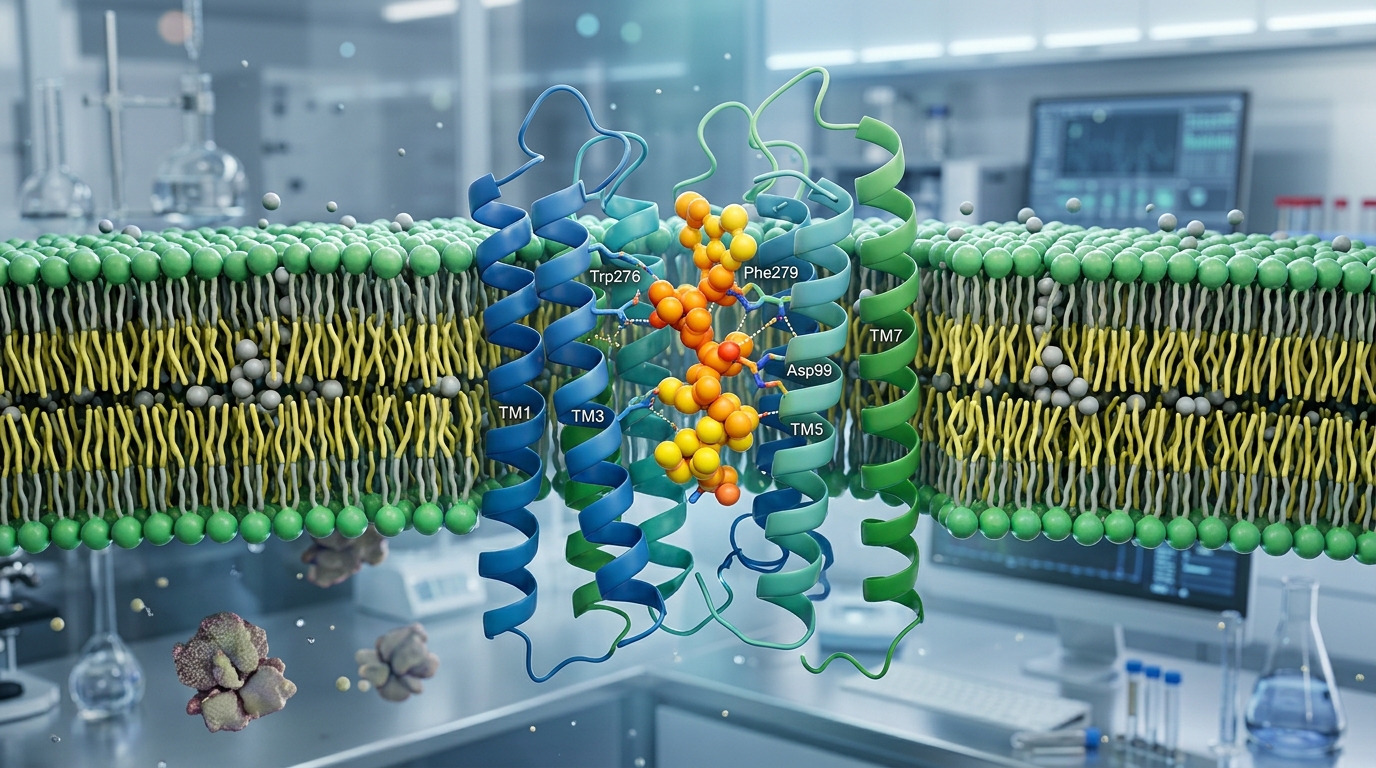
All three secretagogues exert their primary action through the growth hormone secretagogue receptor type 1a (GHS-R1a), a seven-transmembrane G-protein-coupled receptor. The endogenous ligand for this receptor is ghrelin, a 28-amino-acid peptide produced predominantly in the fundus of the stomach.
Binding of ipamorelin to GHS-R1a on anterior pituitary somatotrophs initiates intracellular signaling through the Gq/11 protein subunit. This stimulates phospholipase C (PLC), which cleaves phosphatidylinositol 4,5-bisphosphate (PIP2) into diacylglycerol (DAG) and inositol 1,4,5-trisphosphate (IP3). IP3 binds receptors on the endoplasmic reticulum, mobilizing intracellular calcium ions (Ca2+). Concurrently, protein kinase C (PKC) activation and membrane depolarization facilitate calcium influx via L-type voltage-gated calcium channels. This influx triggers the exocytosis of preformed growth hormone storage vesicles into the systemic circulation in discrete, pulsatile bursts.
Comparative Selectivity: Ipamorelin vs. GHRP-6 and GHRP-2
The defining scientific rationale for studying ipamorelin lies in its functional selectivity. While GHRP-6 and GHRP-2 act on GHS-R1a to induce robust GH secretion, their administration induces off-target neuroendocrine perturbations.
Cortisol and Adrenocorticotropic Hormone (ACTH) Dynamics
The hypothalamic-pituitary-adrenal (HPA) axis is sensitive to non-selective ghrelin receptor agonism. In both animal models and human clinical research, GHRP-2 and GHRP-6 trigger acute elevations in plasma ACTH and serum cortisol:
- GHRP-2: Demonstrates high potency for GH release but concurrently produces dose-dependent increases in ACTH and cortisol. In clinical investigations, acute administration of GHRP-2 consistently stimulated the adrenal axis alongside GH.
- GHRP-6: Induces moderate, reproducible rises in systemic ACTH and cortisol. Clinical research evaluating GHRP-6 noted that peak cortisol increases often paralleled those stimulated by arginine vasopressin or corticotropin-releasing hormone.
- Ipamorelin: Preclinical work published by Raun and colleagues demonstrated that ipamorelin does not induce significant elevations in ACTH or cortisol, even at doses several orders of magnitude above those required for maximal GH stimulation. This absence of HPA axis activation makes ipamorelin a valuable tool compound when investigators must isolate GH effects without confounding glucocorticoid elevations.
Prolactin Secretion
Prolactin release represents another major divergence among these peptides. Somatolactotrophs and lactotrophs in the anterior pituitary express receptors that respond to earlier-generation secretagogues. Administration of GHRP-2 and GHRP-6 leads to marked, transient elevations in circulating prolactin. In contrast, in vitro and in vivo studies indicate that ipamorelin maintains baseline prolactin levels across standard experimental dosing thresholds.
Orexigenic Signaling and Food Intake
Ghrelin is widely known as a central hunger-stimulating signal. Because GHS-R1a is expressed in the arcuate nucleus of the hypothalamus, non-selective agonists frequently stimulate appetite. GHRP-6 is renowned for its intense orexigenic effect; in rodent models, its administration produces rapid hyperphagia. GHRP-2 also promotes food intake, though to a somewhat lesser extent than GHRP-6. Ipamorelin, however, produces minimal feeding stimulation at doses that induce substantial GH release, pointing toward possible biased agonism or differential tissue biodistribution.
Preclinical and Clinical Evidence Review
Preclinical data on ipamorelin is extensive. In juvenile rats, chronic administration of ipamorelin stimulated longitudinal bone growth rate and weight gain without altering circulating markers of adrenal or reproductive axis stress. Additional rodent studies demonstrated that ipamorelin partially preserved bone mineral density in models of steroid-induced osteopenia.
In humans, early clinical pharmacology was explored in healthy volunteers. Pharmacokinetic-pharmacodynamic modeling published by Gobburu et al. confirmed that intravenous ipamorelin produced rapid, dose-dependent increases in GH without altering cortisol, prolactin, or glucose concentrations. The compound was later evaluated in a Phase II multicenter trial for postoperative ileus following bowel resection. While ipamorelin demonstrated a favorable tolerability profile, it failed to meet the primary clinical efficacy endpoints for accelerating gastrointestinal motility, leading the sponsor to halt therapeutic development for that indication.
Research Limitations and Gaps
Despite the clean endocrine profile observed in laboratory settings, the evidence base for ipamorelin contains important limitations:
- Lack of Long-Term Human Efficacy Data: Most published human data are restricted to single-dose pharmacokinetic studies or short-duration clinical trials. Robust, randomized controlled trials assessing chronic health outcomes, lean body mass alterations, or clinical endpoints remain absent.
- Lack of Direct Three-Way Human Comparisons: While head-to-head rodent comparisons are well documented, human trials directly comparing ipamorelin, GHRP-6, and GHRP-2 under identical crossover conditions remain sparse.
- Desensitization Dynamics: GHS-R1a undergoes receptor internalization and desensitization upon repeated exposure to agonists. The exact kinetics of tachyphylaxis and receptor recovery across continuous or long-term pulsed regimens require deeper structural and clinical clarification.
Regulatory Status
Ipamorelin is not approved by the FDA or the European Medicines Agency (EMA) for any human medical condition. In the United States, regulatory bodies have categorized ipamorelin among bulk drug substances that pose safety uncertainties when compounded for human use. Furthermore, all growth hormone secretagogues, including ipamorelin, GHRP-6, and GHRP-2, are prohibited under section S2 of the World Anti-Doping Code at all times. Its lawful availability is strictly restricted to in vitro and preclinical research applications.
Frequently Asked Questions
Why does ipamorelin spare cortisol and prolactin while GHRP-6 does not?
Ipamorelin displays high functional selectivity for the somatotroph GHS-R1a receptor signaling pathway that governs GH exocytosis, while avoiding non-specific hypothalamic-pituitary-adrenal activation and prolactin-releasing mechanisms engaged by GHRP-6 and GHRP-2.
Does ipamorelin stimulate hunger to the same extent as GHRP-6?
No. GHRP-6 strongly triggers hypothalamic hunger centers via central GHS-R1a activation, producing acute orexigenic drives. Preclinical trials show ipamorelin has negligible impact on acute food consumption at standard GH-releasing dosages.
Is ipamorelin more potent than GHRP-2?
In terms of maximal growth hormone peak amplitude per mole, GHRP-2 generally exhibits higher acute potency than ipamorelin in comparative animal assays. However, ipamorelin provides superior selectivity by avoiding the secondary hormonal elevations associated with GHRP-2.
Can preclinical animal findings with ipamorelin be extrapolated to human therapy?
No. While animal studies clarify receptor pharmacology and organ-level physiology, they do not establish human therapeutic safety, optimal administration schedules, or efficacy for chronic conditions.
Research Summary
Ipamorelin represents a pharmacological milestone in the design of growth hormone secretagogues. By preserving the GH-stimulating capacity of earlier compounds while avoiding the off-target elevation of ACTH, cortisol, and prolactin characteristic of GHRP-6 and GHRP-2, it provides a precise tool for exploring GHS-R1a physiology. Nevertheless, its scientific validation is predominantly preclinical; human clinical development stalled after Phase II trials, and it lacks regulatory approval for any therapeutic use.
References
- Raun K, Hansen BS, Johansen NL, Thøgersen H, Madsen K, Ankersen M, Andersen PH. Ipamorelin, the first selective growth hormone secretagogue. European Journal of Endocrinology. 1998;139(5):552-561. PMID: 9849822
- Gobburu JV, Agersø H, Jusko WJ, Ynddal L. Pharmacokinetic-pharmacodynamic modeling of ipamorelin, a growth hormone releasing peptide, in human volunteers. Pharmaceutical Research. 1999;16(9):1412-1416. PMID: 10496658
- Svensson J, Lall S, Dickson SL, et al. The GH secretagogues ipamorelin and GHRP-6 increase bone mineral content in adult female rats. Journal of Endocrinology. 2000;165(3):569-577. PMID: 10861684
- Bowers CY. Unnatural growth hormone-releasing peptide begets natural ghrelin. The Journal of Clinical Endocrinology & Metabolism. 2001;86(4):1464-1469. PMID: 11297568