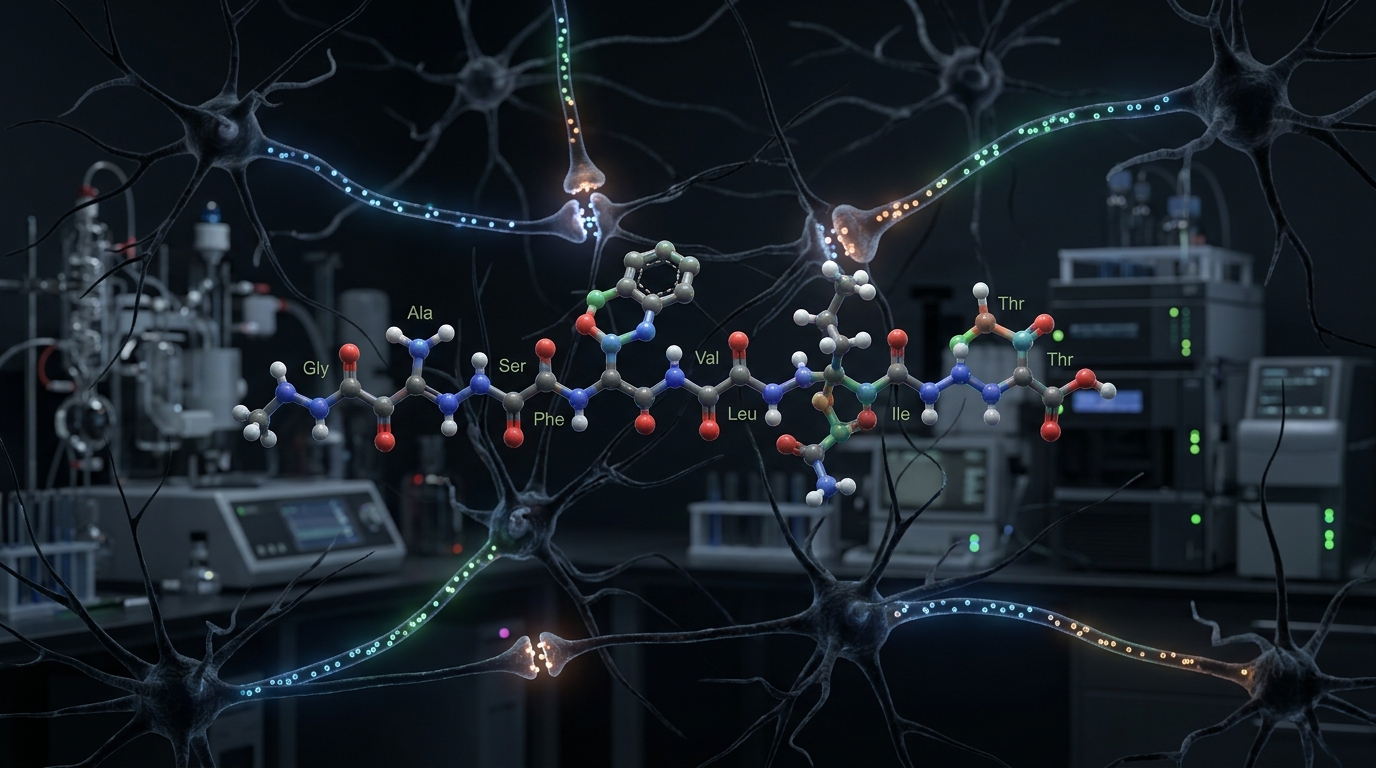
When Swiss researchers isolated delta sleep-inducing peptide (DSIP, also designated emideltide) in the late 1970s, it appeared to fulfill a long-standing biochemical hypothesis: the existence of a humoral, endogenous factor that initiates slow-wave sleep. Yet decades later, neurobiologists still refer to DSIP as an unresolved riddle. Despite extensive preclinical investigation, researchers have not identified an exclusive receptor, cloned an endogenous pre-propeptide gene, or produced reproducible clinical sleep-induction protocols.
Instead, modern delta sleep-inducing peptide mechanisms present a complex, multifaceted picture. Rather than acting as a simple neurological switch for delta-wave oscillations, DSIP displays diverse neuroendocrine, thermoregulatory, and stress-modulatory properties. Understanding why this nonapeptide has resisted straightforward pharmacological classification requires examining its structural oddities, conflicting experimental data, and the core methodological barriers that complicate contemporary research.
The Isolation and Structural Paradox of DSIP
In 1977, Guido A. Schoenenberger and Marcel Monnier isolated DSIP from the cerebral venous blood (sinus confluens) of rabbits that had been put to sleep via electrical stimulation of the thalamus. Chemical analysis revealed a linear nonapeptide with the sequence:
Trp-Ala-Gly-Gly-Asp-Ala-Ser-Gly-Glu
The peptide has a molecular weight of approximately 849 Daltons. Structurally, this sequence does not align with any known family of classical mammalian neuropeptides or peptide hormones. When scientists synthesized the exact nonapeptide sequence in the laboratory, initial trials in rabbits showed an elevation of electroencephalographic (EEG) slow-wave (delta) activity. However, structure-activity relationship (SAR) studies rapidly produced perplexing results:
- Truncating the peptide by even a single amino acid from either terminal dramatically blunted or extinguished its apparent biological properties.
- Substitutions of key residues frequently eliminated activity, demonstrating strict structural specificity.
- Phosphorylation of the serine residue at position seven created a synthetic analogue (phospho-DSIP or DSIP-P) that exhibited significantly enhanced stability and potency in certain laboratory models compared to the parent molecule.
The Elusive Receptor: Where Does DSIP Act?
The foremost mechanistic hurdle in DSIP research is the absence of a confirmed receptor. Most peptide signaling molecules act through designated G-protein coupled receptors (GPCRs), receptor tyrosine kinases, or ligand-gated ion channels. Over four decades of binding assays have failed to identify a specific, high-affinity receptor dedicated exclusively to native DSIP.
Instead of direct receptor activation, investigation suggests that DSIP modulates several major endogenous neurotransmitter systems:
- Endogenous Opioid Cascades: DSIP does not bind directly to mu, delta, or kappa opioid receptors. However, laboratory assays utilizing brainstem tissue demonstrate that DSIP stimulates the release of immunoreactive Met-enkephalin, indicating an indirect upstream modulatory role.
- Monoaminergic Systems: Radioligand and tissue-culture studies show interactions between DSIP and adrenergic signaling. In pineal tissue, the peptide alters N-acetyltransferase activity in a manner dependent on alpha-1 adrenergic receptor function. Other animal assays report interactions with central 5-HT1A serotonergic pathways during thermoregulation.
- Mitochondrial Energetics: In vitro experiments on rat brain preparations have linked DSIP administration to alterations in mitochondrial respiratory chain enzymes and membrane integrity under oxidative stress, suggesting actions beyond conventional cell-surface receptor signaling.
Because these effects span distinct biochemical targets without a single binding domain, some researchers hypothesize that DSIP acts as a neuromodulator that alters membrane fluidity, modulates allosteric sites on carrier proteins, or influences membrane-bound regulatory enzymes rather than activating a dedicated single receptor.
Discordant Sleep Findings and the U-Shaped Response Curve
The central historical premise—that DSIP reliably triggers delta sleep—has yielded persistent empirical inconsistencies. While initial studies by the Basel group reported clear slow-wave sleep induction in rabbits, later replication attempts across other species generated conflicting outcomes. In feline models, DSIP infusions sometimes accentuated rapid eye movement (REM) sleep rather than delta-wave non-REM sleep. In rodents, multiple independent laboratories observed no statistically significant shift in total slow-wave sleep duration following infusions of the native peptide.
These discrepancies are compounded by an atypical pharmacodynamic profile:
- Biphasic (U-Shaped) Dose Responses: DSIP often exhibits a bell-shaped or U-shaped dose-response curve, wherein biological effects appear only within a narrow, low-nanomolar concentration window. Concentrations above or below this range frequently produce neutral or opposite effects, complicating standard toxicological and pharmacological assays.
- Delayed Action Profiles: Unlike rapid hypnotics, central EEG alterations following DSIP administration in animal models often emerge hours after systemic levels have fallen below detection thresholds, inconsistent with direct receptor occupancy kinetics.
- Weak Human Clinical Efficacy: Early double-blind human trials evaluating intravenous DSIP in chronic insomnia patients noted modest changes in sleep latency, but comprehensive polysomnographic measures and subjective sleep quality showed minimal or non-significant therapeutic improvement.
The Genetic Precursor and Cross-Reactivity Riddle
In modern molecular endocrinology, genuine endogenous peptides are traced to a clear coding gene that translates a pre-prohormone precursor. To date, the specific gene responsible for native DSIP biosynthesis has not been definitively cloned or characterized in any mammalian genome.
This absence has cast doubt on whether native DSIP exists as an independent, widely distributed signaling molecule in vivo. Radioimmunoassays (RIAs) and immunohistochemical studies have detected extensive “DSIP-like immunoreactivity” (DSIP-LI) throughout the rodent hypothalamus, pituitary, gut, and human cerebrospinal fluid. However, anatomical mapping reveals that DSIP-LI concentrates heavily in neurosecretory hypothalamic nuclei—such as the paraventricular and supraoptic nuclei—structures primarily involved in neuroendocrine output rather than sleep regulation.
Biochemists have suggested that existing polyclonal and monoclonal antibodies against DSIP cross-react with other endogenous peptides or high-molecular-weight carrier complexes. Some investigations suggest that DSIP-like immunoreactivity may reflect structural fragments derived from larger precursor proteins that carry analogous epitope domains.
Pharmacokinetics and Methodological Barriers
Preclinical evaluation of DSIP is heavily constrained by rapid enzymatic clearance. The native nonapeptide possesses a plasma half-life of roughly 15 minutes in biological systems, primarily driven by rapid enzymatic cleavage of the N-terminal tryptophan residue by aminopeptidases. Although peptide transport studies in guinea pig and rodent models confirm that small amounts cross the blood-brain barrier via saturable transport mechanisms, the brief circulating lifespan severely limits central bioavailability.
Efforts to stabilize the peptide have yielded halogenated, cyclic, and phosphorylated derivatives, but these altered compounds frequently display pharmacological targets distinct from native DSIP. As a result, findings obtained from synthetic analogues cannot be assumed to describe the endogenous nonapeptide.
Regulatory and Investigational Status
Delta sleep-inducing peptide (emideltide) is not approved by the United States Food and Drug Administration (FDA) or international regulatory health authorities for any clinical indication. It is not recognized as a validated treatment for chronic insomnia, sleep apnea, pain, or withdrawal disorders. DSIP remains restricted entirely to laboratory and preclinical research settings.
Frequently Asked Questions
Is DSIP an FDA-approved treatment for insomnia?
No. DSIP is not approved by the FDA for any human medical condition. Controlled clinical trials evaluating DSIP for insomnia are limited, decades old, and failed to establish sufficient therapeutic efficacy or safety profiles required for drug approval.
Does DSIP act through sleep-related GABA receptors?
No. Unlike benzodiazepines or Z-drugs, DSIP does not bind to the GABA-A receptor complex. Its putative neurochemical actions involve indirect modulation of monoamines, neuroendocrine release, and endogenous enkephalin systems, though a dedicated primary receptor remains unidentified.
Why did animal studies yield conflicting results regarding sleep?
Outcomes varied significantly depending on the animal species, baseline circadian rhythm, time of day, and precise dosing. Furthermore, native DSIP often showed weaker slow-wave sleep promotion than phosphorylated synthetic analogues, and differences in administrative routes and observer protocols contributed to inconsistent findings across labs.
Has the gene responsible for producing DSIP been cloned?
No. Despite advanced genomic sequencing, researchers have not mapped or cloned a specific gene encoding a pre-pro-DSIP precursor. The source of DSIP-like immunoreactivity measured in tissue remains an open scientific question.
Research Summary
Delta sleep-inducing peptide (DSIP) is an atypical nonapeptide whose mechanistic identity remains fundamentally unresolved. While isolated on the basis of slow-wave sleep promotion in early animal dialysates, subsequent preclinical studies revealed inconsistent somnogenic outcomes, pronounced species variation, and bell-shaped dose-response curves. Mechanistically, DSIP lacks an isolated, validated receptor target and an identified pre-propeptide gene. Human evidence is minimal, confined to small historical pilot studies that showed modest or negligible clinical benefit. Currently, DSIP possesses no approved medical indications, and scientific knowledge regarding its actions relies heavily on unresolved laboratory and animal models.
References
- Kovalzon, V. M., & Strekalova, T. V. (2006). Delta sleep-inducing peptide (DSIP): a still unresolved riddle. Journal of Neurochemistry, 97(2), 303–309.
- Graf, M. V., & Kastin, A. J. (1986). Delta-sleep-inducing peptide (DSIP): an update. Peptides, 7(6), 1165–1187.
- Graf, M. V., & Kastin, A. J. (1984). Delta-sleep-inducing peptide (DSIP): a review. Neuroscience & Biobehavioral Reviews, 8(1), 83–93.
- Schoenenberger, G. A. (1984). Characterization, properties and multivariate functions of delta-sleep-inducing peptide (DSIP). European Neurology, 23(5), 321–345.
- Monti, J. M., et al. (1987). Effects of delta sleep-inducing peptide on sleep of chronic insomniac patients. A double-blind study. Neuropsychobiology, 18(4), 201–205.
- Nakamura, A., et al. (1989). Delta-sleep-inducing peptide (DSIP) stimulates the release of immunoreactive Met-enkephalin from rat lower brainstem slices in vitro. Neuropharmacology, 28(10), 1047–1052.
- Graf, M. V., et al. (1988). Delta sleep-inducing peptide modulates the stimulation of rat pineal N-acetyltransferase activity by involving the alpha 1-adrenergic receptor. Journal of Neurochemistry, 51(3), 734–739.