Understanding CJC-1295 and Modified GRF 1-29
In peptide endocrinology, few distinctions generate as much confusion as the comparison between CJC-1295 and Modified GRF 1-29. While both molecules are synthetic analogs of growth hormone-releasing hormone (GHRH) engineered to stimulate anterior pituitary somatotrophs, their pharmacokinetic profiles, structural adaptations, and receptor dynamics diverge significantly . This comparative analysis examines how the molecular architecture of CJC-1295 alters its biological behavior relative to Modified GRF 1-29.
Endogenous human GHRH is a 44-amino-acid peptide secreted by the arcuate and ventromedial nuclei of the hypothalamus. Early structure-activity relationship studies demonstrated that full biological potency and receptor activation reside within the first 29 N-terminal residues, termed GRF(1-29) or sermorelin. However, native GRF(1-29) suffers from rapid in vivo clearance, exhibiting a circulating plasma half-life of only 7 to 12 minutes due to rapid enzymatic degradation by dipeptidyl peptidase-IV (DPP-IV) and endopeptidases, alongside rapid renal elimination.
To overcome these metabolic liabilities, chemical modifications yielded two distinct research tools: Modified GRF 1-29 (a tetrasubstituted analogue) and CJC-1295 (the tetrasubstituted peptide conjugated to a specialized bioconjugation linker) . Evaluating CJC-1295 vs Modified GRF 1-29 requires examining the structural differences that dictate their contrasting systemic behaviors.
Chemical Structure and the Drug Affinity Complex (DAC)
Both peptides share a common stabilized backbone consisting of 29 amino acids with four strategic amino acid substitutions designed to resist enzymatic hydrolysis and chemical oxidation:
- D-Alanine at position 2: Replaces native L-alanine, providing steric protection against DPP-IV cleavage at the Ala2-Asp3 peptide bond .
- Glutamine at position 8: Replaces asparagine to prevent spontaneous deamidation in aqueous environments.
- Alanine at position 15: Replaces glycine to enhance alpha-helical conformation and proteolytic resistance.
- Leucine at position 27: Replaces methionine to eliminate susceptibility to oxidative degradation.
This 29-amino-acid sequence is known chemically as [D-Ala2, Gln8, Ala15, Leu27]-hGRF(1-29)-NH2, or Modified GRF 1-29 (frequently referred to in non-technical literature as “CJC-1295 without DAC”) .
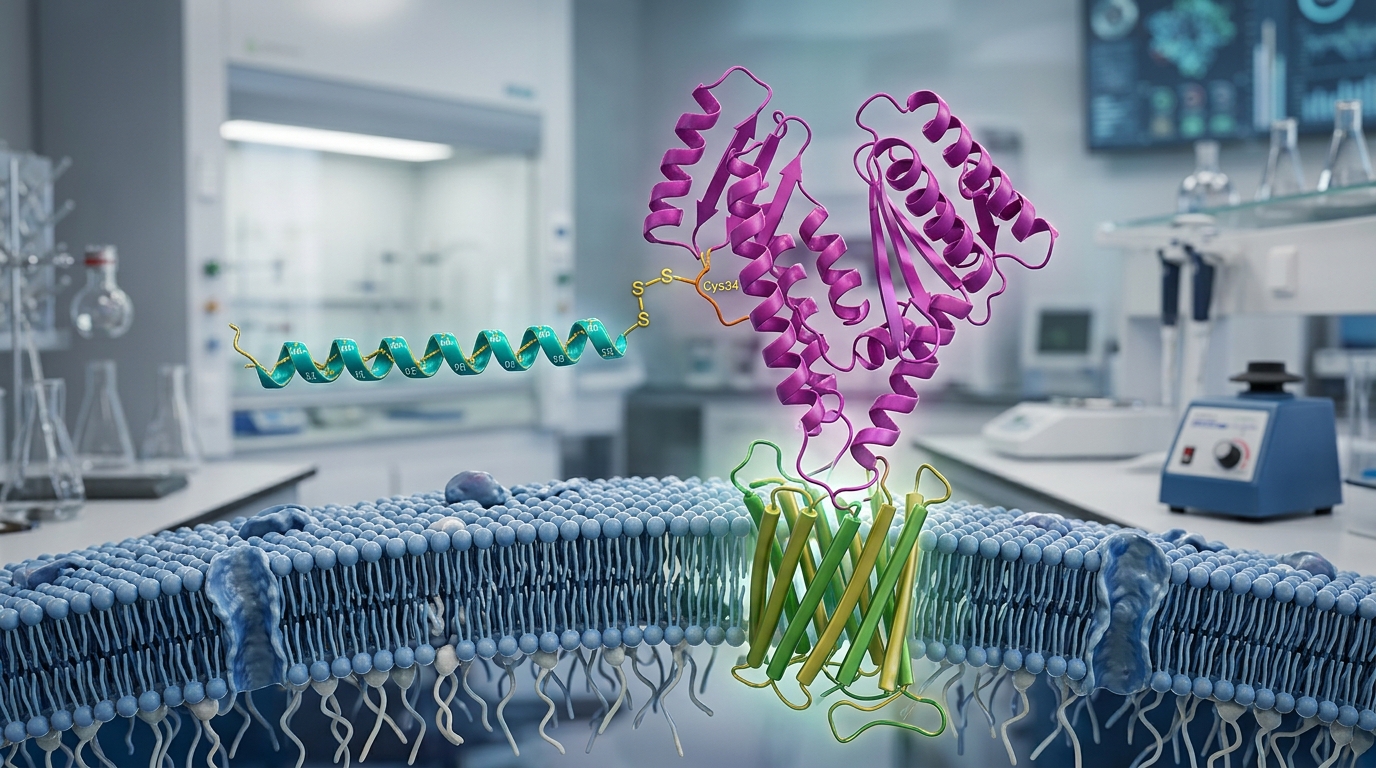
The defining structural divergence in CJC-1295 is the addition of a C-terminal lysine residue linked to a maleimidopropionic acid moiety, creating the 30-amino-acid construct: [D-Ala2, Gln8, Ala15, Leu27, Lys30(maleimidopropionyl)]-hGRF(1-29) . This reactive maleimide group forms the core of the proprietary Drug Affinity Complex (DAC) technology . Following parenteral administration, the maleimide linker spontaneously and selectively forms a stable covalent thioether bond with the unpaired cysteine-34 (Cys34) residue of circulating serum albumin .
Comparative Pharmacokinetics and Half-Life Dynamics
The structural divergence between CJC-1295 and Modified GRF 1-29 translates into stark pharmacokinetic differences:
- Modified GRF 1-29: The four amino acid substitutions confer significant resistance to DPP-IV, extending its terminal elimination half-life to approximately 30 minutes in circulation compared to 7 minutes for native GHRH . However, because its molecular weight remains low (~3.36 kDa), it is subject to rapid glomerular filtration and systemic clearance.
- CJC-1295 (with DAC): Covalent bioconjugation to endogenous serum albumin creates a high-molecular-weight macromolecular complex (~69 kDa) . This albumin-bound peptide evades renal filtration, undergoes endothelial recycling via the neonatal Fc receptor (FcRn) pathway, and is sterically shielded from tissue peptidases . In clinical pharmacokinetic trials, CJC-1295 demonstrated an extended half-life of 5.8 to 8.1 days in humans .
GHRH Receptor Kinetics and Pituitary Signaling
Both peptides target the growth hormone-releasing hormone receptor (GHRHR), a Class B G-protein-coupled receptor (GPCR) predominantly localized on the cell surface of somatotrophs in the anterior pituitary gland . Receptor activation stimulates the G-alpha-s pathway, activating membrane-bound adenylyl cyclase, escalating intracellular cyclic adenosine monophosphate (cAMP), and subsequently activating protein kinase A (PKA) . This phosphorylation cascade opens L-type voltage-gated calcium channels, triggering calcium influx and vesicle exocytosis of stored growth hormone (GH), while also promoting GH gene transcription via the CREB transcription factor.
Despite binding the same receptor target, the contrasting pharmacokinetics create fundamentally different receptor kinetics:
- Transient Occupancy (Modified GRF 1-29): The rapid clearance of Modified GRF 1-29 produces brief, sharp receptor occupancy lasting 30 to 60 minutes. This allows the GHRH receptor to cycle through activation, internalization, and recycling back to the cell surface without inducing prolonged receptor down-regulation or tachyphylaxis.
- Continuous Occupancy (CJC-1295): The albumin-bound conjugate remains in constant contact with somatotroph membranes, providing continuous tonic stimulation across days . In vitro binding studies show that the bulky albumin carrier slightly reduces steric affinity for the GHRHR relative to free peptide, but this is offset by constant receptor exposure and high local effective concentration over time .
Physiological Secretory Dynamics: Pulsatility vs. Tonic Elevation
Endogenous growth hormone secretion in healthy mammals is strictly pulsatile, governed by an alternating balance between hypothalamic GHRH surges and somatostatin-mediated inhibitory pauses. The difference between CJC-1295 and Modified GRF 1-29 profoundly influences how this endocrine rhythm behaves:
Administration of Modified GRF 1-29 produces a discrete, episodic pulse of growth hormone that mimics natural physiological bursts . Circulating GH levels rise rapidly within 15 to 30 minutes and return to baseline within 2 to 3 hours as the peptide is cleared, allowing normal feedback inhibition and hypothalamic-pituitary somatotropic cycling to remain intact .
In contrast, clinical studies conducted by Teichman et al. (2006) and Ionescu et al. (2006) evaluated the endocrine effects of CJC-1295 in human subjects . A single subcutaneous injection of CJC-1295 produced a dose-dependent, 2- to 10-fold elevation in mean serum GH concentrations lasting 6 days or longer, alongside a 1.5- to 3-fold elevation in circulating Insulin-Like Growth Factor 1 (IGF-1) lasting 9 to 11 days .
Importantly, 24-hour hormone profiling demonstrated that continuous GHRH receptor stimulation by CJC-1295 does not eliminate endogenous GH pulsatility . Hypothalamic somatostatin continues to periodically interrupt GH secretion, preserving episodic pulse frequency . However, CJC-1295 substantially raises interpulse trough levels and increases baseline GH secretion, converting the endocrine pattern from sharp, discrete spikes with quiescent intervals into a sustained, elevated hormonal tone .
Safety Findings and Research Limitations
Human trials evaluating CJC-1295 noted that it was generally well tolerated at tested doses, with reported adverse events including transient flushing, mild injection-site erythema, headache, and transient gastrointestinal discomfort . Notably, CJC-1295 demonstrated pituitary selectivity: it did not induce significant elevations in circulating levels of prolactin, cortisol, luteinizing hormone (LH), follicle-stimulating hormone (FSH), or thyroid-stimulating hormone (TSH) .
Nonetheless, distinct scientific and methodological limitations apply to both compounds:
- Long-Term Tonic Stimulation Concerns: In preclinical and human research models, sustained elevation of trough GH and continuous IGF-1 elevation (as induced by CJC-1295) raise theoretical questions regarding long-term somatotroph receptor desensitization and potential metabolic alterations, such as shifts in glucose tolerance, compared to intermittent pulsatile stimulation.
- Clinical Trial Discontinuation: Formal clinical development of CJC-1295 by ConjuChem Biotechnologies was discontinued during Phase II trials following an adverse event involving a patient with underlying cardiac disease, leaving the comprehensive long-term safety profile unresolved in broad human populations.
- Limited Direct Comparative Trials: While both molecules have been characterized independently, direct, head-to-head randomized trials comparing CJC-1295 and Modified GRF 1-29 within the same clinical cohort are lacking in the published literature.
Regulatory and Legal Status
Neither CJC-1295 nor Modified GRF 1-29 is approved by the United States Food and Drug Administration (FDA) or the European Medicines Agency (EMA) for clinical or therapeutic use . Both substances are strictly designated as investigational compounds intended solely for laboratory in vitro and animal in vivo research.
Furthermore, the World Anti-Doping Agency (WADA) classifies CJC-1295, Modified GRF 1-29, and related GHRH analogs under Section S2 (Peptide Hormones, Growth Factors, Related Substances, and Mimetics) of the Prohibited List, banning their possession and use in competitive athletics at all times .
Frequently Asked Questions
Are CJC-1295 and Modified GRF 1-29 the same compound?
No. While both molecules share the same core 29-amino-acid tetrasubstituted peptide backbone, CJC-1295 possesses an additional C-terminal lysine derivative containing a maleimidopropionic acid linker (DAC) . Modified GRF 1-29 lacks this linker.
Why is Modified GRF 1-29 often called “CJC-1295 without DAC”?
The term “CJC-1295 without DAC” is an informal, non-standard naming convention in research literature. Because CJC-1295 was originally developed by appending the DAC moiety onto Modified GRF 1-29, suppliers and laboratories began referring to the non-conjugated precursor as CJC-1295 without DAC, despite it being a distinct chemical entity .
How does the half-life of CJC-1295 compare to Modified GRF 1-29?
Modified GRF 1-29 exhibits a circulating plasma half-life of approximately 30 minutes in mammals . CJC-1295 binds covalently to serum albumin via its DAC moiety, extending its plasma elimination half-life to approximately 6 to 8 days in human clinical studies .
Does continuous stimulation by CJC-1295 shut down normal GH pulses?
Clinical data indicate that CJC-1295 does not abolish episodic GH secretion; endogenous hypothalamic somatostatin continues to trigger intermittent troughs and peaks . However, interpulse baseline levels are significantly elevated, resulting in continuous elevations in serum IGF-1 compared to the brief pulse profile of Modified GRF 1-29 .
References
- Jetté, L., Léger, R., Thibaudeau, K., et al. (2005). Human growth hormone-releasing factor (hGRF)1-29-albumin bioconjugates activate the GRF receptor on the anterior pituitary in rats: identification of CJC-1295 as a long-lasting GRF analog. Endocrinology, 146(7), 3052–3058. https://pubmed.ncbi.nlm.nih.gov/16014402/
- Teichman, S. L., Neale, A., Lawrence, B., Gagnon, C., Castaigne, J. P., & Frohman, L. A. (2006). Prolonged stimulation of growth hormone (GH) and insulin-like growth factor I secretion by CJC-1295, a long-acting analog of GH-releasing hormone, in healthy adults. The Journal of Clinical Endocrinology & Metabolism, 91(3), 799–805. https://pubmed.ncbi.nlm.nih.gov/16352683/
- Ionescu, M., & Frohman, L. A. (2006). Pulsatile secretion of growth hormone (GH) persists during continuous stimulation by CJC-1295, a long-acting GH-releasing hormone analog. The Journal of Clinical Endocrinology & Metabolism, 91(12), 4792–4797. https://pubmed.ncbi.nlm.nih.gov/16982767/
- Alba, M., Fintini, D., Sagazio, A., et al. (2006). Once-daily administration of CJC-1295, a long-acting growth hormone-releasing hormone (GHRH) analog, normalizes growth in the GHRH knockout mouse. American Journal of Physiology-Endocrinology and Metabolism, 291(6), E1290–E1294. https://pubmed.ncbi.nlm.nih.gov/16822960/
Research Summary
CJC-1295 and Modified GRF 1-29 represent distinct pharmacological approaches to stimulating the GHRH pathway. Both share a four-amino-acid substituted GRF(1-29) backbone that confers resistance to DPP-IV enzymatic degradation. However, CJC-1295 incorporates a Drug Affinity Complex linker that enables covalent bioconjugation to circulating serum albumin, transforming a 30-minute half-life compound into an ultra-long-acting analog with an elimination half-life exceeding 6 to 8 days in humans. While Modified GRF 1-29 elicits brief, physiological pulses of GH release, CJC-1295 creates a prolonged elevation in baseline GH and circulating IGF-1 while preserving endogenous secretory rhythmicity. Neither peptide is FDA-approved, and both remain experimental investigational tools restricted to scientific research.