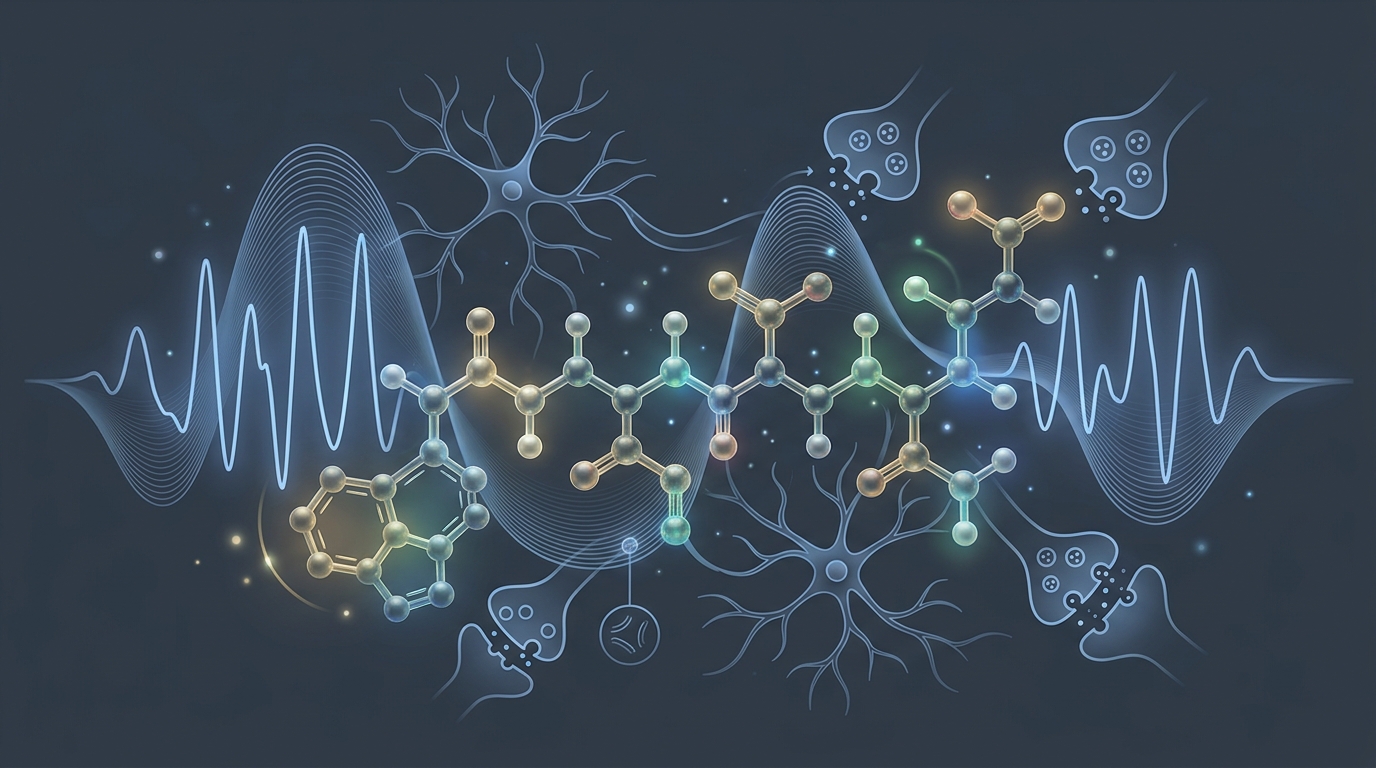
Main Conclusion: Delta Sleep-Inducing Peptide (DSIP) acts as an endogenous regulatory nonapeptide that synchronizes slow-wave sleep architecture, attenuates neuroendocrine stress axes, and provides cellular protection in experimental models, though its therapeutic translation remains constrained by rapid enzymatic degradation and variable clinical replication.
Reason 1: Neuromodulation of Slow-Wave Sleep and EEG Delta Rhythms
DSIP alters central electroencephalographic (EEG) sleep architecture without functioning as a conventional hypnotic or direct gamma-aminobutyric acid (GABA) receptor agonist.
Human Clinical Evidence
- Polysomnographic Findings: Small-scale human clinical trials in the 1980s by Schneider-Helmert et al. administered synthetic DSIP (intravenous or subcutaneous infusions, 25–30 nmol/kg) to chronic insomniacs and healthy volunteers, demonstrating increased slow-wave sleep (delta wave synchronization) and REM sleep efficiency alongside reduced sleep onset latency, without producing next-day psychomotor hangover or rebound insomnia.
- State-Dependent Action: Clinical observations noted that DSIP does not enforce immediate sedation in alert subjects; rather, it facilitates circadian sleep induction only during physiologically appropriate sleep windows.
Animal Evidence
- Original Isolation: First isolated in 1977 by Monnier and Schoenenberger from rabbit cerebral venous blood following intralaminar thalamic stimulation, exogenous DSIP infusion into the cerebral ventricles of rabbits, rats, and cats reliably enhanced low-frequency delta power (0.5–4 Hz) on EEG recordings.
In-Vitro Evidence
- Receptor Binding Studies: Radioligand binding assays have failed to identify a single high-affinity “DSIP receptor,” instead demonstrating indirect allosteric modulation of monoaminergic and glutamatergic pathways in isolated brain slices.
Hypotheses and Anecdotal Claims
- Hypothesis: Researchers hypothesize that DSIP acts as a neuromodulatory peptide trigger that recalibrates intrinsic sleep-wake master clocks (suprachiasmatic nucleus) rather than directly driving central nervous system depression.
- Anecdotal Claims: Biohacking communities report rapid sleep-onset correction and vivid dreaming, though these lack controlled longitudinal monitoring.
Reason 2: Modulation of Neuroendocrine Stress Cascades and HPA Axis Activity
DSIP exerts homeostatic control over the hypothalamic-pituitary-adrenal (HPA) axis, mitigating stress-induced hyperactivation and stabilizing autonomic output.
Human Clinical Evidence
- Corticotropin and Cortisol Dynamics: Limited clinical trials in patients undergoing acute withdrawal from alcohol or opiates indicated that intravenous DSIP administration significantly reduced subjective withdrawal distress, tremors, and elevated plasma cortisol and adrenocorticotropic hormone (ACTH) levels.
- Growth Hormone Secretion: Human evaluations documented mild elevations in basal growth hormone release following acute DSIP administration in healthy adult males.
Animal Evidence
- Stress Resilience Assays: Rodent restraint and cold-stress assays show that pretreatment with DSIP suppresses systemic catecholamine spikes, prevents stress-induced gastric mucosal ulceration, and preserves basal myocardial contractility under acute adrenergic stress.
- Amphetamine Hyperthermia: In murine models, DSIP significantly attenuated hyperthermia and metabolic exhaustion caused by central amphetamine administration.
In-Vitro Evidence
- Hypothalamic Explants: In-vitro perifusion experiments on rat hypothalamic explants showed that DSIP inhibits corticotropin-releasing hormone (CRH) output stimulated by elevated potassium or inflammatory cytokines.
Hypotheses and Anecdotal Claims
- Hypothesis: DSIP is hypothesized to act as an endogenous anti-stress buffer peptide, released to restore neurochemical equilibrium during physiological overload.
- Anecdotal Claims: Self-administered experimental reports suggest reductions in perceived anxiety and somatic tension under chronic stress.
Reason 3: Cytoprotective, Antioxidant, and Opioid-Modulatory Actions
DSIP and its stable analogs exhibit antioxidant properties, tissue-protective signaling during ischemic insults, and mild modulation of endogenous opioid pathways.
Human Clinical Evidence
- Chronic Pain and Withdrawal: Preliminary clinical investigations in chronic intractable pain and substance dependence documented that DSIP co-administration modestly reduced subjective pain scores and lowered required analgesic doses.
Animal Evidence
- Ischemia-Reperfusion Injury: Preclinical models of cerebral and cardiac ischemia demonstrate that DSIP reduces infarct volume, limits post-ischemic lipid peroxidation, and decreases superoxide radical generation in rodent tissues.
- Thermal Nociception: In rodent tail-flick and hot-plate tests, DSIP enhanced endogenous opioid responsiveness and produced mild naloxone-reversible anti-nociception without inducing direct physical dependence.
In-Vitro Evidence
- Mitochondrial Membrane Stability: Isolated cell culture experiments confirm that DSIP reduces reactive oxygen species (ROS) accumulation and prevents loss of mitochondrial membrane potential under oxidative challenge.
Hypotheses and Anecdotal Claims
- Hypothesis: Scientists hypothesize that DSIP acts indirectly via endogenous peptide cascades or upstream protein phosphorylation to induce cytoprotective enzymes such as superoxide dismutase (SOD).
- Anecdotal Claims: Research compound communities claim accelerated physical recovery and decreased delayed-onset muscle soreness, though mechanistic validation in humans is currently absent.