Core Conclusion
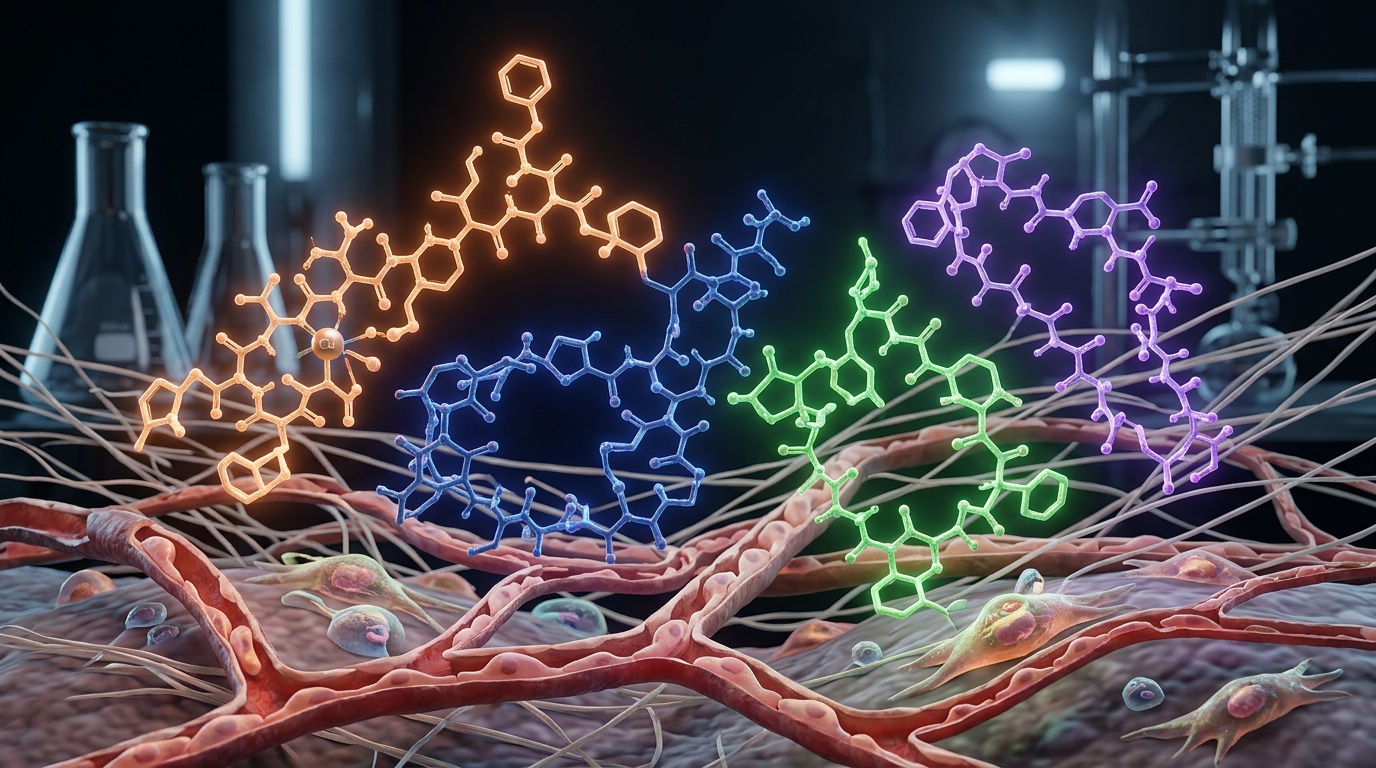
The KLOW peptide stack—a multi-component research blend of GHK-Cu, BPC-157, TB-500, and KPV—is hypothesized to facilitate comprehensive soft-tissue regeneration and resolve localized inflammation by concurrently activating microvascular perfusion, inhibiting nuclear inflammatory signaling, and stimulating extracellular matrix remodeling.
Primary Scientific Pillars
- Synergistic Angiogenic Promotion and Cytoskeletal Cell Migration: BPC-157 and TB-500 work cooperatively to accelerate endothelial proliferation, vascular sprouting, and actin-driven cellular motility to restore perfusion in ischemic or damaged tissues.
- Targeted Multi-Pathway Inflammatory Resolution: KPV and GHK-Cu selectively downregulate nuclear factor kappa B (NF-κB) transcription and pro-inflammatory cytokine expression without inducing broad-spectrum systemic immunosuppression.
- Extracellular Matrix (ECM) Architecture and Fibroblast Regulation: GHK-Cu and BPC-157 modulate collagen subtype deposition, balance matrix metalloproteinase (MMP) activity, and guide organized structural repair over aberrant fibrotic scar formation.
Pillar 1: Angiogenesis and Cellular Migration
Biological Rationale
Effective cellular repair requires rapid restoration of microcirculation to supply oxygen and metabolic substrates, paired with actin filament mobilization to allow fibroblasts and endothelial cells to traverse wound margins.
Evidence Breakdown
- Animal Evidence: Rodent models demonstrate that BPC-157 directly upregulates vascular endothelial growth factor (VEGF) and early growth response 1 (egr-1), resolving ischemic tissue injury in crushed muscle, severed tendons, and vascular occlusions. Thymosin Beta-4 / TB-500 animal trials show enhanced endothelial tube formation and accelerated wound closure via direct actin binding.
- In-Vitro Evidence: Cell culture assays confirm TB-500 sequesters G-actin into F-actin, facilitating cell motility across extracellular matrices. BPC-157 accelerates migration and survival of human umbilical vein endothelial cells (HUVECs) exposed to oxidative stress.
- Human Clinical Evidence: Recombinant Thymosin Beta-4 has been evaluated in Phase II human trials for trophic skin ulcers and corneal repair with favorable tolerability; however, combined human trials with BPC-157 do not currently exist.
- Hypotheses & Anecdotal Claims: Research models hypothesize that combining BPC-157’s VEGFR2 modulation with TB-500’s cytoskeletal mobilization creates a synergistic rate of microvascular capillary bed recovery. Anecdotal bodybuilding and biohacking communities claim accelerated resolution of acute musculoskeletal tears.
Pillar 2: Multi-Pathway Inflammatory Resolution
Biological Rationale
Chronic inflammation arrests soft-tissue recovery in a continuous catabolic state; dampening selective pro-inflammatory cascades allows tissue progression from reactive inflammation into the proliferative and remodeling phases.
Evidence Breakdown
- In-Vitro Evidence: KPV (a tripeptide derivative of α-MSH) binds target receptors to inhibit the translocation of the NF-κB p65 subunit, drastically suppressing TNF-α, IL-6, and IL-1β expression in leukocyte and epithelial cultures. GHK-Cu downregulates pro-inflammatory gene expression and suppresses reactive oxygen species (ROS) formation in macrophage cultures.
- Animal Evidence: KPV delivered in animal models of dextran sulfate sodium (DSS)-induced colitis and cutaneous inflammatory models demonstrated significant reduction in mucosal leukocyte infiltration and systemic inflammatory markers.
- Human Clinical Evidence: GHK-Cu has human clinical data demonstrating cutaneous anti-inflammatory and antioxidant activity in dermatological applications. Clinical trial data for KPV remains limited primarily to early-stage dermatological and mucosal formulations.
- Hypotheses & Anecdotal Claims: Hypotheses suggest KPV’s gut-mucosal protective signaling complements BPC-157’s cytoprotective mechanisms to alleviate systemic dysbiosis and chronic neuroinflammation, though robust dual-peptide clinical data is lacking.
Pillar 3: ECM Synthesis and Structural Remodeling
Biological Rationale
Restoring mechanical load and structural integrity requires balanced synthesis of Type I and Type III collagen, alongside precise regulation of matrix metalloproteinases to prevent dysfunctional fibrotic scarring.
Evidence Breakdown
- Human Clinical Evidence: GHK-Cu has extensive human clinical validation in topical wound healing and dermatology, showing measurable increases in dermal procollagen synthesis, elastin synthesis, and normalization of MMP-1 and MMP-2 activity.
- Animal Evidence: Animal studies with BPC-157 show accelerated biomechanical strength restoration in transected Achilles tendons and transected medial collateral ligaments (MCL), showing dense, parallel-aligned collagen fibrils. GHK-Cu accelerated healing of full-thickness skin wounds in rats and mice with minimal scar formation.
- In-Vitro Evidence: GHK-Cu modulates both basic fibroblast growth factor (bFGF) and transforming growth factor-beta (TGF-β), steering fibroblast differentiation away from hypertrophic scar formation.
- Hypotheses & Anecdotal Claims: Researchers hypothesize that the quadruple combination acts sequentially: KPV resolves acute inflammatory arrest, BPC-157 and TB-500 drive perfusion and cell migration, and GHK-Cu finishes matrix organization. Anecdotal user reports cite rapid recovery from tendinopathy and joint wear, though rigorous human pharmacokinetic and synergy studies remain unperformed.