Executive Summary
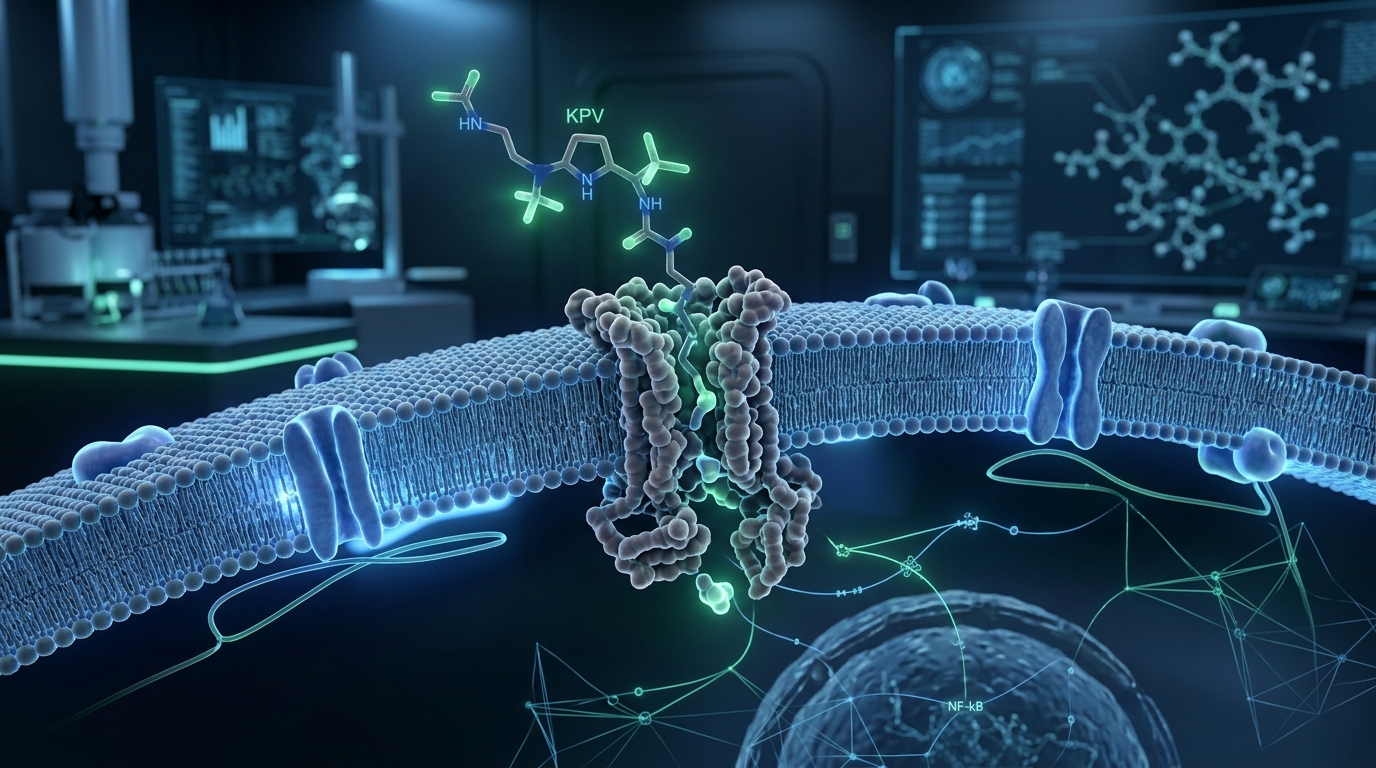
KPV (Lysine-Proline-Valine) is an active C-terminal tripeptide fragment of alpha-melanocyte-stimulating hormone (α-MSH) that exerts localized anti-inflammatory, epithelial barrier-stabilizing, and antimicrobial effects primarily mediated via cellular internalization through the peptide transporter PepT1 and subsequent inhibition of the NF-κB signaling cascade.
Core Supporting Arguments
The research interest in KPV as a targeted peptide therapeutic is supported by three primary pillars:
- Intracellular Inhibition of NF-κB and Pro-Inflammatory Signaling: KPV translocates into cells via PepT1 to suppress nuclear translocation of NF-κB, thereby reducing downstream inflammatory cytokines without the melanogenic side effects of full-length α-MSH.
- Promotion of Epithelial and Mucosal Barrier Integrity: KPV accelerates wound healing, reduces mucosal ulceration, and modulates tight junction architecture in gastrointestinal and dermal models.
- Direct Antimicrobial and Antifungal Bioactivity: KPV exhibits membrane-permeabilizing and candidacidal properties against pathogenic organisms such as Candida albicans and Staphylococcus aureus.
Evidence Base and Scientific Validation
1. Intracellular Inhibition of NF-κB Signaling
In Vitro Evidence
Multiple in vitro investigations demonstrate that KPV acts as a biomimetic fragment of α-MSH (residues 11–13). In human intestinal epithelial cell lines (Caco-2 and HT-29) and monocytic cell lines (THP-1), research confirms that KPV relies on the oligopeptide transporter PepT1 (SLC15A1) for cellular entry. Once internalized, KPV inhibits interleukin-1β (IL-1β)- and tumor necrosis factor-alpha (TNF-α)-induced IκBα degradation, preventing NF-κB p65 subunit nuclear translocation. Consequently, mRNA expression and secretion of pro-inflammatory mediators, including IL-8, IL-6, and intercellular adhesion molecule-1 (ICAM-1), are significantly attenuated.
Animal Evidence
In murine models of chemically induced colitis (dextran sulfate sodium [DSS] and trinitrobenzene sulfonic acid [TNBS]), orally or parenterally administered KPV led to significant reductions in colonic myeloperoxidase (MPO) activity, macroscopic damage scores, and mucosal TNF-α and IL-1β concentrations. Notably, PepT1 knockout mice failed to derive anti-inflammatory benefits from KPV, confirming the necessity of the transporter for in vivo efficacy.
Human Clinical Evidence
There are currently no completed, large-scale Phase II/III randomized controlled trials evaluating isolated KPV peptide monotherapy in human inflammatory diseases. Clinical evidence remains limited to preliminary dermatological and mucosal pilot formulations.
Mechanistic Hypotheses
Researchers hypothesize that KPV’s minimal size allows it to achieve high tissue penetration while avoiding melanocortin receptor-1 (MC1R)-driven pigmentary alterations, rendering it a selective non-pigmenting anti-inflammatory candidate.
2. Epithelial and Mucosal Barrier Restoration
In Vitro Evidence
In cultured human keratinocytes (HaCaT) and intestinal epithelial monolayers, KPV exposure preserved transepithelial electrical resistance (TEER) during inflammatory challenge. Immunofluorescence assays showed preserved membrane distribution of zonula occludens-1 (ZO-1) and occludin, alongside reduced paracellular permeability to dextran flux.
Animal Evidence
In rodent dermal excisional wound models, topical KPV treatment accelerated re-epithelialization, suppressed excessive neutrophil infiltration, and reduced scar formation by normalizing the ratio of collagen type III to type I. In chronic gut mucosal injury models, KPV reduced mucosal denudation, crypt hyperplasia, and histological erosion scores.
Human Clinical Evidence
Direct robust human clinical trial data confirming enhanced wound healing or intestinal mucosal restitution in clinical cohorts are currently lacking. Early-phase topical evaluations of α-MSH-related peptides have shown favorable safety and tolerability profiles, but KPV-specific data remain predominantly preclinical.
Anecdotal Claims
Within experimental and research biohacking communities, sublingual and subcutaneous KPV administration is frequently cited for mitigating symptoms of inflammatory bowel disease (IBD), mast cell activation syndrome (MCAS), and psoriasis. These claims remain clinically unverified and require formal clinical trials.
3. Direct Antimicrobial and Antifungal Bioactivity
In Vitro Evidence
Experimental assays show that KPV possesses direct microbicidal activity at micromolar concentrations against Candida albicans, inhibiting germ tube formation and disrupting fungal cell wall integrity. In bacterial assays, KPV demonstrated inhibitory effects against Staphylococcus aureus, reducing colony-forming units (CFUs) and impairing biofilm stability.
Animal Evidence
In murine models of systemic and localized candidiasis, co-administration of KPV or related melanocortin fragments decreased fungal load in target tissues (e.g., kidneys, mucosal linings) and improved survival metrics relative to untreated infected controls.
Human Clinical Evidence
No human clinical trials have evaluated KPV as an independent anti-infective or antifungal therapeutic agent.
Mechanistic Hypotheses
It is hypothesized that KPV’s cationic lysine residue interacts electrostatically with anionic phospholipid components of microbial cell membranes, leading to permeabilization and non-specific physical lysis, which may minimize the risk of standard microbial resistance mechanisms.
Research Considerations and Scientific Status
While KPV exhibits a favorable preclinical pharmacokinetic and safety profile due to its endogenous peptide origin and low molecular weight, its clinical translation is constrained by rapid enzymatic degradation by circulating aminopeptidases and lack of formal human pharmacokinetics data. Ongoing research focuses on targeted nanocarrier systems and oral enteric formulations designed to enhance local gastrointestinal delivery while minimizing systemic clearance.