Key Takeaways
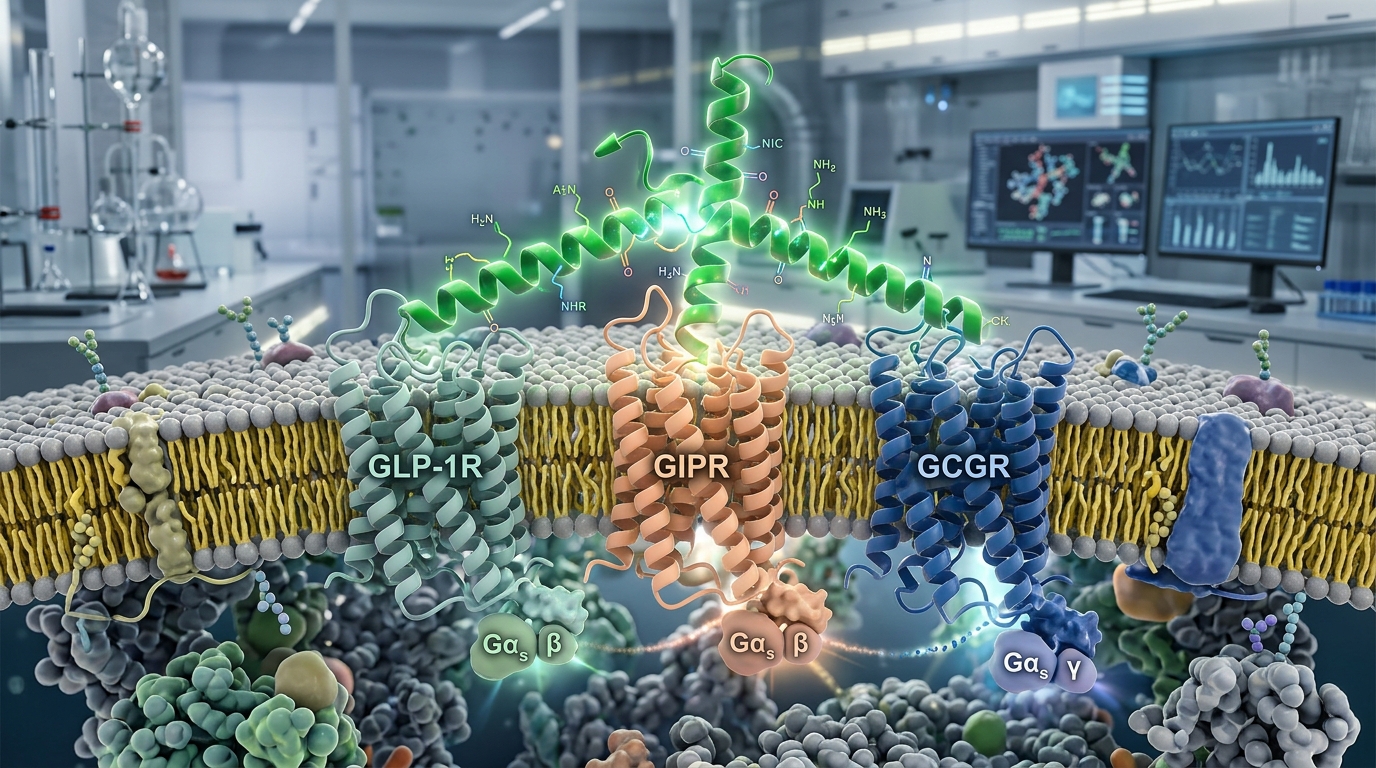
- Distinct Receptor Profiles: Tirzepatide is a dual agonist targeting glucagon-like peptide-1 (GLP-1) and glucose-dependent insulinotropic polypeptide (GIP) receptors. Retatrutide is an investigational single peptide that targets three distinct receptors: GLP-1, GIP, and the glucagon receptor (GCGR).
- The Role of Glucagon Agonism: While GLP-1 and GIP primarily regulate satiety, gastric emptying, and insulin secretion, the addition of glucagon receptor agonism in retatrutide stimulates energy expenditure, promotes hepatic lipid metabolism, and accelerates fatty acid oxidation.
- Clinical Trial Evidence: In published Phase 2 clinical trials, retatrutide demonstrated an average body weight reduction of up to 24.2% at 48 weeks at the 12 mg dose. Tirzepatide in its Phase 3 SURMOUNT-1 trial achieved a 22.5% mean reduction at 72 weeks at the 15 mg dose. Direct head-to-head trials have not yet been conducted.
- Regulatory Status: Tirzepatide is FDA-approved for type 2 diabetes and chronic weight management. Retatrutide remains an investigational agent undergoing Phase 3 evaluation and is not approved for clinical use or available by prescription.
Understanding Multi-Receptor Agonism: Dual vs. Triple
The pharmacological management of metabolic disorders has evolved from single-hormone receptor agonists toward unimolecular multi-receptor agonists. The therapeutic objective is to engage complementary metabolic pathways simultaneously to produce additive or synergistic improvements in glycemic regulation, appetite control, and metabolic rate.
When comparing retatrutide vs tirzepatide, the central scientific distinction lies in the number and composition of the receptor pathways each molecule engages. Tirzepatide represents dual incretin agonism, targeting the GIP and GLP-1 receptors. Retatrutide expands this concept into triple agonism (sometimes called a “tri-agonist” or “triple-G” peptide) by recruiting the glucagon receptor alongside GIP and GLP-1 pathways.
Receptor Pharmacology: How Retatrutide and Tirzepatide Operate
To understand the clinical divergence between dual and triple agonism, researchers evaluate how each target receptor functions within human physiology:
1. Glucagon-Like Peptide-1 (GLP-1) Receptor
Both tirzepatide and retatrutide exhibit agonism at the GLP-1 receptor. GLP-1 is an incretin hormone secreted by intestinal L-cells in response to nutrient ingestion. Agonism at this receptor delays gastric emptying, enhances glucose-dependent insulin secretion from pancreatic beta cells, suppresses postprandial glucagon secretion, and acts on appetite centers within the hypothalamus to reduce overall caloric intake.
2. Glucose-Dependent Insulinotropic Polypeptide (GIP) Receptor
Both agents also activate the GIP receptor. GIP is secreted by intestinal K-cells. While historically viewed strictly as an insulin-stimulating incretin, pharmacological GIP receptor activation appears to modulate central feeding behavior, buffer against gastrointestinal adverse effects common to GLP-1 monotherapy, and enhance lipid storage buffering in subcutaneous adipose tissue, which decreases ectopic fat accumulation.
3. Glucagon Receptor (GCGR) — Retatrutide’s Differentiator
The defining pharmacokinetic and pharmacodynamic differentiator of retatrutide is its intrinsic glucagon receptor agonism. Endogenous glucagon increases blood glucose by stimulating hepatic glycogenolysis and gluconeogenesis. However, when co-administered with potent insulinotropic agents (GLP-1 and GIP), the hyperglycemic potential of glucagon is counterbalanced. Instead, glucagon agonism yields several distinct metabolic actions:
- Increased Basal Energy Expenditure: Glucagon receptor signaling promotes thermogenesis and elevates energy expenditure, allowing caloric deficit beyond appetite reduction alone.
- Enhanced Hepatic Lipid Oxidation: GCGR activation directly stimulates hepatic fatty acid oxidation and inhibits lipogenesis, accelerating the clearance of intrahepatic triglycerides.
- Lipolysis: Glucagon drives the breakdown of stored triglycerides into circulating free fatty acids for energy utilization.
Clinical Evidence: Comparing Efficacy and Outcomes
Because retatrutide and tirzepatide have not been evaluated in a direct head-to-head randomized controlled trial, comparisons must rely on individual phase trial data, recognizing methodological, population, and duration differences.
Retatrutide Phase 2 Results
The landmark Phase 2 trial of retatrutide published in the New England Journal of Medicine enrolled 338 adults with obesity or overweight and related comorbidities. At 48 weeks, participants receiving the maximum studied dose (12 mg once weekly) achieved a mean weight reduction of 24.2%. Notably, over 25% of individuals receiving the 12 mg dose achieved a body weight reduction of 30% or greater at 48 weeks. Retatrutide also produced profound reductions in liver fat content in a secondary imaging sub-study, showing greater than 80% mean reduction in hepatic steatosis, with normal liver fat restored in nearly 90% of evaluated participants.
Tirzepatide Phase 3 Results (SURMOUNT-1)
In the Phase 3 SURMOUNT-1 trial evaluating tirzepatide in 2,539 adults with obesity or overweight without diabetes, participants receiving the maximum maintenance dose (15 mg once weekly) achieved a mean weight reduction of 22.5% at week 72. Approximately 36% of participants in that cohort achieved a 25% or greater reduction in total body weight.
Cardiometabolic Biomarkers
Both compounds produce substantial improvements in systolic and diastolic blood pressure, fasting insulin levels, and lipid profiles. However, because of glucagon receptor engagement, retatrutide has demonstrated unique dynamics on lipid metabolism, yielding marked decreases in circulating triglycerides and non-HDL cholesterol alongside its liver fat clearance effects.
Safety Profiles and Tolerability
The adverse event profile of retatrutide largely parallels that observed with dual agonists like tirzepatide, with several specific physiological considerations:
- Gastrointestinal Symptoms: Nausea, diarrhea, vomiting, and constipation were the most frequent adverse events across trials for both compounds. These effects were overwhelmingly dose-dependent and occurred primarily during dose escalation. Slow dose titration protocols (e.g., initiating retatrutide at 2 mg rather than 4 mg) significantly attenuated gastrointestinal severity.
- Heart Rate Elevation: In retatrutide clinical trials, transient, dose-dependent increases in mean resting heart rate were observed, peaking between weeks 24 and 36 before declining toward baseline. Glucagon and GLP-1 receptors are both expressed in sinoatrial nodal tissue, requiring continued monitoring in ongoing Phase 3 cardiovascular outcome trials.
- Cutaneous Sensations: Mild-to-moderate transient hyperesthesia or skin sensitivity was reported in a small percentage of retatrutide participants during Phase 2 escalation, a phenomenon less commonly documented in tirzepatide trials.
Regulatory Status and Research Pipeline
The development and regulatory standings of the two agents differ substantially:
- Tirzepatide: Approved by the U.S. FDA for the treatment of type 2 diabetes (under the trade name Mounjaro) and for chronic weight management in adults with obesity or overweight and weight-related comorbidities (under the trade name Zepbound).
- Retatrutide (LY3437943): An investigational compound that is not approved by the FDA or any other global regulatory authority. It is currently being evaluated in extensive Phase 3 programs, including the TRIUMPH trials (evaluating chronic weight management, obstructive sleep apnea, and knee osteoarthritis) and the TRANSCEND trials (evaluating type 2 diabetes).
Frequently Asked Questions
Is retatrutide a “GLP-3” agonist?
No. The term “GLP-3” is a scientific misnomer occasionally used in casual commentary. There is no biological peptide called GLP-3. Retatrutide is properly classified as a triple hormone receptor agonist that activates GLP-1, GIP, and glucagon receptors.
Why does retatrutide include glucagon if glucagon raises blood sugar?
While glucagon on its own stimulates hepatic glucose output, co-activating GLP-1 and GIP receptors creates sufficient glucose-dependent insulin secretion to prevent hyperglycemia. This allows retatrutide to harness glucagon’s benefits—increased energy expenditure, direct lipolysis, and liver fat oxidation—without compromising glycemic control.
Has retatrutide been tested directly against tirzepatide in a head-to-head trial?
No published head-to-head randomized clinical trials have directly compared retatrutide and tirzepatide in the same study cohort. All comparative analyses currently rely on cross-trial evaluations of Phase 2 and Phase 3 data.
Can retatrutide be prescribed or purchased legally for clinical use?
No. Retatrutide has not received regulatory approval from the FDA or international agencies. Its use is restricted to participants enrolled in authorized clinical research trials.
Research Summary
Retatrutide and tirzepatide represent successive generations of multi-receptor peptide therapeutics. While tirzepatide validates the efficacy of dual GLP-1/GIP incretin agonism, retatrutide introduces glucagon receptor activation as a third therapeutic pillar, aiming to increase energy expenditure and optimize hepatic lipid clearance alongside caloric intake reduction. Clinical data from Phase 2 human trials demonstrate high efficacy in weight loss and metabolic markers, but definitive safety, cardiovascular outcomes, and long-term durability remain under investigation in Phase 3 trials. Tirzepatide is FDA-approved and clinically available, whereas retatrutide remains strictly investigational.
References
- Jastreboff AM, Kaplan LM, Frías JP, et al. Triple-Hormone-Receptor Agonist Retatrutide for Obesity — A Phase 2 Trial. N Engl J Med. 2023;389(6):514-526.
- Jastreboff AM, Aronne LJ, Ahmad NN, et al. Tirzepatide Once Weekly for the Treatment of Obesity (SURMOUNT-1). N Engl J Med. 2022;387(3):205-216.
- Coskun T, Urva S, Roell WC, et al. LY3437943, a novel triple GIP, GLP-1, and glucagon receptor agonist: Preclinical properties and human pharmacology. Cell Metab. 2022;34(9):1234-1247.
- Frias JP, Nauck MA, Van J, et al. Efficacy and safety of retatrutide in patients with type 2 diabetes: a randomised, double-blind, placebo-controlled, and active-controlled, parallel-group, phase 2 trial. Lancet. 2023;402(10406):972-984.