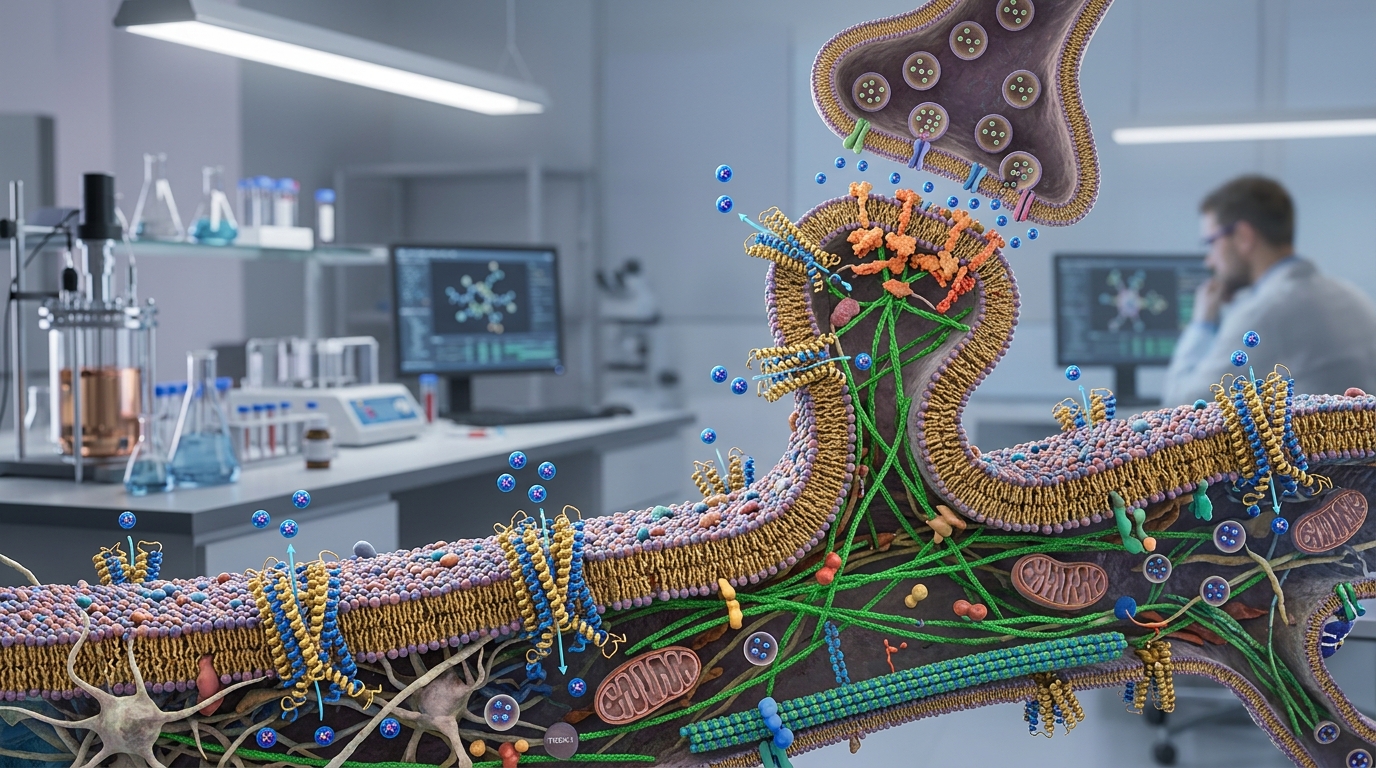
PE-22-28 neuroplasticity research has emerged as a compelling area of neuropharmacology, focusing on the modulation of two-pore-domain potassium channels to stimulate structural and functional brain remodeling. Derived from the endogenous propeptide spadin, PE-22-28 is a shortened synthetic heptapeptide that selectively inhibits TREK-1 (KCNK2) potassium channels. In preclinical rodent investigations, this compound demonstrated a notable capacity to stimulate adult hippocampal neurogenesis and synaptic protein expression within days rather than the weeks typically required by conventional monoaminergic agents. Despite these intriguing laboratory findings, PE-22-28 remains an experimental research tool with substantial limitations and no human clinical trials to date.
Key Takeaways
- Targeted Mechanism: PE-22-28 acts as a high-affinity antagonist of the TREK-1 potassium channel, reducing background potassium leak and altering neuronal membrane excitability.
- Accelerated Preclinical Neurogenesis: Rodent models indicate that PE-22-28 enhances cell proliferation in the hippocampal dentate gyrus after four days of administration.
- Synaptic Remodeling: Laboratory studies demonstrate increased expression of postsynaptic density protein 95 (PSD-95), pointing toward enhanced synaptogenesis.
- Improved Stability Over Spadin: As a truncated derivative of spadin, PE-22-28 displays higher potency and prolonged in vivo bioactivity in animal systems.
- Preclinical Limitation: No human clinical data, established therapeutic dosing guidelines, or comprehensive toxicology profiles exist.
What Is PE-22-28?
PE-22-28 is a synthetic seven-amino-acid peptide with the primary sequence Gly-Val-Ser-Trp-Gly-Leu-Arg (GVSWGLR). It corresponds to residues 22 through 28 of spadin, a 17-amino-acid peptide cleaved from the propeptide of sortilin (also known as neurotensin receptor 3). When sortilin undergoes post-translational maturation, its propeptide is released into biological fluids. Scientists studying the metabolic breakdown products of this propeptide identified shortened sequences that maintained or enhanced target receptor binding.
Structural optimization led to the synthesis of PE-22-28, which was designed to resolve the rapid metabolic degradation that limited spadin’s in vivo utility. In vitro patch-clamp evaluations confirmed that this heptapeptide binds to the human TREK-1 channel with an inhibitory concentration (IC50) of approximately 0.12 nM, representing significantly greater affinity than the parent spadin molecule (IC50 of 40–60 nM).
Mechanism of Action: TREK-1 Modulation and Neuronal Signaling
To understand the link between PE-22-28 and neuroplasticity, researchers focus on the TREK-1 channel (encoded by the KCNK2 gene). TREK-1 is a two-pore-domain background potassium (K2P) channel abundantly expressed in limbic areas, including the prefrontal cortex, hippocampus, and dorsal raphe nucleus. Under resting conditions, TREK-1 channels facilitate outward potassium efflux, which hyperpolarizes the neuronal membrane and limits spontaneous firing.
When PE-22-28 blocks TREK-1 channels, it impedes this outward potassium current. This reduction leads to a modest, sustained depolarization of the neuronal membrane, bringing the resting potential closer to the action-potential threshold. In the dorsal raphe nucleus, this increased excitability stimulates serotonergic neuron firing rates. Downstream, this electrical and chemical signaling engages intracellular cascades involving calcium influx, cyclic AMP response element-binding protein (CREB) activation, and the transcription of neurotrophic factors.
Preclinical Evidence on PE-22-28 Neuroplasticity
Neuroplasticity encompasses both the generation of new functional neurons (neurogenesis) and the structural reorganization of synaptic connections (synaptogenesis). Preclinical research has examined PE-22-28 across several laboratory models:
1. Rapid Hippocampal Neurogenesis
In classical psychopharmacology, conventional antidepressants such as selective serotonin reuptake inhibitors (SSRIs) require three to four weeks of continuous administration to induce detectable adult neurogenesis in the subgranular zone of the dentate gyrus. In contrast, murine studies published by French neuropharmacology teams revealed that subchronic administration of PE-22-28 (at doses around 0.3 to 4 µg/kg) significantly increased 5-bromo-2′-deoxyuridine (BrdU) incorporation—a cellular marker of active DNA synthesis—after only four days of treatment. This demonstrates an unusually rapid stimulation of neural precursor cell proliferation.
2. Synaptogenesis and Synaptic Protein Upregulation
In addition to cell proliferation, researchers evaluated synaptic maturation by measuring postsynaptic density protein 95 (PSD-95) in primary cortical and hippocampal neuronal cultures. Exposure to PE-22-28 and its terminal-modified analogs produced a robust increase in PSD-95 expression. PSD-95 serves as an essential scaffolding protein that stabilizes glutamate receptors at the postsynaptic membrane, indicating enhanced dendritic spine assembly and synaptic strengthening.
3. Behavioral Correlates in Animal Stress Models
The structural changes observed at the cellular level coincided with behavioral adaptations in rodents. In behavioral paradigms designed to test stress responses and depressive-like behaviors—such as the forced swim test, the novelty-suppressed feeding test, and learned helplessness paradigms—mice treated with PE-22-28 showed rapid reductions in immobility time and decreased latency to feed. These behavioral improvements parallel the timeline of enhanced neurogenic activity.
PE-22-28 vs. Parent Peptide Spadin
Researchers developed PE-22-28 specifically to address the pharmacokinetic shortfalls of earlier spadin constructs:
- Structure: Spadin contains 17 amino acids (PE-12-28), whereas PE-22-28 is trimmed down to 7 amino acids.
- Receptor Affinity: PE-22-28 achieves full TREK-1 channel blockade at sub-nanomolar levels, roughly 300 to 500 times more potent than spadin in vitro.
- In Vivo Bioactivity: Native spadin exhibits a functional duration of action limited to approximately 7 hours before enzymatic breakdown. PE-22-28 and its derivatives extend in vivo functional activity up to 23 hours in murine test protocols.
- Selectivity: Patch-clamp studies show high selectivity for TREK-1 (K2P2.1) over closely related two-pore channels such as TREK-2 (K2P10.1), TRAAK (K2P13.1), TRESK (K2P18.1), and TASK-1 (K2P3.1).
Research Limitations and Evidence Gaps
While laboratory results are scientifically informative, substantial caveats must be recognized:
- Complete Absence of Human Data: There are zero published clinical trials, pharmacokinetic studies, or safety assessments of PE-22-28 in human volunteers. Rodent neurogenic rates do not directly translate to human adult neurogenesis.
- Unknown Long-Term Safety: TREK-1 channels are also expressed in cardiac myocytes and vascular smooth muscle. The theoretical consequences of long-term TREK-1 inhibition on cardiac electrophysiology or central seizure thresholds remain uncharacterized.
- Route and Bioavailability Barriers: As an unformulated peptide, PE-22-28 is susceptible to gastrointestinal degradation and requires parenteral or intranasal administration in research protocols to bypass first-pass clearance.
- Limited Independent Replication: Much of the foundational evidence originates from a select group of academic laboratories, highlighting the need for wider independent validation across diverse models.
Regulatory and Legal Status
PE-22-28 is an experimental chemical compound. It is not approved by the U.S. Food and Drug Administration (FDA), the European Medicines Agency (EMA), or any other global regulatory authority for human or veterinary medical use. It is synthesized and supplied strictly for in vitro and laboratory animal research.
Frequently Asked Questions
What makes PE-22-28 different from standard antidepressants?
Traditional antidepressants primarily block the reuptake or degradation of monoamine neurotransmitters (serotonin, norepinephrine, or dopamine). PE-22-28 operates upstream by blocking the TREK-1 potassium leak channel, altering neuronal membrane potential and triggering neurogenic and synaptogenic cascades much faster in animal models.
Has PE-22-28 been tested in human clinical trials?
No. As of current scientific literature, no human clinical trials have been registered or completed for PE-22-28. All pharmacological data are derived exclusively from cell cultures and rodent studies.
How is neuroplasticity measured in PE-22-28 animal studies?
Investigators measure neuroplasticity using biochemical and histological markers, including BrdU labeling for newborn cell proliferation in the hippocampus, Western blotting for synaptic scaffold proteins like PSD-95, and behavioral stress assays.
Is PE-22-28 orally bioavailable?
Like many short linear peptides, PE-22-28 is susceptible to rapid enzymatic degradation in the digestive tract. Laboratory studies utilize intravenous, intraperitoneal, or specialized delivery systems to assess its systemic activity.
Research Summary
Current scientific evidence for PE-22-28 is exclusively preclinical, comprising in vitro electrophysiology and rodent behavioral and histological assays. The compound demonstrates potent, selective inhibition of the TREK-1 potassium channel, leading to increased neuronal excitability and accelerated hippocampal neurogenesis within four days in animal paradigms. However, human evidence is nonexistent, therapeutic safety and systemic side-effect profiles remain undefined, and the molecule is not FDA-approved for any medical application. PE-22-28 serves at present as a molecular tool for investigating potassium channel biology and neuroplastic pathways in laboratory settings.
References
- Djillani, A., Pietri, M., Moreno, S., Heurteaux, C., Mazella, J., & Borsotto, M. (2017). Shortened Spadin Analogs Display Better TREK-1 Inhibition, In Vivo Stability and Antidepressant Activity. Frontiers in Pharmacology, 8, 643. PMC5601071
- Mazella, J., Petrault, O., Lucas, G., Deval, E., Beraud-Dufour, S., Gandin, C., … & Borsotto, M. (2010). Spadin, a sortilin-derived peptide, targeting TREK-1 channels: a new concept in the antidepressant therapy. PLoS Biology, 8(4), e1000355. PubMed PMID: 20405001
- Heurteaux, C., Lucas, G., Guy, N., El Yacoubi, M., Thümmler, S., Peng, X. D., … & Lazdunski, M. (2006). Deletion of the TREK-1 potassium channel results in a depression-resistant phenotype. Nature Neuroscience, 9(9), 1134-1141. PubMed PMID: 16862152