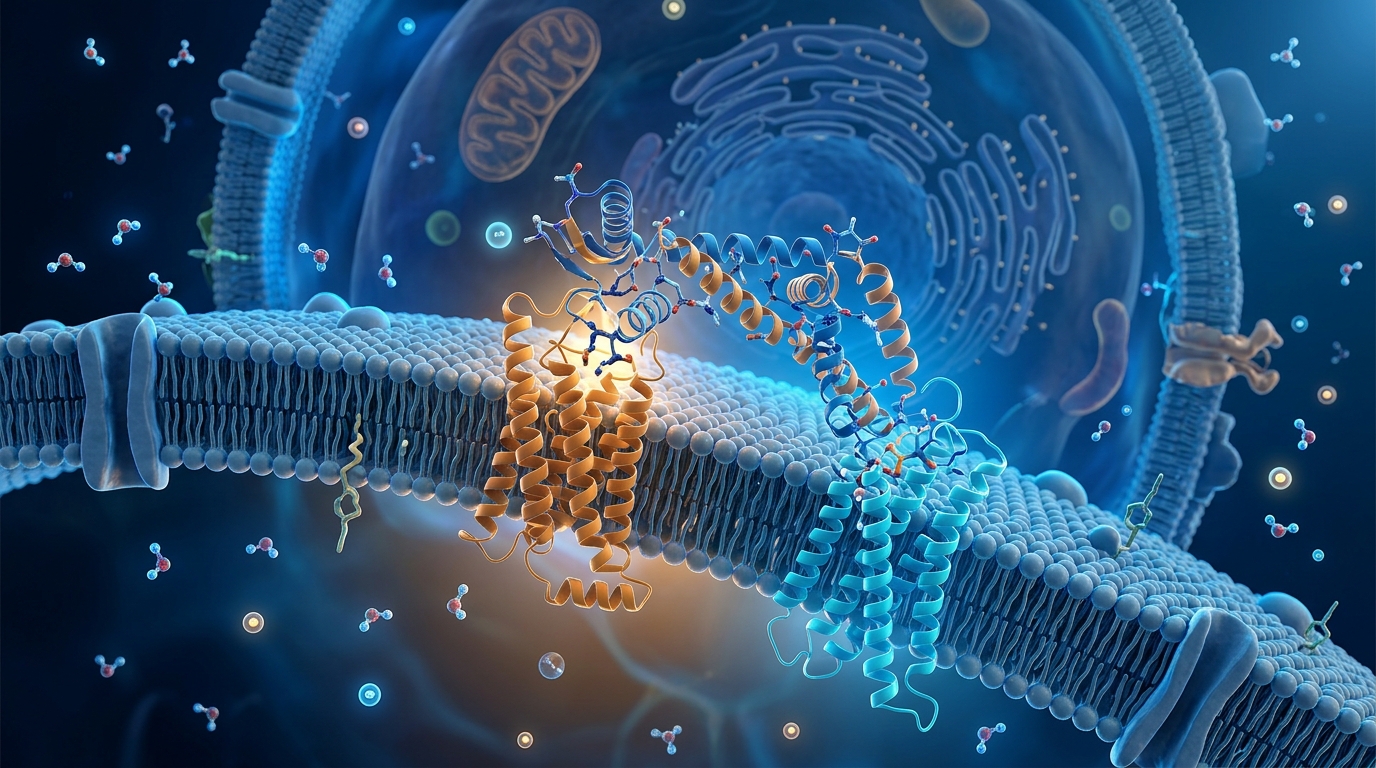
Survodutide (BI 456906) is an investigational dual GLP-1 and glucagon receptor agonist that achieves superior metabolic reprogramming, substantial body weight reduction, and direct hepatic histologic improvement compared to traditional mono-agonist therapies.
This conclusion is supported by three primary pillars of scientific and clinical evidence:
- Mechanistic Synergy: Dual agonism balances GLP-1-mediated appetite regulation with glucagon-mediated hepatic lipid oxidation and energy expenditure.
- Robust Clinical Weight Loss: Human Phase 2 clinical trials establish significant, dose-dependent body weight reductions of up to 18.7% over 46 weeks.
- Direct Hepatic and Antifibrotic Efficacy: Biopsy-confirmed clinical data demonstrate up to 83% improvement in metabolic dysfunction-associated steatohepatitis (MASH) without worsening fibrosis.
Pillar 1: Mechanistic Synergy of Dual GLP-1 and Glucagon Receptor Agonism
Survodutide is an acylated peptide engineered for balanced activity at human GLP-1 and glucagon receptors (GLP-1R and GCGR), harmonizing central satiety pathways with peripheral metabolic acceleration.
Evidence Breakdown:
- In-Vitro Evidence: Cell-based receptor activation assays demonstrate that survodutide functions as a full agonist at both human GLP-1R (EC50 ~0.33 nM) and GCGR (EC50 ~0.52 nM), demonstrating stable signaling across both cyclic AMP (cAMP) downstream pathways.
- Animal Evidence: Rodent and non-human primate studies indicate that adding GCGR agonism to GLP-1R agonism increases brown adipose tissue thermogenesis and enhances hepatic mitochondrial fatty acid beta-oxidation, leading to greater energy expenditure than selective GLP-1 agonists alone.
- Human Clinical Evidence: Phase 1 pharmacokinetic and pharmacodynamic human data confirm continuous 24-hour target engagement with a half-life supporting once-weekly subcutaneous administration, with the GLP-1 component mitigating the theoretical hyperglycemic risks associated with GCGR activation.
- Scientific Hypothesis: Researchers hypothesize that simultaneous GCGR stimulation prevents the compensatory metabolic slowdown typically observed during hypocaloric GLP-1 monotherapy.
Pillar 2: Robust Clinical Weight Loss Efficacy Across Human Trials
Phase 2 clinical data demonstrate that survodutide achieves weight loss outcomes that outperform conventional selective GLP-1 mono-agonists in overweight or obese populations.
Evidence Breakdown:
- Human Clinical Evidence (Phase 2 Obesity Trial): In a 46-week randomized, double-blind, placebo-controlled trial (NCT04667377) of 387 adults with overweight or obesity without type 2 diabetes, survodutide reached a mean body weight reduction of up to 18.7% at the highest dose (4.8 mg weekly) compared to 2.8% for placebo on actual treatment analysis.
- Human Clinical Evidence (Glycemic Control): In trials involving patients with type 2 diabetes, survodutide demonstrated significant HbA1c reductions (up to -1.9%) alongside substantial weight loss, confirming that the GLP-1 component adequately counters glucagon-driven glycogenolysis.
- Animal Evidence: Diet-induced obese (DIO) mice treated with survodutide demonstrated marked reductions in total fat mass while preserving lean body mass proportions more effectively than caloric restriction alone.
- Anecdotal & Real-World Claims: Early researcher observations suggest a rapid onset of early satiety and reduced food cravings within the first two weeks of dose titration; however, formal behavioral outcomes remain under active Phase 3 clinical evaluation (SYNCHRONIZE program).
Pillar 3: Direct Hepatic and Antifibrotic Outcomes in MASH Research
Survodutide directly addresses metabolic dysfunction-associated steatohepatitis (MASH, formerly NASH) by eliminating hepatic fat accumulation and halting progressive tissue remodeling.
Evidence Breakdown:
- Human Clinical Evidence (Phase 2 MASH Biopsy Trial): In a pivotal 48-week Phase 2 trial (NCT04771273) in patients with biopsy-confirmed MASH and fibrosis stages F1–F3, up to 83.0% of survodutide-treated patients achieved biopsy-proven MASH improvement without worsening of fibrosis, compared to 18.2% in the placebo cohort (p < 0.0001).
- Human Clinical Evidence (Fibrosis Reversal): In secondary trial endpoints, significant proportions of patients exhibited direct improvement in liver fibrosis by at least one stage (up to 34.5% vs. 22.2% in placebo), alongside dramatic relative reductions in liver fat content exceeding 60% on MRI-PDFF.
- In-Vitro & Animal Evidence: In primary murine and human hepatocyte cultures, GCGR activation directly stimulated hepatic autophagy and lipophagy, downregulating pro-inflammatory chemokines and stellate cell activation markers (alpha-SMA, Collagen-1).
- Scientific Hypothesis: It is hypothesized that the dual-acting compound exerts a ‘two-hit’ resolution mechanism: systemic caloric deficit via GLP-1 combined with direct hepatic lipolysis and mitochondrial uncoupling via glucagon signaling.